From the September 2026 issue of Apollo.
There’s the Duomo, of course, and the Last Supper, and the Galleria, and La Scala and the Pinacoteca and the Castello Sforzesco. But whenever anyone comes to visit us I just as often send them to see the Chiesa di San Maurizio al Monastero Maggiore, aka the Sistine Chapel of Milan.
San Maurizio was originally conceived as the hall of worship of an adjacent Benedictine convent, which dates back to the eighth century and has since become an archaeological museum. Rebuilt and decorated in the 16th century, the church is divided into two sanctuaries: a small one, at the front, which the general public would enter from the street to attend Mass, and, behind that, a large Aula delle Monache (hall of the nuns), where the cloistered sisters could worship hidden from view. The two sanctuaries are separated by a tramezzo (partition wall) with a central screened aperture through which the nuns could listen in on the public Mass without compromising their vow of enclosure.
Both sides of this wall, and much of the rest of the church’s interior, including its rib-vault ceiling, are covered in paintings and frescoes. Many are from the 16th century and were painted by Bernardino Luini or his sons. Some depict biblical stories; several are portraits of saints.
Among these is Luini’s Saint Agatha, the patron saint of Catania in Sicily. In her left hand Agatha holds a palm, the symbol of martyrdom. On the fingers of her right she balances a platter containing two disembodied breasts.
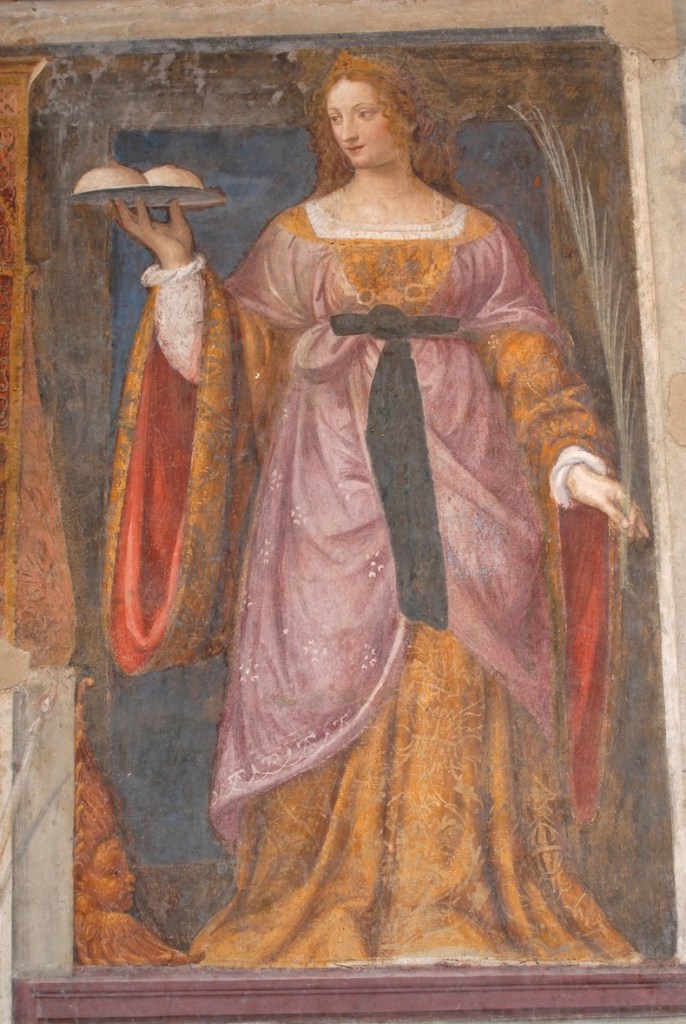
As hagiography would have it, Agatha was a beautiful Christian virgin who refused to break her vow of chastity by sleeping with Quintianus, a Roman senator and governor of Sicily. To punish her, Quintianus sent Agatha to live in a brothel. When Agatha refused to service the brothel’s customers, she was jailed and ordered by Quintianus to be beaten and tortured, which included her breasts being cut off with tongs. For upholding her faith despite this torment, Agatha is also regarded as the patron saint of nurses, breast cancer patients and victims of sexual assault.
Her disembodied breasts have meant different things to me over the years: violence, violation, fetishism, the utilitarian submission to breastfeeding, the clinical submission to mammograms and mastectomies, and the willing or unwilling submission to celibacy. At times, Agatha has seemed to say: ‘What’s mine is yours.’ At others: ‘I won’t be needing these any more.’ The curving folds of her mauve-and-gold bodice seem inconsistent with a flat chest, as though for her trouble Agatha was made voluptuously whole again, the breasts on her platter downgraded to a spare pair. The story of her torture and mutilation doesn’t register in her Mona Lisa smile: she appears peaceful, stoic, calmly uncoupled from her suffering, as martyrs often do. On the other side of a little wooden window that once permitted the nuns a glimpse of the Host is Saint Catherine of Alexandria, another virgin who refused a powerful man’s advances. Catherine, too, here exudes utter serenity, even as she stands beside the spiked wheel on which she was sentenced to die.
When I send friends to San Maurizio, I almost always suggest that they also stop in Marchesi 1824, a historic Milanese pasticceria, a short walk away. A regular sight in the confectioner’s windows is the Marchesi rosa: a dome-shaped, single-serving sponge cake with Bavarian cream, encased in glossy pink icing and topped by a tiny Marchesi crown. I often think Marchesi’s rose look like diaphragms (the contraceptive kind) – or the Milanese equivalent of Sicily’s minne di Sant’Agata: ricotta-filled semi-spheres with a white glaze and a nipple-like cherry, commemorating Agatha’s breasts. In both cases, these exquisite dolci evoke perfectly round, smooth, obedient appendages, too conveniently severed from the sentient human who bore them.
From the September 2026 issue of Apollo.