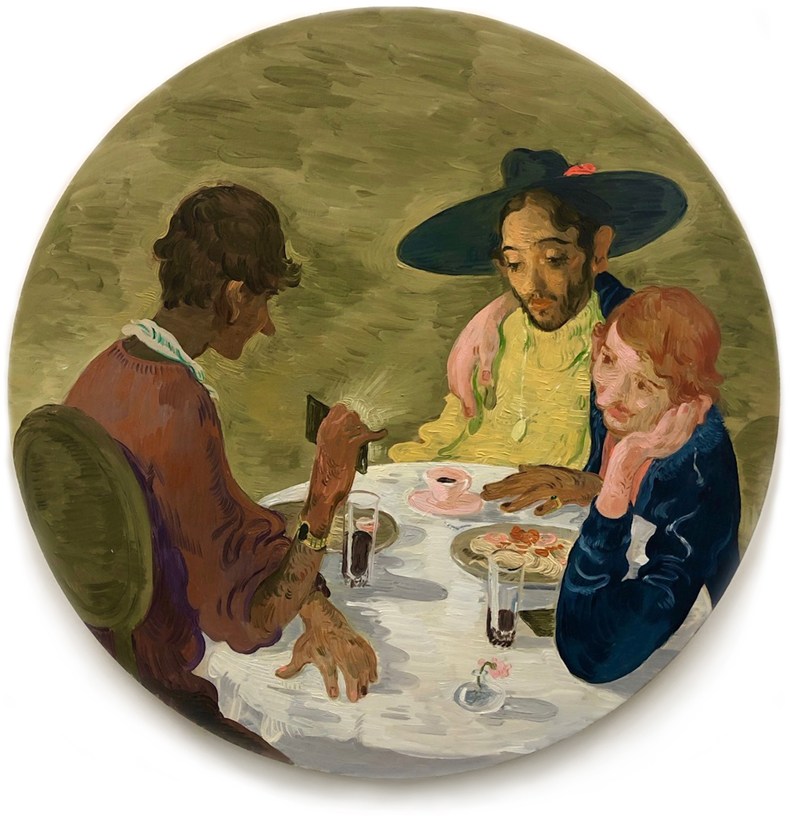
Every work by the Pakistani-American painter Salman Toor is in some sense anachronistic. Take Lunch (2019), one of the earlier works on view at his first European exhibition at the Courtauld. A painting of three friends huddled around a table, its round shape and rustic palette reminiscent of a Renaissance tondo. At first glance the friends’ sparse plates and attire offer few hints that this might be the present. One man’s hat gives the opposite impression: black with a large brim, it could almost be a Dutch capotain. But one detail dispels any doubt: one of the three is showing the others something on his phone.
Toor performs this sleight of hand from the other direction too. The face of the central figure in Bar Boy (2019) is lit up by his phone as he appears to distract himself from his loneliness in a bustling bar. The brushwork is looser, more cartoonish than in Lunch. The composition, executed without underdrawing or preparatory sketches, seems spontaneous, heightened by the disparate goings-on amid the groups surrounding the man. It adds up to a picture that is contemporary yet seems to age the longer we look at it: there is something baroque in its array of dramatically posed figures half-cloaked in shadow, reminiscent of a tavern scene by Caravaggio or Vermeer.
The result is what we might call Toor’s high-camp formalism: the use of centuries-old techniques and conceits to instil a sense of melodrama, even grandiosity, in scenes of contemporary queer life: going out, going to bed, having lunch, mediated by a backdrop of laptops, phones and errant chargers. By doing so, Toor presents his characters – mostly queer South Asians – with a status and dignity that Western art has largely denied them.
Toor was born in 1983 in Lahore, where he attended Aitchison College, an elite all-boys school that counts several prime ministers among its alumni. During this time two things happened: he found himself drawn to the works of the European Old Masters and tried to come out to his parents, who did not accept it at the time. Years later he left Pakistan to pursue painting in the United States, enrolling in the Pratt Institute in New York.
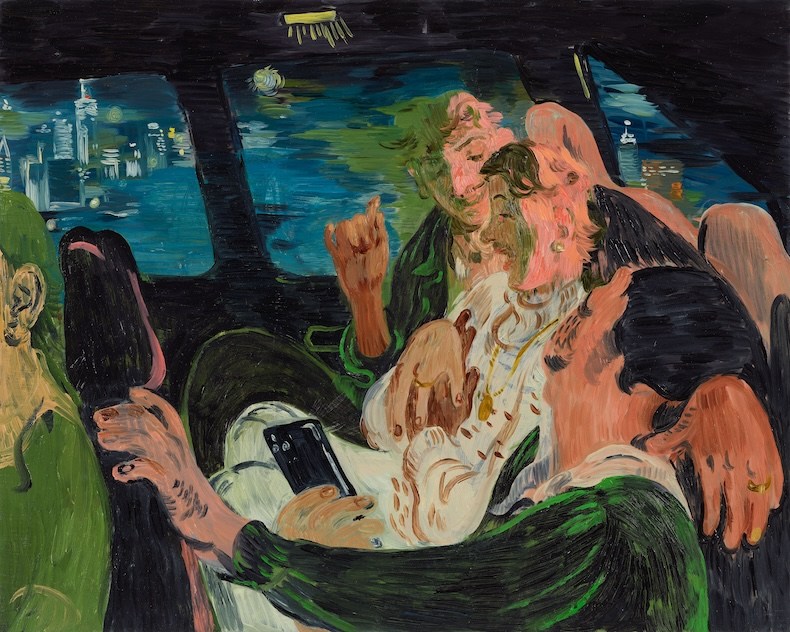
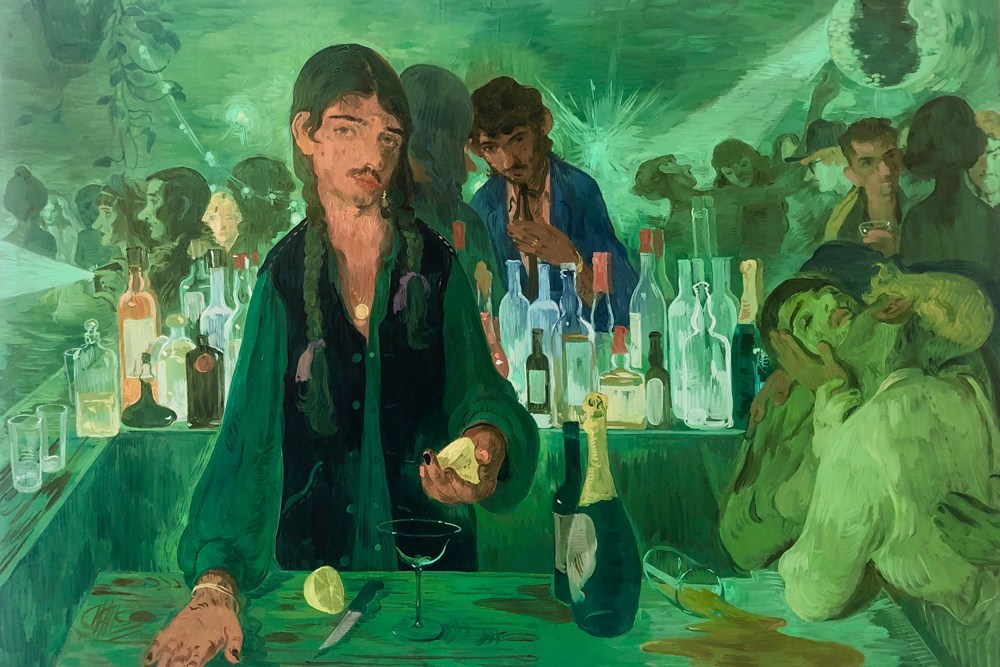
Over the eight years covered by the Courtauld show we can see an evolving relationship between Toor’s coming to terms with his sexuality and his love of art history. In The Bar on East 13th, painted between Lunch and Bar Boy, we are greeted by a pigtailed barman as if we are a customer – a visual echo of the composition of Manet’s A Bar at the Folies-Bergère (1882; on view in an adjacent room as part of the Courtauld’s permanent collection). As in Manet’s painting, a mirror behind the barman gives a glimpse of his point of view. But where the Manet is poised, Toor’s scene is frenetic. Composed of seven shades of green, the work makes a virtue of the way the colour can shift between warm and cold to add depth and intensity to the darkness of a nightclub interior. A shimmering disco ball and some dancing figures in the background are painted in cooler tones, such as emerald and viridian, while in the foreground the barman and two men lasciviously necking are intensified by an earthier olive and ‘Hooker’s green’, a pigment traditionally used in botanical illustration.
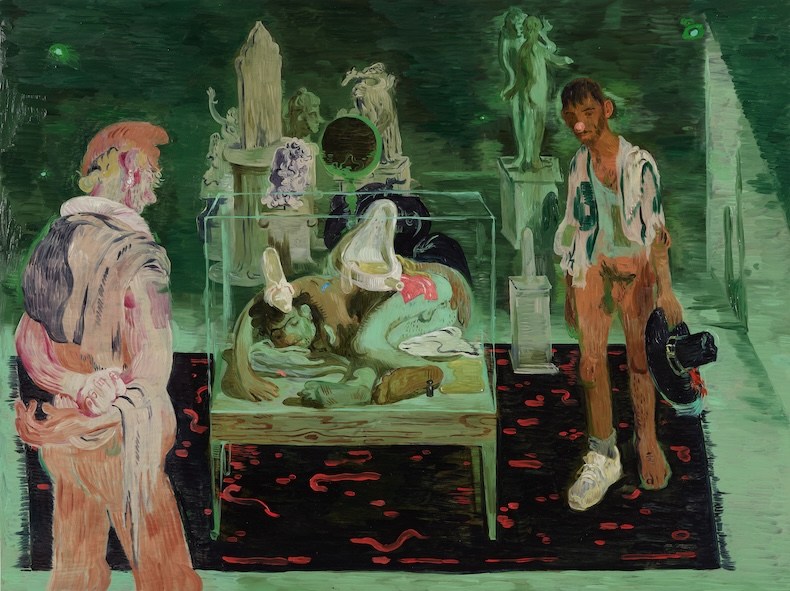
One of Toor’s earliest green night-time scenes, The Bar on East 13th is also his first clearly homoerotic work – his ‘coming out through paint’ as he puts it. From that point his art-historical reference points began visibly expanding beyond the Old Masters, including not only Manet but also Pahari miniatures – as in Ghost Ball (2023), a blown-up, viridescent reinterpretation of a work by the 18th-century court painter Pandit Seu – and Duchamp, whose famous urinal makes a cameo in Museum Boys (2021). It’s around this point that Toor’s appropriation of historical forms and references becomes subtler, more oblique, with his own technique speaking increasingly for itself.
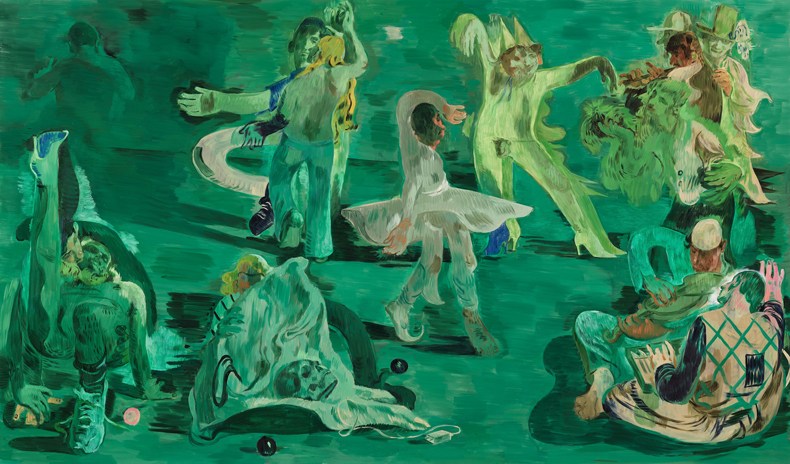
Toor paints delicately, holding his brush near the end of the handle, his pictures emerging as a gradual buildup of feathery strokes. At no point however does this layering become impasto: the surface of each panel or canvas is smooth and uniform, the brushwork evocative of motion rather than texture. This he puts to especially powerful effect in his rendering of light.
In Toor’s favourite Dutch Masters – particularly Rembrandt – light usually has a clear direction but no obvious source. We don’t know where it comes from and often it doesn’t matter: the point is to draw our attention to how light changes the face or heightens the drama of a scene. In Pillow Fight (2022) we see Toor maintain this drama while also making his light source explicit and symbolically important. Two nude lovers tussle on a bed; the picture captures the instant before one brings a pillow down on the other’s head. Following the pillow’s imminent trajectory, our eye is drawn to a laptop on a stool, dimly illuminating the sheets and part of one lover’s face and arm.
This immediately complicates our interpretation. Now it’s unclear whether the men were in the middle of watching something or if this fight is some erotic performance played out for an unseen third party. Either way the sentiment is the same: light in this day and age, Toor seems to say, may well be more ubiquitous than it was in Rembrandt’s day – but it is also more surveillant, more intrusive, there to pull us away even in our most intimate moments.
‘Salman Toor: Someone Like You’ is at the Courtauld Gallery, London, until 10 January 2027.