From the March 2026 issue of Apollo.
When Salvador Dalí said, ‘A real connoisseur does not drink wine but tastes of its secrets,’ he could not have anticipated that, almost 50 years later, sobriety would be on the rise. Dalí, who was interested in the use of grapes, bottles and beverages, offers a helpful reminder of the use of inebriation to combat the tyranny of reason: to enjoy a drink is to discover a softening of edges, a tolerance for ambiguity and a willingness to follow strange associations where they lead. There is something culturally amnesiac about treating intoxication as only a moral failure or health hazard, rather than one of civilisation’s most useful instruments for loosening the screws on the world.
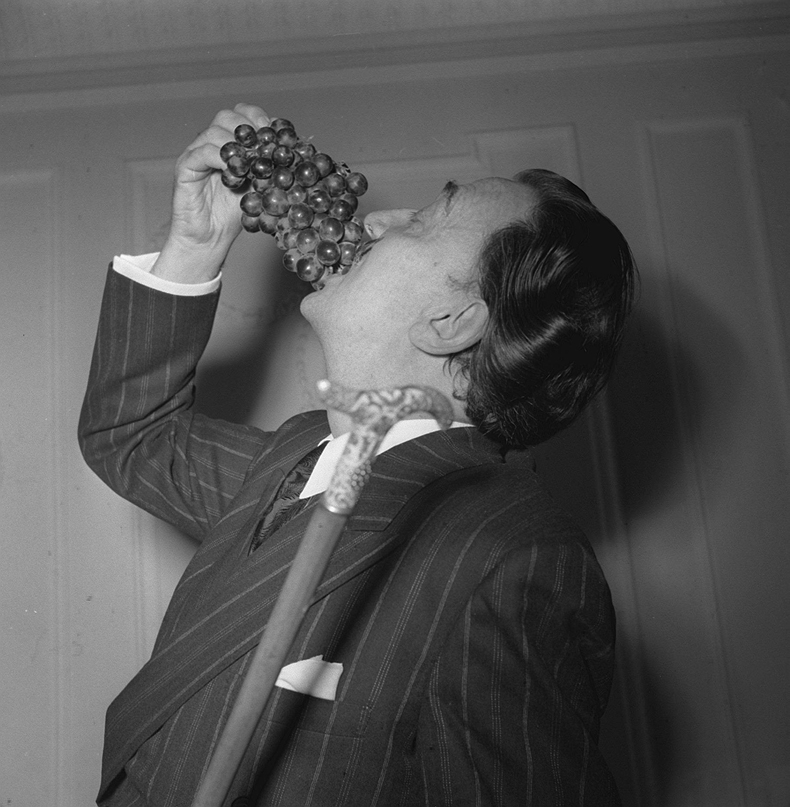
Dalí was fascinated by the grape as a miniscule globe – a world – that triggered the imagination and fed desire. Grapes appeared in early works such as Still Life with Grapes (1922), but he also produced more explicitly viticultural works, such as The Grape Pickers (1953) – though, with its subtitle, Bacchus Chariot, it is not hard to see the mythological aspect of Dalí’s interest.
In his autobiography The Secret Life of Salvador Dalí (1942) the fruit is practically eroticised. He describes Gala, who went on to become his wife, eating black grapes on a dry stone wall and each grape making her ‘brighter and more beautiful’ until he feels her ‘sweeten in unison with the grapes on the vines’. The etching Lovers with grapes (1971) shows a bunch of grapes hanging, like mistletoe, over a couple about to lock lips.
The same sensibility is the guiding principle behind the book The Wines of Gala (1977). It refuses the usual organising principles of oenology, offering a ‘revolutionary ordering of wine by emotional experience’ rather than by geography or grape. Instead of Bordeaux versus Burgundy, Dalí suggests ‘wines of frivolity’, ‘wines of light’ or ‘wines of the impossible’. Dalí, with his co-author Louis Orizet, is organising wines ‘according to the sensations they create in our very depths’. Dalí and Orizet insist that taste is not just flavour but a lived experience: a phenomenon capable of channeling desire, dread, comedy and sacrament.
Of course, there’s another reason why Dalí’s attitude towards wine feels contemporary: he understood the commercial realities of both art and wine. We now live in a world where brand collaborations with artists are everywhere from programming to product design. Dalí got there early and he did it boldly.
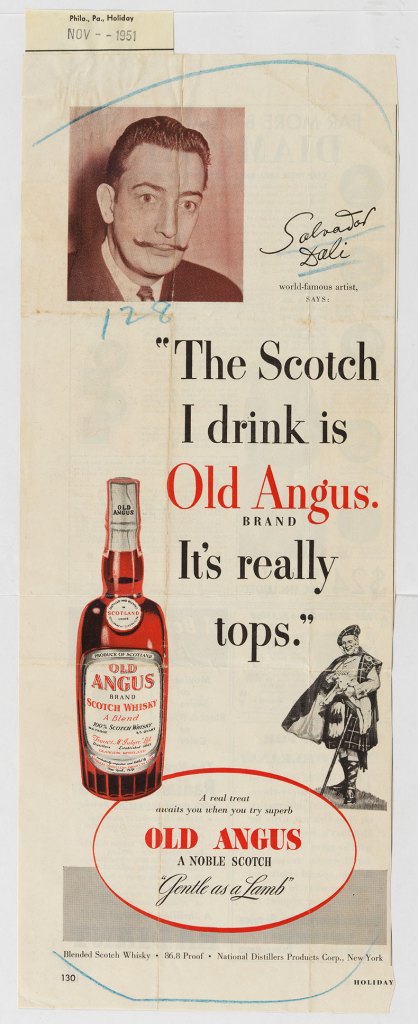
In 1951, he appeared in an advert for Old Angus blended Scotch. In 1958, he created the label artwork for the vintage of Château Mouton Rothschild’s Grand Vin. In 1964, he moved from label to bottle to screen: he designed a special Osborne sherry Conde de Osborne bottle and then fronted an Osborne Veterano brandy advert in 1965, decades before Bill Murray’s character praised ‘Suntory time’ in Lost in Translation (2003). In 1974 Dalí appeared in an Alka-Seltzer advert; he was happy to promote both cause and cure.
The criticism that has been levelled at Dalí for his commercial work derives from the fantastical notion of art as a pure realm. For Dalí, wine could stir up desire and become something to fetishise; it could evoke place and personae. He saw wine as as much an idea as a drink.
While those promoting sobriety nowadays might posture about purity, they are also scrambling for substitutes that mimic the old rituals of drinking: mocktails, non-alcoholic ‘spirits’, that promise pleasure without consequence. This workaround is understandable, but it is also Daliesque in its own way: desperate, ingenious, slightly melting at the edges.
There is a better lesson in Dalí’s fascination with wine and grapes for today’s sobriety supporters: pleasure is not a problem to be solved. It is a phenomenon to participate in sensually, culturally, commercially. Taste the secrets of wine, yes. But also notice who sells them to you, how they’re packaged and why you wanted them in the first place.
From the March 2026 issue of Apollo.