From the May 2026 issue of Apollo.
The room is silent until the half-foot-high carved wooden effigy of Karl Marx snaps into action: leaning forwards as he starts to wind a metal handle, then bending judderingly backwards as the handle comes back around its fulcrum towards his long beard. As Marx continues to turn the handle, slowly the great flying contraption above him whirrs into gear, a steampunk assemblage of scrap metal: cogs, bicycle wheels, the end of an old music stand. Footlights flicker from blue to green to red, casting shadows of spinning spokes on the wall behind, while through the speaker an accordion strikes up a thin melodic strain, which is soon joined by a youth choir in full voice. ‘Oh, our locomotive, fly ahead! Next stage is communism,’ they sing fervently in Russian.
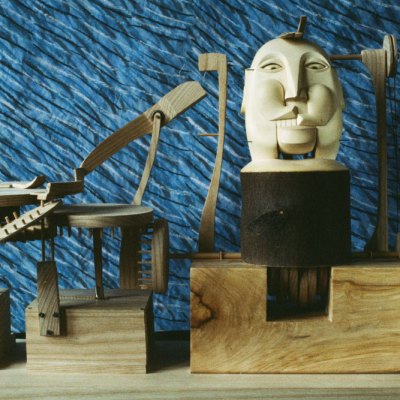
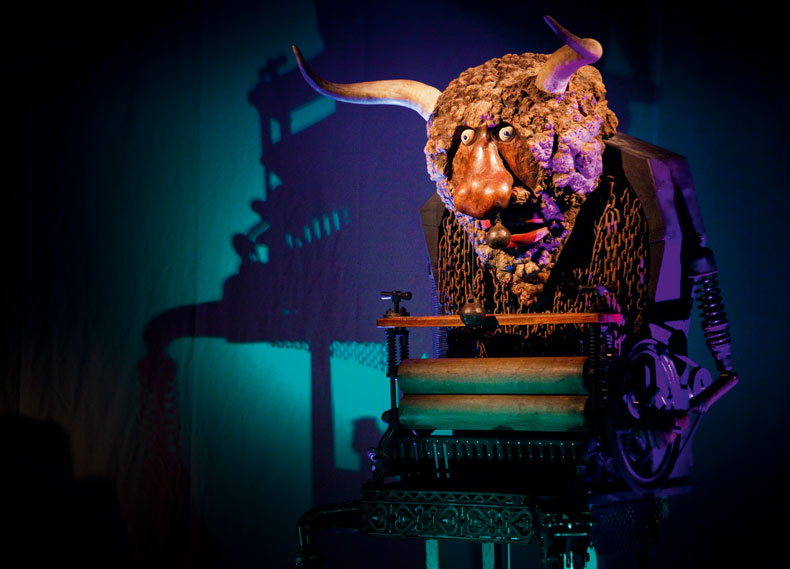
Great Idea (Karl Marx) (1990) is the first in a triptych – perhaps trilogy is the better word – that has long been many visitors’ first encounter with the world of Sharmanka Kinetic Theatre (the name is from the Russian for ‘hurdy-gurdy’, or ‘barrel-organ’). Proletarian Greetings To Honourable Jean Tinguely From Master Eduard Bersudsky Out of the Cradle of Three Revolutions, to give the series its full title, progresses to The Dreamer in the Kremlin, named after H.G. Wells’s report of his encounter with Lenin in 1920, and Autumn Stroll in Perestroika, which unfolds to a marching beat set by the stomping of an old pair of work boots. It opens ‘Wheels of Life’, a 45-minute performance of ‘kinemats’, as their creators – sculptor Eduard Bersudsky, and his wife and long-time collaborator, the theatre critic and director Tatyana Jakovskaya – describe them. The show is a heady brew of carnivalesque and often bawdy humour, brought to life by Bersudsky’s wonderfully eerie carvings of people and creatures, drawing inspiration from everything from Russian toys to medieval gargoyles and the Expressionist sculptures of Ernst Barlach. Another performance, ‘Journey’ (marketed as for ‘audiences of all ages’), focuses on kinemats completed since the couple’s move to Scotland in 1993. For as long as I can remember, these two shows have each been held once a day in Sharmanka’s home at Trongate 103, in Glasgow’s Merchant City.
Trongate 103, established as a multi-venue arts hub by Glasgow City Council in 2009, is currently at the heart of a bitter dispute. The various arts organisations in the building – which as well as Sharmanka include the Glasgow Print Studio (GPS), Street Level Photoworks and the disability arts charity Project Ability – were promised 25 years of peppercorn rents upon the opening of the centre. Yet on 27 February this year, City Property, an arm’s-length external organisation, informed its tenants that rates were to be hiked 400 per cent. At time of writing, negotiations over the new leases appear to have been fruitless; GPS has stated that it has entered into a monthly rolling contract ‘under duress’, while smaller organisations including the Glasgow Media Access Centre (GMAC), whose chair, Mark Langdon, has described events as ‘cultural vandalism’, have decanted to temporary premises elsewhere in the city.
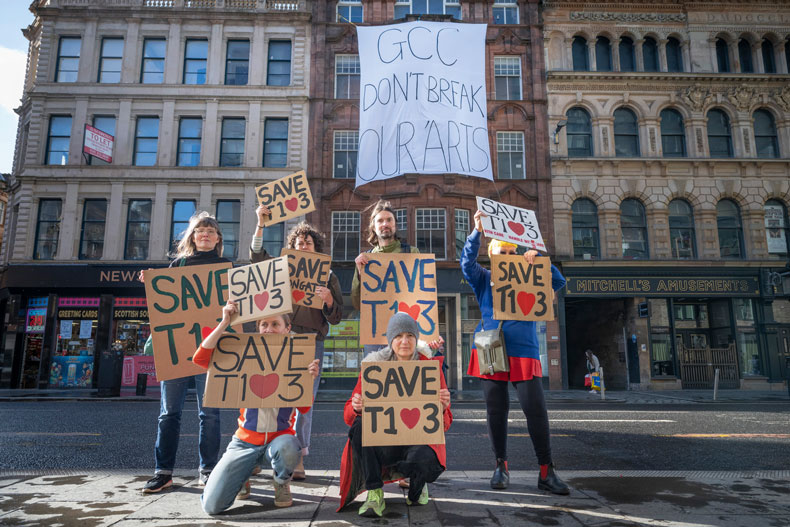
Against the backdrop of the sudden closure of the Centre for Contemporary Arts in January and the shocking fire that destroyed a Victorian landmark next to Glasgow Central Station last month, to say it has been a testing time for anybody invested in Glasgow’s arts and heritage would be an understatement. The furore surrounding Trongate 103 has become the lightning rod for a cultural fightback. Several hundred protested outside City Chambers on 27 March, including the Labour MSP Paul Sweeney; on 3 April Glasgow City Council passed a motion tabled by the Scottish Greens, formally committing to ‘engage urgently with tenants, partners and funders to consider the sustainability of rent and service charge increases for Trongate 103 tenants’, while also voting through some temporary relief in the form of a £200,000 fund to help creatives with property costs. Yet it is not clear how much of this is earmarked for Trongate 103, whose additional costs in increased rent and backdated service charges in any case far exceed this funding.
All seven of the institutions at Trongate 103 have become, in their own way, crucial to Glasgow’s arts infrastructure; they have endeavoured to respond to recent tribulations in one voice through the T103 Tenants’ Forum. For me, however, news of the threat to Sharmanka comes as a particular body blow. This is not just because I have loved it since I was a teenager; in my twenties, the Sharmanka poster on the living-room wall while I lived in London with an old school-friend seemed to both of us the perfect memento of our home town’s capacity for the eccentric, the marvellous and the subversive. Perhaps because it has often slipped too neatly under the rubric of ‘visitor attraction’, Sharmanka has not always been sufficiently recognised as an art-historically significant collection – yet it is hard to name a more compelling and singular continuation of the tradition of kinetic art into the contemporary era anywhere in the world.
These works insist upon yet at the same time frustrate a sense of narrative. They are motion machines that ultimately go nowhere. Sergey Jakovsky – Jakovskaya’s son; Bersudsky’s stepson – describes them (like Russia more broadly) as lying somewhere between the worldview of the West, with its insistence on linear progress, and more cyclical Eastern philosophies. Jakovsky has been the artistic director of Sharmanka since the retirement of his parents in 2018, having previously overseen the lighting. He is clear about the existential threat the institution faces, but he is also circumspect: ‘We’re from Russia and we’re stubborn. We’ve survived worse than this.’
Jakovsky was 13 when the family arrived in Scotland in 1993; he tells me of his ‘not unhappy’ though in retrospect ‘highly constrained’ early childhood behind the Iron Curtain. Kinemats crowded their little flat in Leningrad, where informal performances would be hosted for a small coterie of fellow nonconformists. With perestroika came new possibilities; Jakovskaya mobilised the amateur theatre troupe she directed, Four Little Widows, to renovate a former kindergarten as a performance space, in which the first iteration of Sharmanka opened in December 1989.
Jakovsky speaks in reverent tones of what happened next: a succession of minor miracles. Proletarian Greetings was first exhibited in St Petersburg in August 1991: an auspicious moment – and not only because the dissolution of the Soviet Union began in earnest with the August coup. It was also the month that the great Swiss kinetic sculptor Jean Tinguely died suddenly of a heart attack in Bern, just as Bersudsky had been due to welcome him to Russia and present him with this singular homage. In what was described as an act of ‘humanitarian aid’ from West to East, Tinguely’s assistant donated to Bersudsky an assortment of spare mechanical parts and one of Tinguely’s powerful Parvalux motors. (Jakovsky tells me, crestfallen, that this motor ‘finally packed in last year’.)
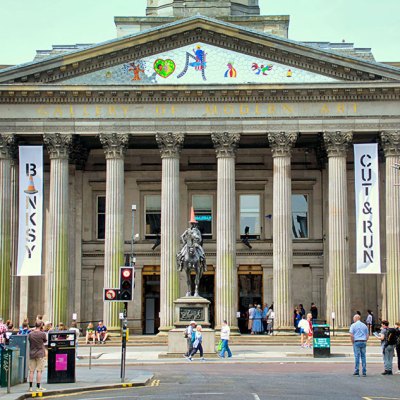
To an uncanny degree, then, fate had charged Bersudsky with taking up Tinguely’s baton. The story of how the family ended up in Glasgow is just as serendipitous. Among Sharmanka’s earliest international visitors was Maggy Stead Lenert, who was in Russia studying linguistics; entranced, she entreated her husband Tim Stead, the woodcarver and furniture maker, to come and see for himself. Jakovsky tells me that, in short order, Stead had planted a Sharmanka catalogue on the desk of Julian Spalding, recently appointed director of Glasgow Museums, who was commissioning work for the Gallery of Modern Art (GoMA), due to open in 1996. Spalding purchased Proletarian Greetings for the city and commissioned a new work, Titanic (1994).
Escaping the economic strictures of post-Soviet Russia, the family installed itself in the Scottish Borders, near the Steads. Bersudsky spoke no English, Stead no Russian, but Jakovsky describes them as being ‘like two bears that emerge from different forests – intertwined souls, not really knowing each other’s language, but somehow understanding each other perfectly well’. A 10-metre-high Millennium Clock Tower (1999) was originally envisioned by Spalding for the Kelvingrove, but eventually built for the National Museum of Scotland in Edinburgh where it first performed on 1 January 2000, and where it continues to delight visitors with its performance on the hour, every hour. The final coup of Sharmanka’s first decade in the UK was its only exhibition in London to date in 2002; Simon Callow wrote at the time that ‘its run was extended and then extended and then extended again: there never was such a successful exhibition at the Theatre Museum.’
‘In the nineties, we thought: Jesus Christ, how lucky were we?’Jakovsky says. ‘Never mind if we actually made it out of Russia, but to come to a place where it seems that the culture is at the forefront of everything – a city that gets it, on the world scale.’ Bersudsky and Jakovskaya continued to collaborate on kinemats through the 21st century, often paying homage to their new home: Rag-n-Bone Man (2002) honours the traders at the Barras market, ‘connoisseurs of old junk’; Tree of Life (2005), performed in collaboration with Derevo Theatre group as part of the New Year Celebrations at the Royal Museum of Edinburgh in 2006, fused Slavic and Celtic mythic beliefs about the natural world. With their arrival at Trongate 103 in 2009, Sharmanka had an established home – and since Jakovsky took the reins in 2018, he has doubled the audience in Glasgow.
That everything was going so well makes recent events all the more depressing. Spalding wrote in 2023 that Glasgow ‘has taken to its heart the art of Eduard Bersudsky, the latter-day Hieronymus Bosch of Communism and after’. There are few greater indictments of how far the city has fallen than the withdrawal of its protection. Jakovsky has a simple pitch to the city: ‘We’re a responsible, self-sustaining company; so far we’ve operated without any regular funding. But if Glasgow wants to have Sharmanka as a permanent cultural entity, we need a secure, financially viable home.’
Update: On Friday 24 April, Glasgow City Council confirmed it would provide funding support for the organisations at Trongate 103 until March 2027. Council officers are also exploring options to transfer the building out of the City Property portfolio and back into public ownership.
Corrections (6 May): 1) City Property is an arm’s-length organisation of Glasgow City Council, not an independent contractor. 2) The Millennium Clock Tower was intended by Julian Spalding for Kelvingrove Art Gallery, but that project wasn’t commissioned.
From the May 2026 issue of Apollo.