From the April 2026 issue of Apollo.
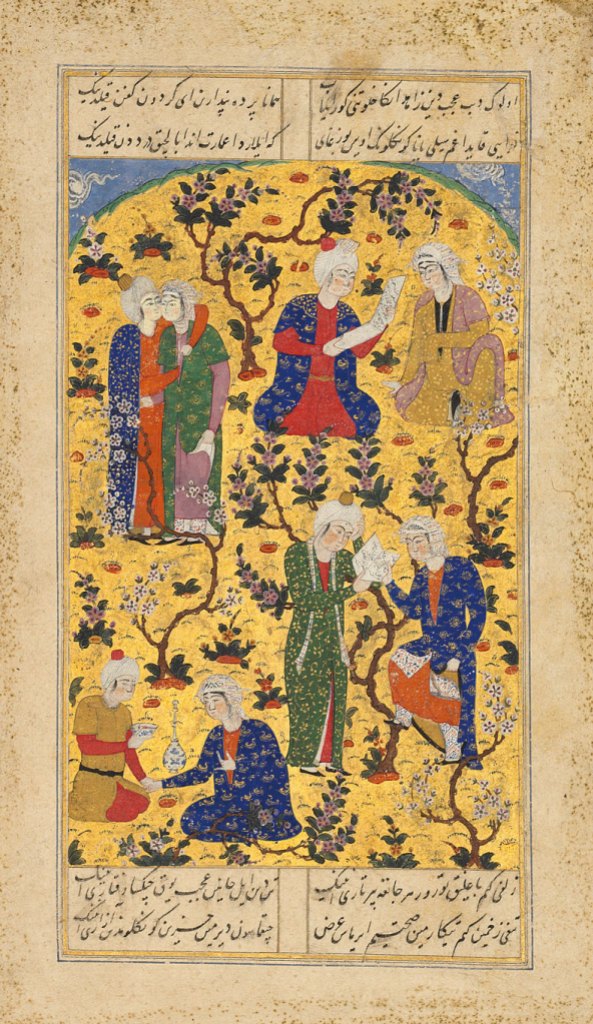
In a gouache and gold miniature from Safavid Iran, Lovers in a Landscape (c. 1510), four couples in a garden are engaged in the refined pursuits of embracing, poetry and wine, surrounded by flora and the accoutrements – flasks and bowls – necessary for drinking. The work is one of many from this period, including woven silks, paintings and illuminated manuscripts, that incorporate wine and its associated vessels into their composition and decoration to connect intoxication and beauty. The work comes from Shiraz in south-western Iran, a city which from antiquity had produced wine for courtly and religious purposes.
Today the name Shiraz endures in viticulture for wines made of the dark, thick-skinned grape – bold, fruity wines in regions in Australia and California or, in its other spelling, Syrah, restrained and peppery wines from France and South Africa. For centuries, origin stories linked the grape to Shiraz in Iran, through crusaders returning to France with the vine; one of the most durable legends attaches itself to the Hermitage appellation in the northern Rhône, supposedly named for Gaspard de Stérimberg, who, in 1224, after fighting in the Albigensian Crusade in Languedoc, withdrew to the top of a hill as a hermit, giving the site its name.
The link with Shiraz has now been settled by scientists – the decisive turn having come with DNA work in the late 1990s. Foundation Plant Services at the University of California, Davis, identified the Dureza and Mondeuse Blanche varietals, both native to France, as parents of Syrah/Shiraz. Yet genetic parentage is not the whole story of a varietal and the wine it makes, especially one that travels and inspires through trade, taste, literary memory and artistic imagination. The name Shiraz still carries an archive of associations, Persian, poetic, courtly and sensual, that remain vital to how this varietal is imagined and imbibed. Though the vine is not from Shiraz, Iran nevertheless remains foundational to the early history of wine production in the broader Near Eastern world. In the 7th century, approximately 1,200 litres of top-quality Shiraz were sent to Isfahan palaces for consumption by courtiers and the elite. A 17th-century Safavid court could aestheticise the apparatus of drinking itself: in the 1680s, the French diamond merchant Jean Chardin travelled to the court of the Shah Abbas and his descriptions of Isfahan include a royal winehouse furnished with long-necked bottles in cornelian, jade, crystal, onyx, agate, gold and silver, some inlaid with gems; vessels as luxury objects and courtly display. He also noted the quality of the wine, dark red and able to age for years.
It is within the arts, however, that the connection between Shiraz and wine culture is strongest. Since the 14th century, when Hafiz wrote ghazals (love poems) while ‘drunk on the wine of the Beloved’, wine in Persian art had functioned simultaneously as an object of pleasure, a sign of cultivated sociability and a symbol of love, whether human or divine. Hafiz’s poems embrace pleasure, defiance and metaphysical intoxication: ‘I will not depart from love, beauty, and wine. I have repented a hundred times, and I will not do it again.’ He inspired artists and craftsmen throughout the dynasty, who created miniatures that included quotations from his poetry – often relating to drunkenness and merriment.
In Persian visual culture wine is materially and aesthetically elaborate. Wine was pictured, handled, poured, stored, taxed, served and staged. Courtly painting and manuscript illustration repeatedly depict rulers, courtiers, mystics and attendants in scenes of convivial drinking. In Allegory of Worldly and Otherworldly Drunkenness (c. 1531–33) by Sultan Muhammad, illustrating a poem from Hafiz’s Divan, a drinking scene becomes a meditation on vision, ecstasy and transcendence with its cast of musicians, dancers and intoxicated bodies, and an orchestra of angels above.
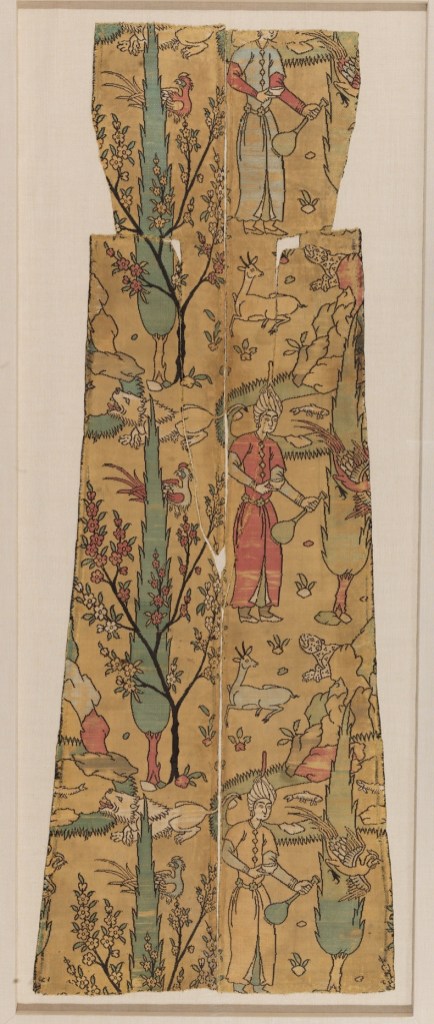
Safavid textiles also register wine as part of social interaction, etiquette and visual pleasure. A 16th-century silk fragment held by the Metropolitan Museum of Art shows a repeated image of a youth carrying a cup and a long-necked bottle through a lush garden world of ponds, birds, trees and animals. The figures and environment are visually interwoven: serving wine is not a separate act but part of an entire sensorial ecology of courtly life. Wine is not just for consumption but is designed into space and surface; it is an ornament and an atmosphere.
Although Shiraz the city and Shiraz/Syrah the grape are not directly related, culturally the name and associations of ‘Shiraz’ still open on to a much richer legacy that includes Hafiz’s mystical lyricism, Safavid miniature painting and luxury craft objects designed for the rituals of wine. DNA may be important in determining parentage and optimal cultivation, but the art of Iran reminds us that wine names come freighted with meanings and associations science was never meant to measure. Or as the poet put it in Ode 487: ‘Well, Hafiz, Life’s a riddle – give it up: There is no answer to it but this cup.’
From the April 2026 issue of Apollo.