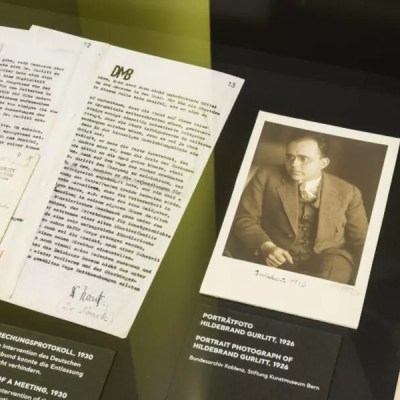
Switzerland has established an independent committee to advise on disputes about art looted during the Nazi era. The Commission for Historically Problematic Art, which came into being this week, comes 27 years after the declaration of the Washington Principles on Nazi-Confiscated Art, which were endorsed by the Swiss government. The committee is led by Simonetta Sommaruga, who has twice served as the country’s president. ‘After more than 25 years of debate and delay, we have moved beyond words and into action’, said Andrea Raschèr, an independent consultant who led the Swiss culture ministry’s department of legal and international affairs from 1995–2006. Recommendations given by the commission, whose 10 members include Sommaruga as well as legal and cultural experts, are non-binding, and the current owner of the contested object must agree to having it assessed. As well as Nazi-looted art, the commission will also consult on restitution claims for art acquired as a result of colonialism. ‘With this, Switzerland will make its contribution to addressing a dark chapter of history’, said Jon Pult, a Social Democratic member of parliament who first proposed a motion for the panel to be formed in 2021.
The Museum of Fine Arts Boston has laid off 33 employees – approximately 6.3 per cent of its workers – to address a ‘growing structural deficit’. In a statement issued on 28 January, the museum said that the ‘painful but necessary step’ marked a ‘sad moment for the MFA and one [they] face with a heavy heart’. The cuts come less than six years after the museum cut more than 100 roles through redundancies and voluntary early retirement. In a post shared on Instagram, the MFA Union, which represents 16 of the staff members affected, said that it was ‘deeply concerned’ about the news and that it expected to ‘meet and bargain with the museum […] to see if there are ways to avert layoffs’, adding that any redundancies should also ensure ‘shared sacrifice from Museum leadership’. The Boston Globe reports that in addition to the loss of active employees, the museum will also axe 23 vacant positions, reducing its workforce by a further 4 per cent.
More than 200 contemporary galleries across Spain will go on strike from 2–7 February to protest against the country’s rate of VAT on art sales. At 21 per cent, Spain currently has the highest VAT rate on art in western Europe, which has led to a ‘loss of competitiveness’, the gallerist Marc Domènech told the Art Newspaper. In 2024 Spain’s minister of culture, Ernest Urtasun, promised to lower VAT on the sale of art works, yet the 21 per cent rate has been in force since 2012. Without changes, said Daniel Cuevas of Galería Daniel Cuevas in Madrid, the current rate will ‘force many artists to abandon their careers and many galleries to close’.
Museums and galleries across the United States closed on Friday as part of a nationwide strike protesting against the violent actions of Immigration and Customs Enforcement (ICE), including the killing of two Minneapolis residents, Renee Good and Alex Pretti, in January. Participating galleries included Gagosian, David Zwirner, Hauser & Wirth and Pace Gallery, as well as the Drawing Center in New York and the Institute of Contemporary Art, Los Angeles.
The Courtauld has announced the creation of two new contemporary art galleries, expected to open in 2029 as part of the major development of the institution’s Somerset House campus. Supported by a £10m gift from the Blavatnik Family Foundation, the construction of the two galleries, as well as a new reading room inside the Courtauld’s remodelled gallery, will bring the foundation’s total support of the institution to £20m. In a statement issued by the gallery on 27 January, director Mark Hallet paid tribute to the Blavatnik’s ‘enlightened philanthropy’, while Leonard Blavatnik said it had been ‘a privilege to play a leading role in shaping the Gallery’s future’, and that the family looked forward to ‘many more years of close collaboration’.
Esther Bell is the new director of the Clark Art Institute in Williamstown, Massachusetts, the museum announced on 29 January. Bell has been the museum’s deputy director since 2022, having joined the Clark as a curator in 2017. Before that, she worked as curator of European paintings at the Fine Arts Museums of San Francisco, and previously held curatorial positions at the Cincinnati Art Museum, the Metropolitan Museum of Art and the Morgan Library and Museum. Bell will begin her new role in July, taking over from Olivier Meslay, who is stepping down after a decade as director. On Bell’s appointment, Meslay said that he was ‘delighted to know that the Clark’s next chapter will be entrusted to Esther’s exceedingly capable hands’.
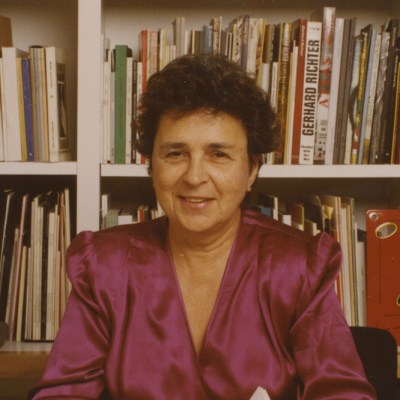
The gallerist Marian Goodman has died at the age of 97. Goodman, who was born in New York in 1928, completed a graduate degree in art history at Columbia University – where she was the only woman in her class – before beginning her career in the city’s art scene in the 1960s, co-founding Multiples, a company that produced artist editions, portfolios and books. In 1977 Goodman founded her eponymous gallery in Manhattan, which went on to represent European artists including Gerhard Richter, Pierre Huyghe and Giuseppe Penone, bringing them to public attention in the Unites States for the first time. In 1995, she opened a second space in Paris – one of the first overseas galleries to do so. In a piece for Apollo, Carolyn Christov-Bakargiev, former director of the Castello di Rivoli Museo d’Arte Contemporanea in Turin, described Goodman as ‘one of the best gallerists in the world’.