From the December 2026 issue of Apollo.
The first colour image in Taryn Simon’s ‘Father Country I Do Love You’ is of birth. A baby’s head is crowning, captured in its last moment before it becomes a person apart – a body and consciousness separate from its mother. The photograph is a stately and impeccable composition in hospital green, pale flesh, dark hair and vernix. Leaving the exhibition after my second visit, I observed visitors as they started their ascent of the Guggenheim Museum’s spiral ramp, gasping and exclaiming as the image came into view.
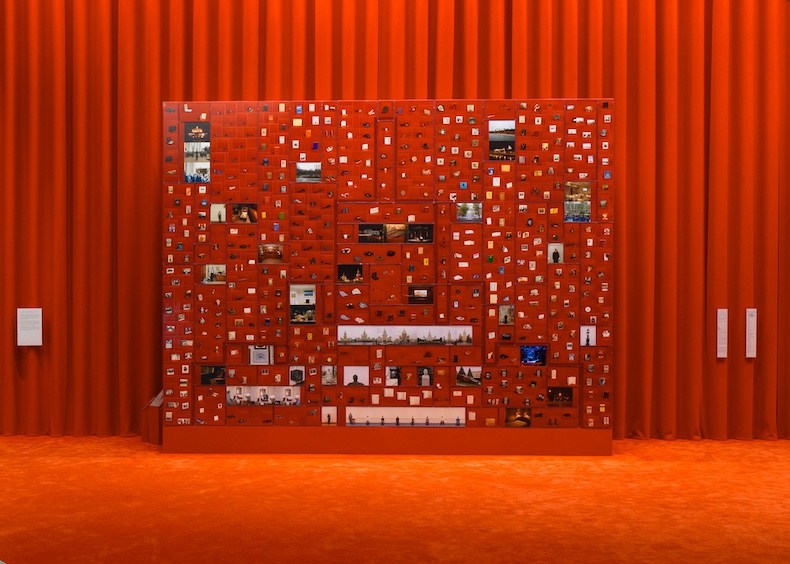
‘Father Country I Do Love You’ is an artwork of stories within stories within stories. A phenomenal exercise in documentary, it might also be read as the great American novel in exhibition form. The work encompasses true horrors, among them terror attacks, school shootings and war. It is also playful. At its apex is a giant marble run. Visitors release coloured balls and send them racing down the museum’s central spiral. There’s a metaphor here: you can release the ball, but only watch a fraction of its journey, the rest you must imagine. It is also an homage to Simon’s father, who worked for the US government in Thailand before going on to sell arcade games. Like the candy-coloured curtains and carpets that demarcate the exhibition’s various chapters, it brings levity to this at-times grim enterprise.
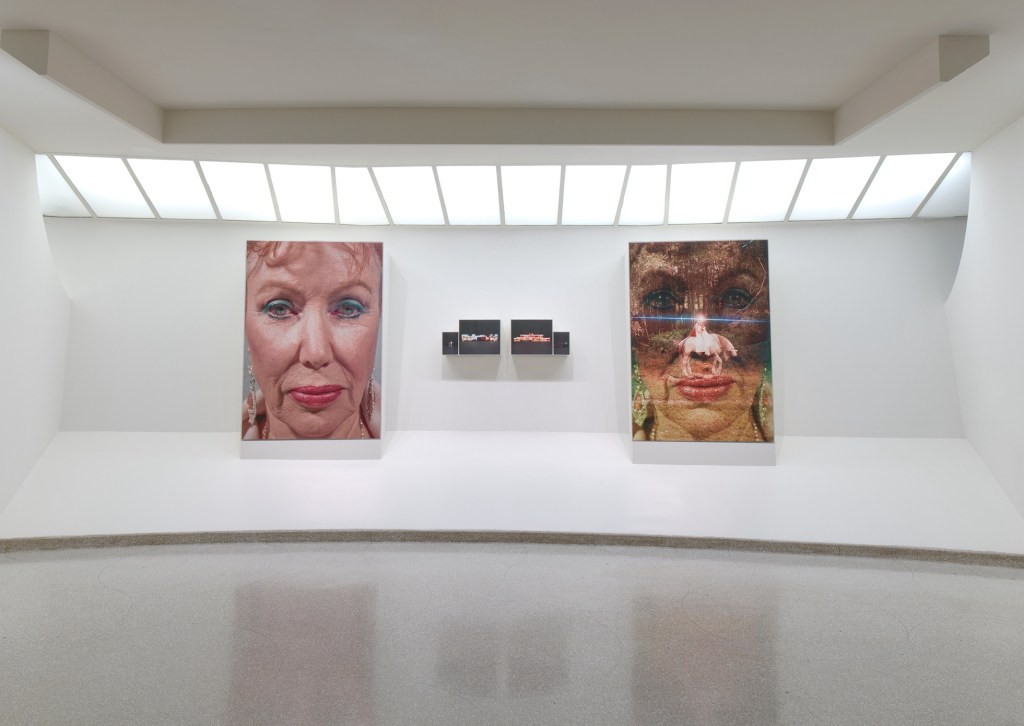
Simon’s relationship with her father forms the exhibition’s outer framework. Its inner structure is provided by an unnamed FBI agent with whom she had her first encounter at a roadside cafe in 2017. Over a decade, Simon tells us, she has gathered his memories, extending across a long career in the bureau and beyond. The agent witnessed defining events of the last half century. He was assigned to monitor (and perhaps turn) Mikhail Gorbachev’s entourage when he visited George H.W. Bush in 1990, a trip that precipitated the end of the Cold War. When a plane hit the Pentagon on 9/11, he was called on to sift through the debris, as he had done after the bombing of the US Embassy in Nairobi three years earlier. The agent proclaims his loyalty to God and country, but his stories expose the limits and failures of the intelligence services. Four consecutive chapters – each colour-coded, like a filing system – are dedicated to ‘Un-American rats’, informants who imperilled colleagues for financial gain, among other motives. Each story is conveyed in fragments: quotes from the agent, Simon’s photographs, scant contextual information. She stages crisp tableaux of objects and of individuals. For one chapter these include luxury goods sold at government auction and the adult son of a CIA officer imprisoned in 1994 for espionage and tax evasion. For another, she photographs the former FBI agent and spy Earl Pitts, now under house arrest, seated on an elevated tree stump.
Simon’s access, and the depth of her investigative work, is redoubtable. The chapter that unfolds amid the rubble of the Pentagon focuses on a holidaymaker – the improbably named Dame Johnnie Melinda Walker – who rolled up to take a snapshot. The agent confiscated her film, which Simon developed 25 years later, holiday photographs and all. She then tracked down Walker to take her portrait and see the original camera. This device in turn carries a jammed reel of film, which Simon extracts and develops, discovering images of a sacred ceremony led by an occult organisation. Scratch one layer of reality and another layer is revealed beneath. And another. And another. ‘Father Country I Do Love You’ positions the artist as interrogator, documentarian, investigator and conspiracy theorist.
The truth is unstable in here, but no more so than it is out in the world. After the birth scene comes a portrait of Jodie Foster, who filmed at the FBI Training Academy in Virginia while playing agent Clarice Starling in The Silence of the Lambs (1991). Simon reminds us that Foster also featured in the real-life FBI investigation of would-be presidential assassin John Hinckley Jr., who was fixated on her. Reality sits alongside fiction. Gathering her fragments, Simon allows the viewer to complete the story, sometimes on the flimsiest evidence. Accompanying a photograph of Gina Bisignano, arrested for storming the Capitol on 5 January, is a text about the investigation of a deluded shooter on Capitol Hill. How much of a connection should we infer here? Much of the show teases a dangerous instinct to find patterns and connections, but the only sure unifying principle shaping ‘Father Country I Do Love You’ is the artist herself.
Coinciding with the 250th anniversary of American independence, and the 25th of 9/11, this is a portrait of a country through the eyes of its intelligence service. It is also a work about individual lives, and how little we can, and do, know of them. In the work’s final panel Simon explains that her father has Alzheimer’s. His memories are now lost to her. In light of this, the birth at the start of the work might also be seen as her birth, marking the start of a relationship with her father that is drawing towards a conclusion. Her obsessive recording and elaboration of the FBI agent’s life story begins to feel like a relationship in lieu, a doomed effort to pin a person in place. For all the evidence Simon accumulates, the character at the centre of her work remains a cipher, as ultimately
mysterious as any other human life.
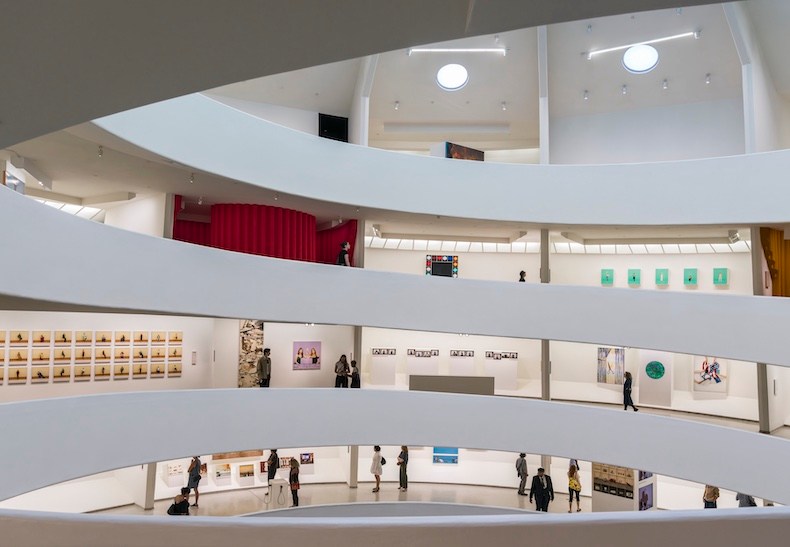
‘Taryn Simon: Father Country I Do Love You’ is at the Solomon R. Guggenheim Museum, New York, until 14 March 2027.
From the December 2026 issue of Apollo.