
From the December 2025 issue of Apollo. Preview and subscribe here.
Among the chit-chat this autumn, including the unexpected success of Frieze London and Art Basel Paris, an item of consequential news emerged. Days before its opening in London, Frieze announced it would launch an edition in Abu Dhabi in November 2026 – hot on the heels of Art Basel, which is opening in Qatar in February 2026. As we reported in June, much attention is being paid to the Gulf by the art market.
Art Basel Qatar is an entirely new fair while Frieze Abu Dhabi is taking over, expanding and internationalising Abu Dhabi Art, until now a small regional brand. They join Art Dubai, established in 2007, and Art Week Riyadh in Saudi Arabia, which is expected to hold its second edition in April 2026.
This rapid expansion was not something anyone would have predicted, in the Gulf or elsewhere. In the aftermath of the pandemic, which forced commercial galleries and art fairs to close and drove art sales online, gallerists regularly declared they would in future go to fewer fairs citing rising costs. Collectors complained of ‘fairtigue’, caused by the enormous growth in the international calendar of events since the early 2000s.
Despite the wealth, the pandemic was tough for galleries in the Gulf too. Sunny Rahbar, co-founder of pioneering Dubai gallery The Third Line, which celebrates its 20th anniversary this year, recalls: ‘It was as hard as the financial crash [of 2008/09]. We almost decided to cut our losses and close. But then we thought: “We’ve spent 15 years building this.”’ Now she says: ‘We are in a position to pick and choose what we do, but I don’t think we’ll be going back to doing seven fairs a year.’
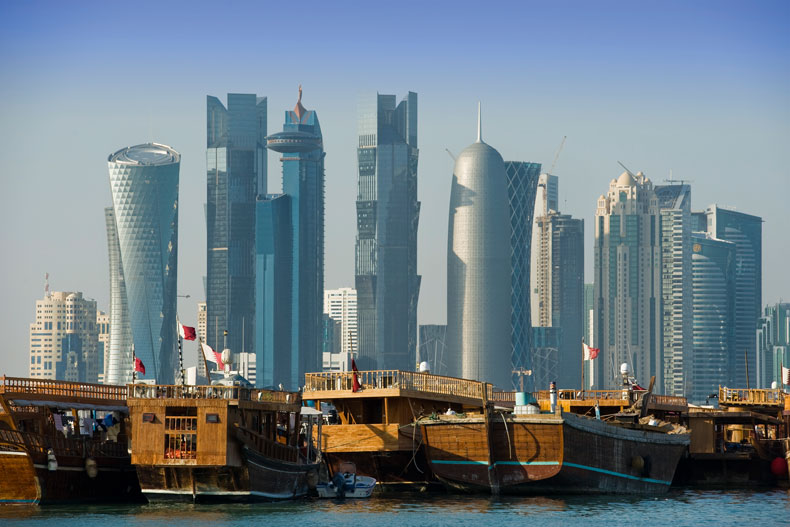
So why the interest in the Gulf? In a word: money. The economy of the Gulf Cooperation Council (GCC) – Bahrain, Kuwait, Oman, Qatar, Saudi Arabia and the United Arab Emirates (UAE) – is booming. GDP is predicted to grow by around 4.4 per cent in 2026, while much of the world, especially Europe, stagnates.
This is partly driven by the Gulf’s huge oil reserves but also state-driven economic diversification. This includes renewable energy, artificial intelligence (AI) and other technologies, tourism and finance. According to the World Economic Forum, Dubai is becoming a global financial hub, with the number of companies operating in banking and capital markets up by 20 per cent in the first half of this year.
The UAE and other GCC countries are also becoming a haven for the wealthy thanks to generous ‘golden visa’ schemes and their reputation for safety. ‘The change is extraordinary,’ Rahbar says. ‘Dubai is so busy, so many people are moving here.’
Meanwhile, the Gulf states have been heavily exercising their ‘soft power’. This includes huge investment in cultural infrastructure, sports and leisure. For some, this represents an opening-up of the region’s closed, traditional and deeply religious societies. For others it is a troubling example of arts- and sportswashing of what continues to be the GCC’s poor human-rights records.
Qatar’s most obvious use of soft power was its hosting of the World Cup in 2022. It has also opened six museums since 2008, including 3-2-1 Qatar Olympic and Sports Museum and a new one devoted to the Indian modernist M.F. Husain. Plans for others include the modern and contemporary Art Mill Museum.
Abu Dhabi investment funds own Manchester City Football Club, stakes in Formula 1 and a large slice of Sotheby’s. Abu Dhabi’s new museums include the Louvre Abu Dhabi, the Zayed National Museum and the Guggenheim Abu Dhabi, which will open in 2026. Dubai has focused on luxury tourism and commerce but announced last month it will construct a Tadao Ando-designed contemporary art museum, the Dubai Museum of Art.
Saudi Arabia, meanwhile, is in overdrive, with investments ranging across football, golf, cricket, horse-racing, motorsport and tennis, not to mention the vast Neom desert city development (even in its reduced state) and the Wadi AlFann sculpture park as part of the massive AlUla heritage and tourism project.
How much all of this has cost is unknown – the Gulf regimes are autocratic monarchies, not democracies, and little information is in the public domain – but it is certainly many billions. Adding art fairs, which attract wealthy elites, arts professionals with ‘cultural capital’ and international press coverage to the mix makes sense – especially as all the new Gulf museums are busy buying art as well. The fairs, not surprisingly, are more than willing partners in this enterprise.
It has been an open secret, for example, that MCH Group, the Swiss owner of Art Basel, has been looking to grow its income streams since it made losses of CHF72m (£60m) in 2020. The same year it sold a large stake to Lupa Systems, a private investment firm owned by Rupert Murdoch’s son James. Since 2021 it has launched a new edition in Paris, signed a deal to help organise Art Week Tokyo in Japan (with government and private funding) and has now announced the fair in Qatar.
Frieze has also grown rapidly since sports and entertainment company Endeavor bought a majority stake in 2016. Since 2019 it has opened editions in Los Angeles and Seoul, as well as taking over the management of the Armory Show in New York and Expo Chicago. Only a few weeks after it was taken into new ownership in October – led by former Endeavor chief executive Ari Emanuel – it signed the Abu Dhabi deal.
But these developments are happening against a background of increasingly precarious times for art fairs. When Ernst Beyeler set up Art Basel in 1970 with two fellow art dealers, there were few other fairs. By 2019 the number of fairs around the world had ballooned to 407, according to research firm Arts Economics.
But this proved to be ‘peak art fair’. Between 2020 and 2023 the cold winds blowing through the art market caused 129 to fold, including MCH Group’s Masterpiece (which held its last edition in London in 2022) and Art Beijing, which had run since 2006. A further 31 went in 2024. The long-established The Art Show in New York, Nada’s Paris edition, Taipei Dangdai and the Eye of the Collector were among the casualties announced this year. Some of these, possibly euphemistically, describe themselves as ‘on pause’.
The problem is that art fairs are challenging businesses to run. Margins are tight and it is often forgotten that the fairs’ principal clients are galleries, most of which are feeling the effect of the art-market downturn, not wealthy collectors.
‘We have to deliver to [the galleries] or they will stop paying our fees,’ says Simon Fox, chief executive of Frieze. These can range from £10,000 for an emerging gallery to £70,000 for a large, blue-chip stand. ‘Unfortunately, fees are high because fairs are expensive to stage and costs have risen more than inflation.’ He says the fair has worked hard to mitigate this with below-inflation price increases, funded in part by new sponsorship deals.
Meanwhile, fairs have year-round costs – staff, offices, marketing expenses, collector and gallery relations – but only a one-week opportunity, if they only have one annual edition, to bring money in. Given these hard realities, the eagerness of investors to still get involved in art-fair businesses is surprising.
In a podcast in 2023, Murdoch explained why he had invested in MCH Group. ‘Formula 1 is probably the best example,’ he told Tim Schneider, founder of the Gray Market newsletter. ‘Where F1 sets down, there’s a huge circus: different events, and people coming from all over, and then they pick up and go to the next city. It occurred to me that that ability to convene a broader community, not just the superfans, could be really lucrative.’ He had seen an opportunity in Art Basel, he said, because it was a similar proposition ‘in the cultural space’.

It’s a plan regarded with scepticism by some. The more art fairs become luxury experiences, the more likely they are to forget their primary purpose, says Alain Servais, a Belgian financier and art collector. ‘Formula 1 is the sort of event that gathers tons of people, spending tons of money, tons of broadcasting rights, tons of everything,’ he says. ‘The danger is that the art ends up as a sort of excuse, in the same way that there are people who don’t care at all about the motor-racing. They are just there with their backs to the track, being seen and drinking champagne.’
These kinds of people, he argues, are no use for the galleries at an art fair. That is probably one of the reasons why Art Basel hastily introduced an extra ‘ultra-VIP’ day before the official start of this year’s Paris fair, after grumblings that the fair was full of fashionistas.
Galleries, meanwhile, say their reasons for doing fairs are prosaic: they are expensive but generate leads and sales. While rent and salaries make up two-thirds of most galleries’ operating costs, around half of the rest is spent on stand fees, shipping works of art, travel and art-fair costs. But around a third of all gallery sales come from art fairs, according to Arts Economics. This may explain why Art Basel says that applications for its Qatar edition’s 87 slots were heavily over-subscribed.
‘We all prefer our galleries [to fairs], where we can control the overall setting,’ says Thaddaeus Ropac. He has galleries in five cities and exhibits at 16 international fairs including next year in Doha. ‘But fairs have become crucial to make contact with large numbers of people and for visitors to discover new art.’ They work best, he adds, when they attract people from a different region. ‘I don’t travel all the way to do a fair in say, Shanghai, to meet everyone I know from New York or Berlin.’
What all this means for the art fairs in the Gulf remains to be seen. ‘The big question is whether new collectors will emerge in the wider Gulf region [to sustain] them,’ says Elie Khouri, a businessman and Dubai-based art collector.
In the first couple of years, international collectors will probably come, he believes, ‘and the governments will pitch in and buy, like they did in the early days of Art Dubai’. But for now, there are few regional collectors. ‘In the UAE we are more like a $150m art market,’ he says. ‘That’s a couple of big paintings at a top auction.’
Rachel Lehmann, co-founder of Lehmann Maupin, which has galleries in London, New York, Hong Kong and Seoul, says that she was happy to have been accepted by Art Basel Qatar, ‘especially as we heard there had been hundreds of applications’. But she is strict about limiting art fairs in future – and says this is a practical business decision: ‘Art Basel has made it easy for us in Qatar. The stands are a fraction of the price of a regular Art Basel booth.’
Others are even less enthusiastic about further art-fair expansion. ‘The whole idea that everything in the art world has to perpetually accelerate and grow is anathema,’ says Stuart Shave, who founded Modern Art in London in 1998. ‘These are not the values of my artists, or their ideas of what art and the art world is for.’
Shave does only four art fairs a year – Frieze London and Art Basel in Basel, Hong Kong and Paris. ‘There’s too much “presenteeism”, being at every fair, every art world event. There’s a sort of doom spiral in some of the press about the art market, but maybe things are starting to find their original form, smaller, more thoughtful and more authentic.’
The first art fair, Art Cologne, was established as recently as 1967. Fairs have since become an integral part of the art market landscape, and as long as they add up financially for galleries and encourage people to buy art they will retain an important role. But the fact that so many have recently disappeared is less a sign of a market in crisis and more an indication of over-extension and too much hype: in fact, a much-needed correction.
From the December 2025 issue of Apollo. Preview and subscribe here.