From the March 2026 issue of Apollo.
Religious leaders are often complex, contradictory figures – none more so than Rabbi Israel Ruzhin (1797–1850), one of the most influential leaders in the history of Hasidic Judaism. It has been said that one winter night, he stood in the snow wearing solid gold boots encrusted with diamonds; when he stepped away, one of his followers noticed blood on the snow. For all the splendour of his boots, they had no sole: the rabbi was walking barefoot.
Whether or not the story is true, it sums up two known sides of his character: regal pomp and steadfast asceticism. Hasidic Jews differed from their most mainstream counterparts in a number of ways, including a more conservative way of life, a heightened, joyous approach to prayer and faithful adherence to a spiritual leader, or rebbe. Although Ruzhin’s followers revered him for his piety and charisma, his lifestyle was extraordinarily lavish – so lavish, in fact, that he incurred the envy of Tsar Nicholas I of Russia, who in 1838 imprisoned him for two years on trumped-up charges of murder. After his release, Ruzhin moved to the Austrian Empire and settled in the Carpathian Mountains, in what is now Ukraine, which is where he grew his court until he died.
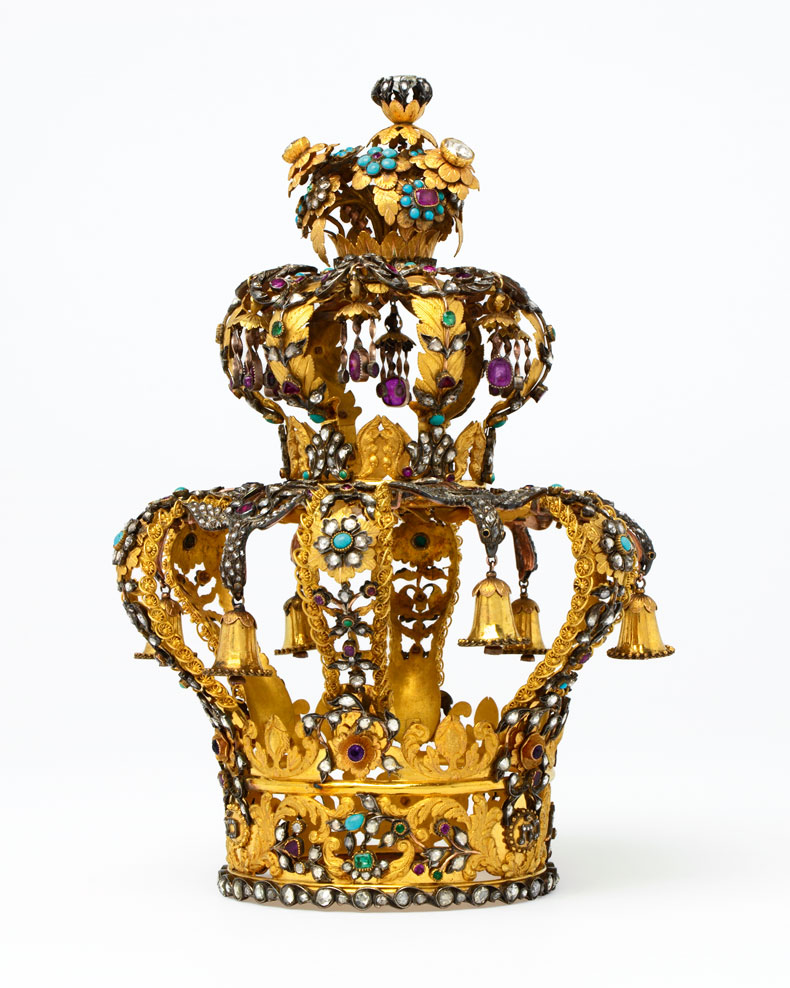
Ruzhin had eight sons, five of whom became a leader of a Hasidic dynasty after their father’s death. (Hasidism is organised into independent sects known as courts or dynasties, each headed by a rebbe.) Two of the sons are believed to have each inherited a gold Torah crown, crafted in c. 1825. They are the only two known to exist. One is in a private collection somewhere in the Americas; the other was sold to an unknown buyer in 1933 and changed hands again in 1967 before being bought at auction by the real-estate magnate and collector of decorative arts Arthur Gilbert in 1999. Gilbert bequeathed the collection he and his wife built up to the UK, and the crown, one of its most wondrous items, is now held by the Victoria and Albert Museum.
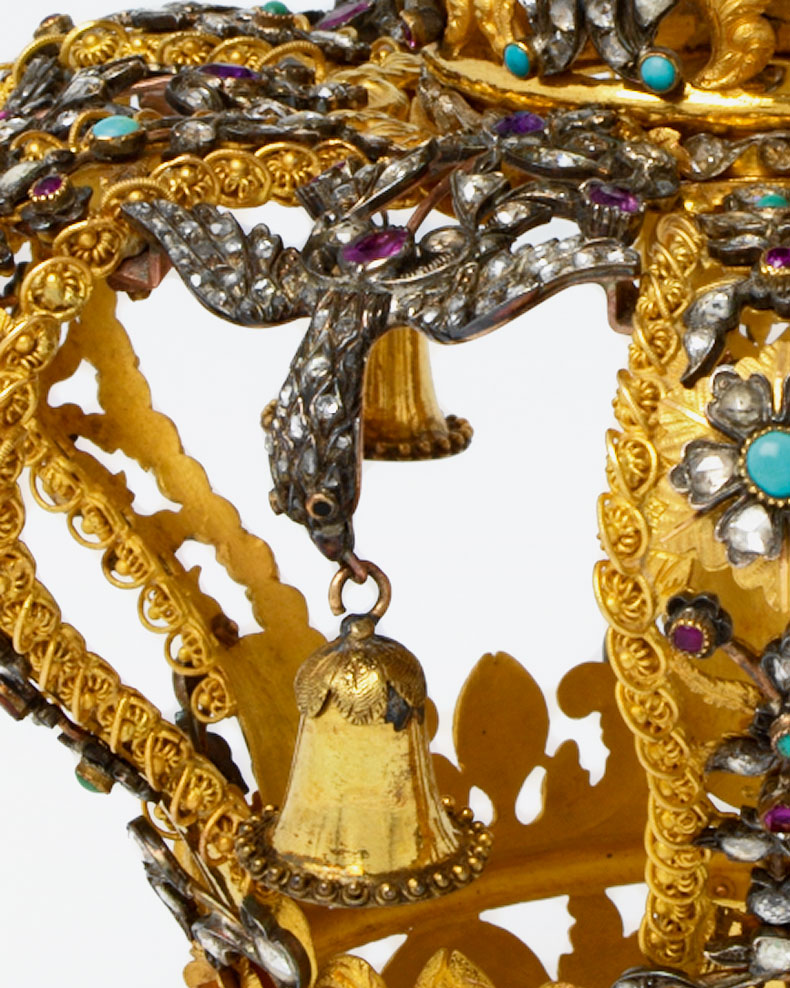
The Torah is the holiest object in Judaism. Although Torah scrolls are simple, unillustrated parchments, they are embellished with ornaments. Among these are Torah finials, which sit at either end of the scroll. Many are rimmonim, named after the Hebrew for ‘pomegranate’: usually made from precious metals, they are adorned with tiny bells that ring whenever the Torah is being carried to or from the ark. As well as recalling the sound of loosened seeds inside a dried-up pomegranate, the chimes bring to mind Moses’s brother Aaron, the first High Priest of the Israelites, whose robe was embellished with bells.
But some finials take the shape of crowns to honour the Torah even further. Torah crowns were first mentioned in the 11th century, at which point they were made of flowers; by the 14th century most were made of silver. The crown in the Gilbert Collection is only 18cm high and 12cm wide; its size and fragility suggest that it was presented, together with its pendant, as a gift to Ruzhin, not so much for functional use as to emphasise the importance of his leadership.
It is made up of five principal parts, from the floral frieze at the bottom to the large diamond set in silver at the top. For the base, a flat sheet of gold would have been pierced and engraved with floral decorations. Then it would have been shaped into a shallow cylinder, open at the top and bottom, and the ends soldered together to form the cylinder for the base of the crown. At the bottom of the base is a resplendent rim, made from diamonds set in silver.
A simple gold rim reinforces the top of the base and joins it with the rest of the crown. Rising up from it are the branches, which are made of gold filigree, shaped and soldered on. The same goes for the foliated designs between the branches, soldered and bolted to the rim of the base. Then jewels have been set: diamonds, rubies, emeralds, turquoise and amethysts. The rubies and emeralds have been backed by foil in the setting, to enhance their colour and luminosity; some of the rubies have a milky appearance, suggesting that they were mined in what is now Myanmar.
At the tip of the crown are small diamonds set in silver branches that are holding up the largest of all – an old mine cut diamond. The set of this gemstone is designed to resemble the head of a flower and, just like a flower, it trembles when moved. Combined with the bells, it makes this Torah crown a remarkably dynamic object.
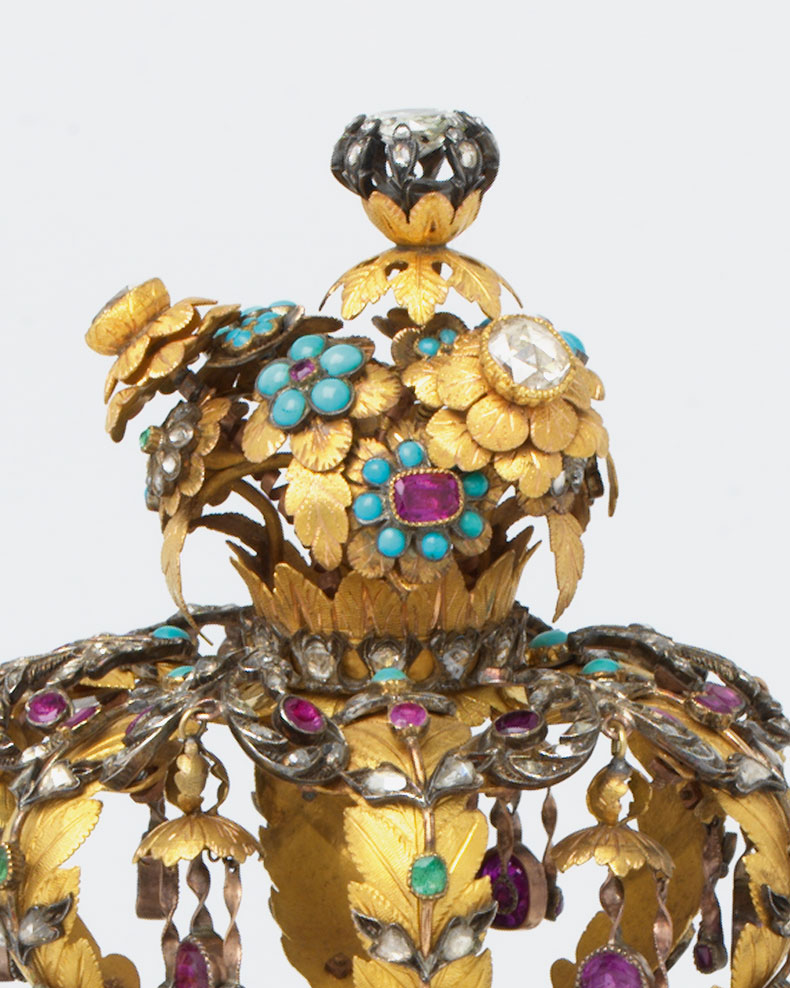
The bells themselves would have been cast, shaped and soldered on. One exquisite detail is the birds that are holding the bells. They resemble the sacrificing pelican in Catholic lore, in which the pelican pecked open her own chest and fed the blood to her offspring – a reference to Christ’s sacrifice. Such bird ornaments were common in late 18th- and 19th-century jewellery; they are not specific to Jewish ritual. It’s something we’re in danger of forgetting: amid the religious strife of the early 19th century, goldsmiths would work together, sharing designs and ideas.
We don’t know exactly where this Torah crown was made, but its quality suggests that it was crafted in Vienna, one of Europe’s leading centres for goldsmithing. It would have been a team effort, with perhaps five to ten people involved: the shaping, engraving, chasing, filigree work, soldering and jewel-setting would have been contracted out to different craftspeople by the goldsmith who ran and owned the workshop.
We are fortunate that the crown has survived at all, given the turbulent times it has lived through. Since at least the 13th century, Jews had been welcome throughout Eastern Europe, in the expansive territories of what was then the Polish-Lithuanian Commonwealth. But when the Commonwealth dissolved in 1795 and its territories were carved up between Prussia, Austria and Russia, Jewish communities were confined to a territory known as the Pale of Settlement, under the dominion of Imperial Russia. Their rights were progressively reduced; pogroms began in Odessa in 1821 and increased in intensity and violence throughout the century. When Tsar Nicholas I acceded to the throne in 1825, many Jewish populations were moved out of their villages and pushed into towns, precipitating waves of migration towards Poland, Germany and, later, England.
Arthur and his wife Rosalinde – Gilbert was her surname, which Arthur adopted (he was born Abraham Bernstein) – were both born in 1913 in London, the children of Jewish immigrants from Poland. In 1935, they set up a womenswear business; they sold up in 1949 and moved to Los Angeles, where Arthur made a fortune developing property. The couple’s experience in the world of fashion had honed their eye for craft and detail and in the late 1960s they began actively collecting decorative art, beginning with English silver and going on to include Arthur’s greatest loves: gold boxes and stone or glass micromosaics. Rosalinde died in 1995 and Arthur in 2001; together they had built up one of the largest collections of micromosaics in the world and the UK’s most comprehensive collection of gold boxes.
Arthur and Rosalinde were active members of their Jewish community, but were not especially observant; Arthur fell out with his father, whom he called ‘tyrannically religious’, and had no interest in collecting Judaica per se. His purchase of the Torah crown, four years after Rosalinde’s death, says a lot about his approach to collecting: he insisted on buying only first-rate items and ones that had a particular resonance for him. The crown is a ritual Jewish object, but its rarity means it is also far more than that. Although it is in some ways an atypical purchase for Arthur, the fineness of the tiny gemstones – not to mention the dynamism of the object, with its trembling diamond – surely appealed to him as a lover of miniatures. Early in their collecting life the Gilberts acquired some very large objects, but whatever size they were, the craftsmanship was always minutely detailed.
Until now the Gilbert Galleries at the Victoria and Albert Museum, where the couple’s collection is housed, have not been explicit about their Jewish heritage. The Torah crown was separated from the rest of the collection and presented among the V&A’s wider collection of Judaica. The redesign of the galleries, which reopen on 14 March, has allowed the Gilberts’ Jewish identity to be made more visible and, after public consultations and careful consideration, the crown will now be displayed in its own space there.
When Arthur saw the crown at a Sotheby’s auction in 1999, he called one of his friends, now a trustee of the Gilbert Collection, for advice. The friend encouraged him to buy it if he wanted it – it was, after all, his decision. The following day, the friend received a call from Arthur, who was incensed at having paid over $1m for the crown. Though he never paid more than he could afford, Arthur would sometimes shell out more than he was comfortable paying, and that day, as on many other days, bidding fever seized him and did not relinquish its grasp. But it worked out for the best: Arthur’s giddy bidding is why this marvellous Torah crown now belongs to the nation.
As told to Arjun Sajip.
Alice Minter is senior curator at the Arthur and Rosalinde Gilbert Collection.
The Gilbert Galleries at the Victoria and Albert Museum, London, have been closed for refurbishment and expansion since 2024 and will reopen on 14 March.
From the March 2026 issue of Apollo.