From the March 2026 issue of Apollo.
John Vanbrugh was baptised at home on 24 January 1664, married at the age of 54 on 14 January 1719 in St. Lawrence’s Church, York, and buried in the family vault in St Stephen Walbrook after his death on 26 March 1726. Beyond these rites of passage the architect and dramatist was not, so far as is known, religious. In fact, he had every reason to dislike the clergy, one of whom, Jeremy Collier, a priest imprisoned for refusing to accept the accession of William and Mary, had caused him difficulties: in 1698 Collier had published A Short View of the Immorality and Profaneness of the English Stage, a pamphlet which attacked the theatre and particularly Vanbrugh’s two recent plays, The Relapse and The Provoked Wife.
Although Vanbrugh designed a chapel for the west wing of Castle Howard, it was never built. The chapel at Blenheim was completed after his death, not to his design. It was Vanbrugh, alongside the third Earl of Carlisle, who promoted the idea of constructing a grand mausoleum in the grounds of Castle Howard – an idea that came to fruition shortly after the architect’s death, with a design by Nicholas Hawksmoor. Vanbrugh’s anti-clerical views are evident in a letter to Lord Carlisle on the subject, following the death of the Duke of Marlborough in 1722:
It having been referr’d to my Ld Godolphin […] to consider about the Dukes funeral and place of burying I have taken the liberty to mention to my Lord [Godolphin] what your Ldshp designs at Castle Howard, and has been practic’d by the most polite peoples before Priestcraft got poor Carcasses into their keeping, to make a little money of.
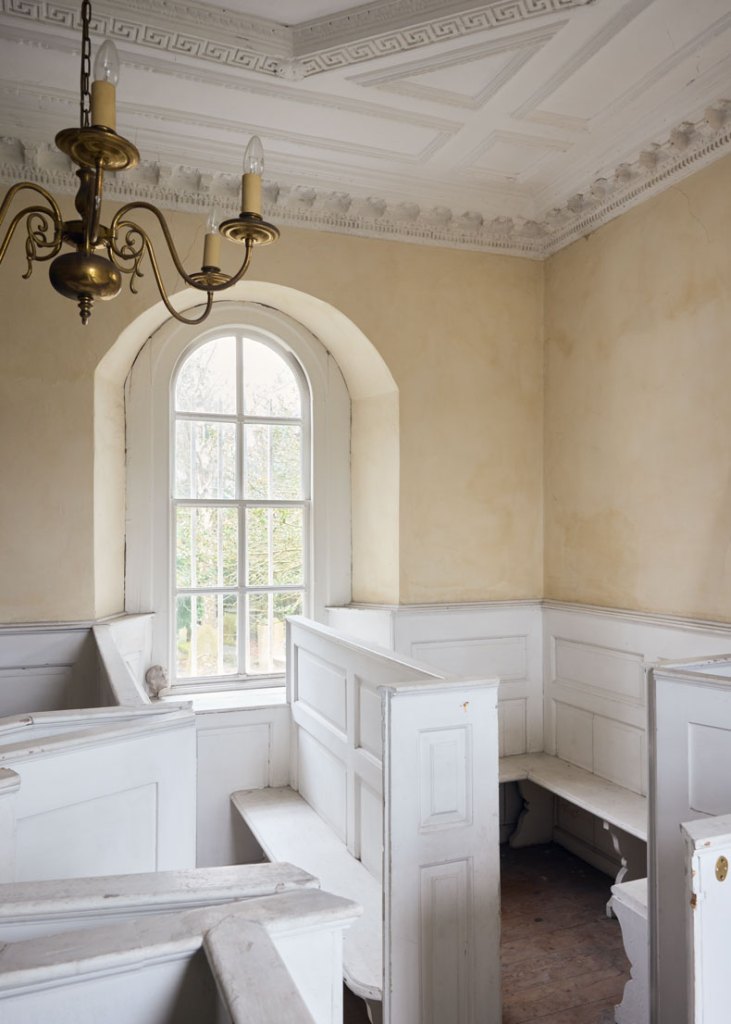
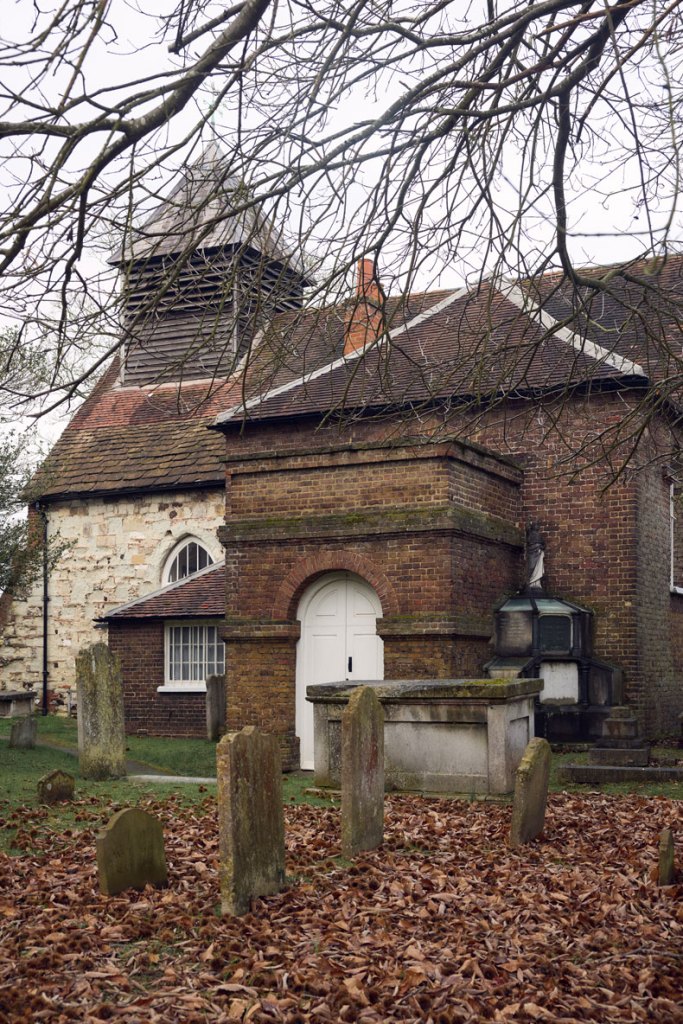
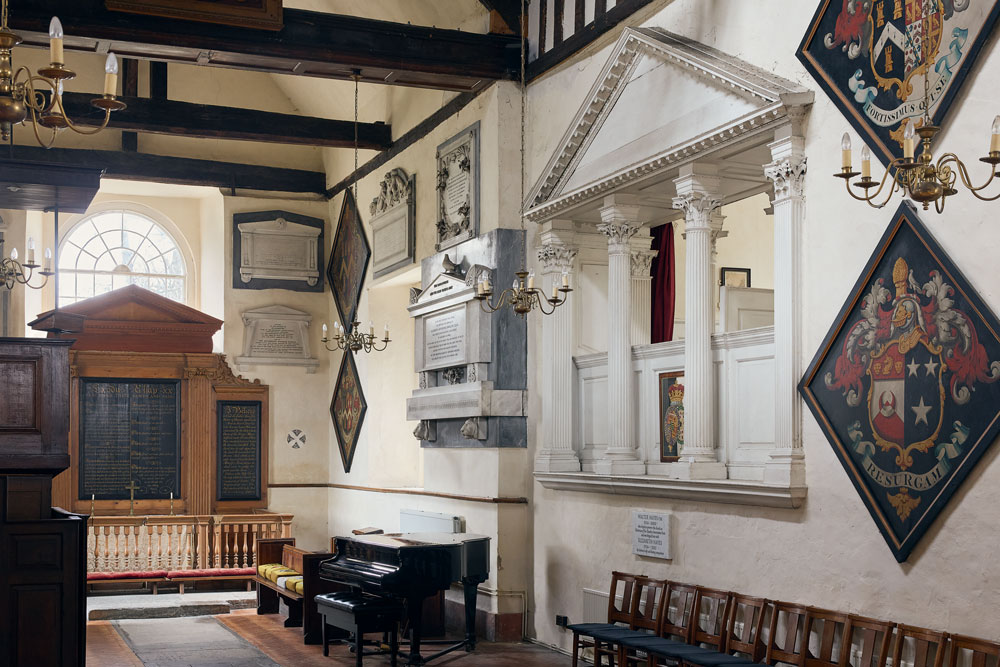
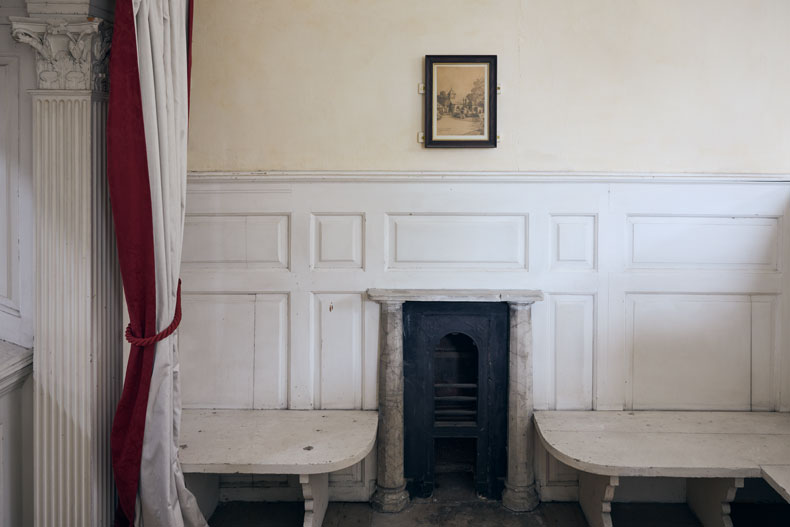
All of that makes the existence of a side chapel known as the Newcastle Pew in a church tucked just behind the high street in Esher, Surrey, a surprising footnote to Vanbrugh’s career. St George’s replaced an earlier, medieval building in around 1540, making it one of the first churches to be constructed after the Reformation. Its small, barnlike appearance does little to prepare the visitor for Vanbrugh’s addition nearly two centuries later: as seen from the main interior, a faintly surreal, pedimented Corinthian temple facade that looks like it belongs to the folly of a large estate, or to the royal box in a theatre. The inside of this raised ‘chamber pew’, a brick structure tacked on to the south side of the church, is accessed via a separate entrance outside, with stairs leading up to a warren of box pews. The lucky occupants of the front section of the chamber had more legroom,a view through the columned opening into the nave, and the benefit of a fireplace on either side. How had this curious addition to a small church in Surrey come about?
In 1709, Vanbrugh had bought a 60-acre farm at Chargate, a mile or so south of Esher. It seems an odd thing for him to have done at a time when he was complaining about not being adequately paid for the work he was doing at Blenheim, and about the drain on his finances that was the great theatre he had constructed on Haymarket in London. It’s possible, therefore, that the farm was paid for by his mother. He went on to build a small house to replace the pre-existing dwelling, not dissimilar in scale and character to his idiosyncratic house in Whitehall, which had been likened by Jonathan Swift to a ‘goose-pie’, a dish known for its peculiar shape. The nickname for the building, which Vanbrugh constructed using brick and stone from the ruined Palace of Whitehall, stuck.
Soon after Vanbrugh had completed his house at Chargate, he sold it to a close friend, Thomas Pelham-Holles, known as Tommy, who had in 1711 inherited massive wealth and estates from his uncle, John Holles, Duke of Newcastle and Earl of Clare (Vanbrugh had also made designs for him at Welbeck), and from his father, Thomas Pelham, 1st Baron Pelham, the following year. The young Pelham-Holles, or Earl of Clare as he became in 1714, was, like Vanbrugh, a member of the Kit-Cat Club, probably one of its last recruits; he was also a founder of the so-called Hanover Club, established in autumn 1713 to secure the accession of the Electress Sophia or, as it turned out, her son, Prince George, on the death of Queen Anne.
Being well connected and politically and socially ambitious, Lord Clare must have wanted somewhere not too far from London and within easy reach of Hampton Court where he could entertain. He commissioned Vanbrugh to add two massive wings to the property, now christened Claremont in his honour, one to the south to contain offices with a courtyard for deliveries, and the other to the north, with private apartments for himself and, after his marriage in April 1717 to Henrietta Godolphin, granddaughter of the Duke and Duchess of Marlborough, for his new wife. Even these two wings were not large enough to satisfy his social ambitions because, after he had been made Duke of Newcastle in 1715, Lord Chamberlain in 1717 and Knight of the Garter in 1718, he added a vast banqueting hall behind the private apartments, as well as a number of garden buildings, beginning with a fortified tower on a nearby hill, known as the Belvedere, which still survives and had a room on the ground floor for a butler to serve drinks.
Unlike most of his contemporaries, the Duke of Newcastle is said to have been pious, although there is apparently little evidence of this in his extensive correspondence. On the other hand, his wife, Henrietta, known as Harriet, may have been, although not much is known of her beyond the fact that she devoted herself to visiting friends, buying christening presents for their children, playing cards and staying at Bath. They were both preoccupied by their health, Henrietta with more reason, as she nearly died only six months after their wedding.
Instead of having a family chapel as part of the new wing at Claremont, the couple travelled by carriage to church to St George’s, a couple of miles away. At a certain point, deciding they needed a private area for themselves and their retinue, they fixed on constructing some kind of side chapel. In 1716, Vanbrugh wrote in a letter to the Duke of Newcastle that he had ‘drawn a Design out for a Seat in Esher Church, which I hope will do’. This is the first mention of their plan to make some change to the church. Vanbrugh added that ‘Arthur is Coppying it out fair, which when done, I’ll send it to the Brigadier’. Arthur was presumably Vanbrugh’s drawing assistant, based in London; ‘the Brigadier’ was Brigadier Richards, a mutual friend whose advice must have been consulted on the design.
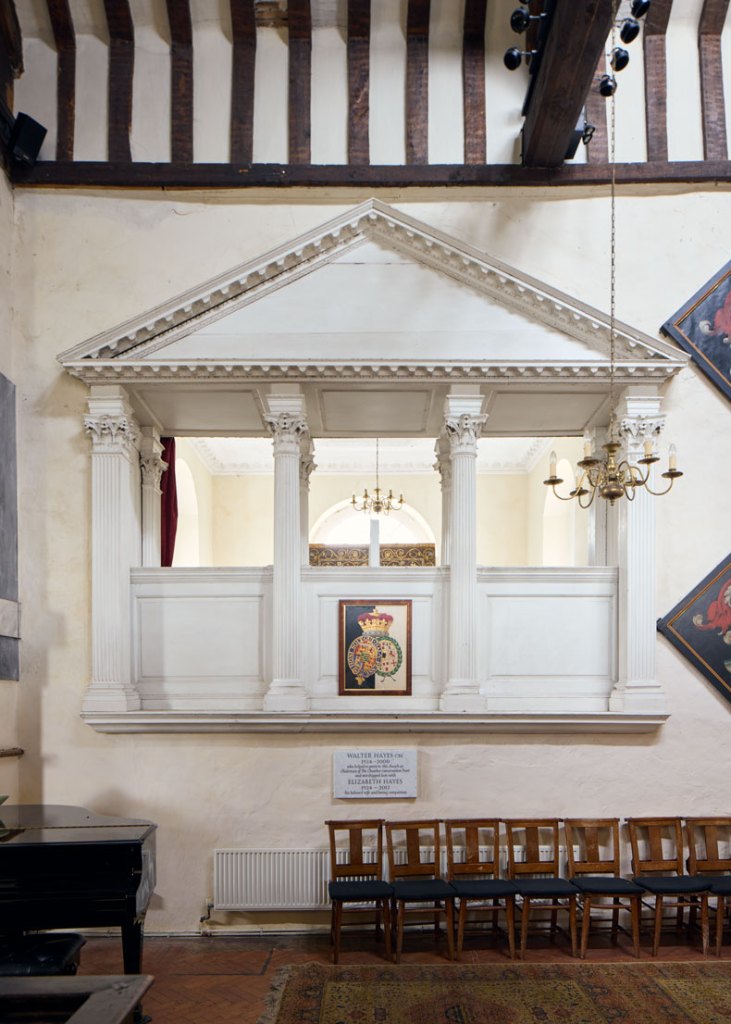
There was a delay in implementing the addition, because it was only in August 1724 that the Duke was granted a faculty to build a gallery pew and porch to the south of the church and, in April 1725, that the vestry agreed that ‘the Duke of Newcastle may beautify the Church according to his Grace’s pleasure’. The pew’s triangular pediment and the detailing of the columns are more conventionally classical than was normal for Vanbrugh, demonstrating that, late in his career, he was willing and able to design in a Palladian way if required, as demonstrated by the nearly contemporary Temple of the Four Winds (1724) at Castle Howard.
It is assumed that the fine triple-deck pulpit that stands in the main body of the church immediately in front of the Newcastle Pew was constructed at the same time; meaning that, even if the pew’s occupants could not see much of the service, they could at least see the sermon being given, and hear it clearly. The fine carved wooden reredos is in the same style as the pulpit, so it is likely that they would have all be done at the same time, although not necessarily all designed by Vanbrugh.
The scale of the side chapel allowed not only the Newcastles, their guests and staff to attend morning service, but also the duke’s younger brother, Henry Pelham, who in 1729 bought Esher Place nearby and had it done up by William Kent. Influential Whig politicians, the brothers would both serve significant terms as prime minister in subsequent decades – 18 years between them.
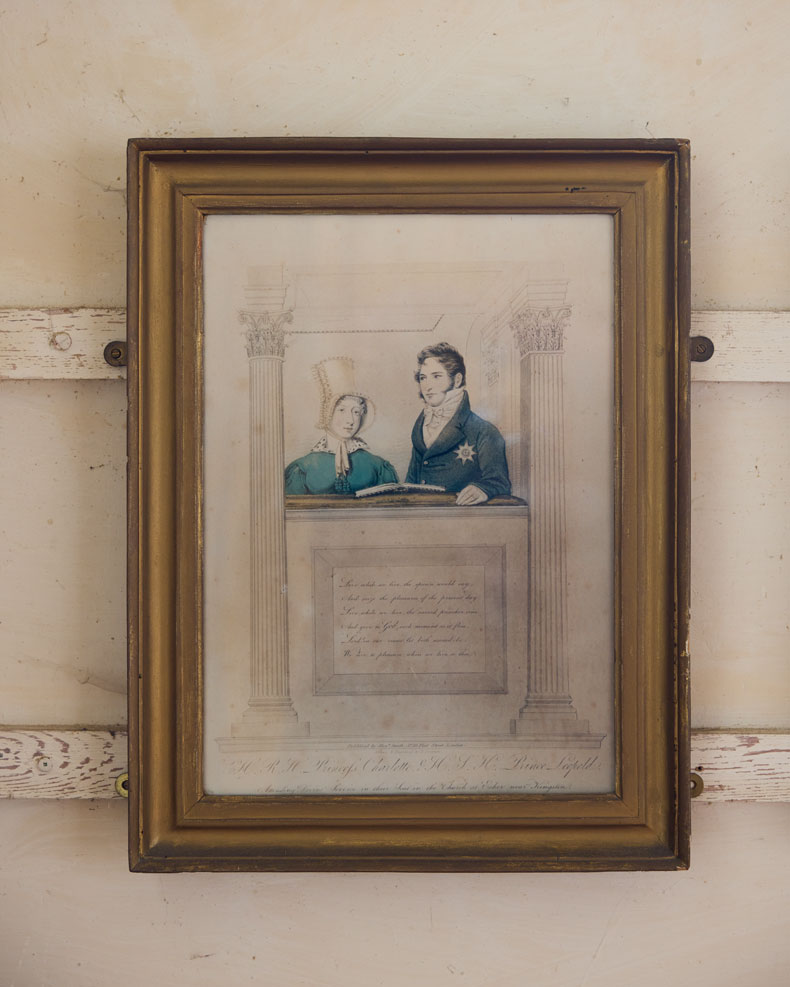
The use of the Newcastle Pew use by grandees continued well beyond the Pelhams. After Vanbrugh’s great mansion at Claremont had been sold by the Duchess of Newcastle to Robert Clive and replaced by a Palladian house designed by Capability Brown and Henry Holland, it passed to Princess Charlotte, daughter of George IV, and Prince Leopold of Saxe-Coburg, who were given it as wedding present in 1816.
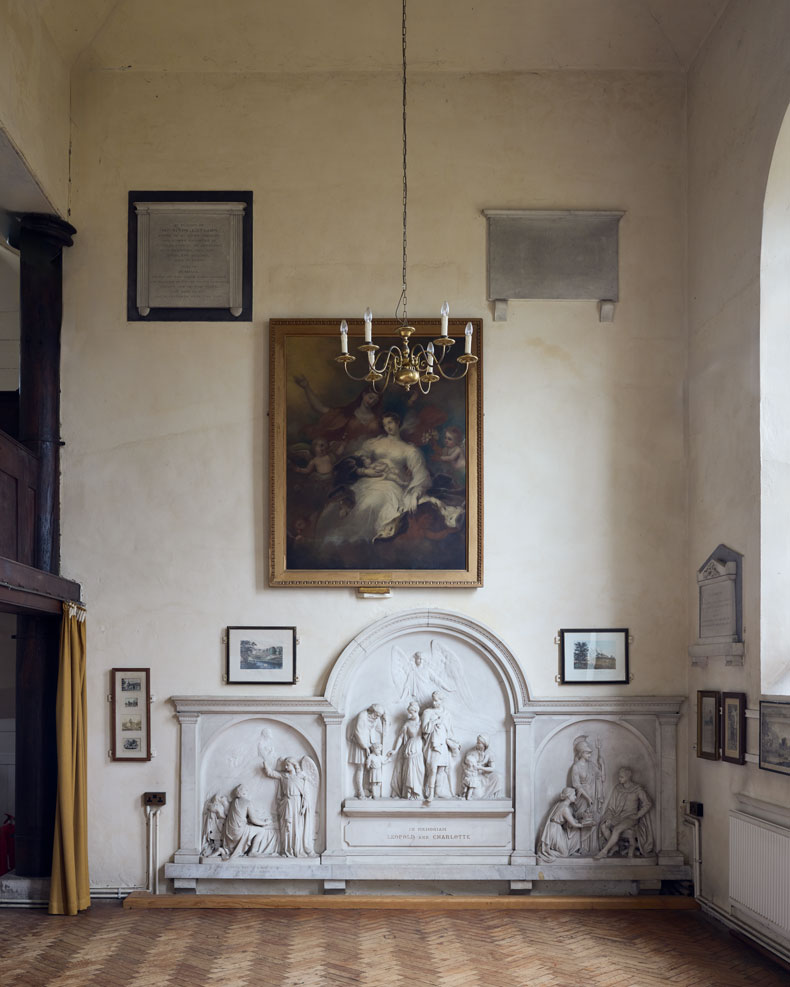
Charlotte’s time there was tragically brief – she died in 1817 in childbirth, at the age of 21. Leopold, however, stayed on at Claremont, hosting his young niece, the future Queen Victoria, who went on to use it as a country retreat in the early years of her reign (and who would certainly, on various occasions, have occupied the Newcastle Pew at St George’s). It was Victoria who in 1870 commissioned the magnificent marble monument to Charlotte and Leopold by Francis John Williamson that occupies the church’s north aisle; the queen commissioned it for Claremont, where it hung on the main staircase, before it was moved to St George’s in 1910. After lending Claremont to the exiled Louis Philippe after 1848, Queen Victoria gave the house in 1882 to her youngest son, the Duke of Albany. In 1931, it was turned into a school. The Newcastle Pew must have been sat in by more members of the royal family than any small parish church apart perhaps from Sandringham.
From the March 2026 issue of Apollo.
John Vanbrugh: The Drama of Architecture by Charles Saumarez Smith is published by Lund Humphries.
‘Vanbrugh: The Drama of Architecture’ is at Sir John Soane’s Museum, London, from 4 March to 28 June | St George’s Church, Esher, is vested in the Churches Conservation Trust, the national charity saving historic churches at risk.