From the January 2026 issue of Apollo. Preview and subscribe here.
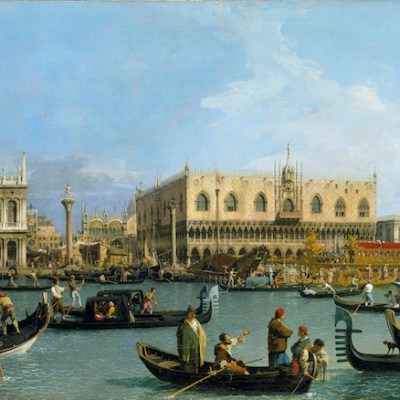
On 1 July 2025 Christie’s sold Canaletto’s Venice, the Return of the Bucintoro on Ascension Day (c. 1731/32) – once owned by Sir Robert Walpole – for £31.9m, setting the auction record for the artist and breaking the record for a Venetian view, or veduta. That record had been held since 2011 by a large canvas by Canaletto’s younger contemporary Francesco Guardi, Venice, a View of the Rialto Bridge, Looking North, from the Fondamenta del Carbon (c. 1768), which fetched £26.7m at Sotheby’s London in 2011.
Venetian vedute have always done well in London. The five bidders over £20 million for this picture, which was backed by both auction house and third-party guarantees, came from Asia, Europe and North America, but it was the English who first developed the taste for them, often through the Grand Tour, which began in the 17th century. Although in decline morally, financially and politically, Venice was then, in the words of Christopher Apostle, head of Old Masters at Sotheby’s, ‘still a cultural powerhouse and a magnet for artists, connoisseurs and collectors from all over Europe. As a result, you get a very robust Venetian style, not just in paintings but in all the arts.’ Among its artists were the late 17th- and early 18th-century mythological and history painters Sebastiano Ricci and Giovanni Antonio Pellegrini, with Giambattista Tiepolo the leading figure in large-scale figurative painting in the late 18th century. Landscapes by Marco Ricci (Sebastiano’s nephew) and Francesco Zuccarelli were popular, but most sought-after by the British were paintings of Venice and its surroundings, a genre first taken seriously by the Udine-born painter Luca Carlevarijs at the turn of the 18th century and introduced to the tourists by the collector and merchant banker Joseph Smith. Smith quickly identified a lucrative market, encouraging Zuccarelli and the architect and draughtsman Antonio Visentini to include idealised versions of British Palladian mansions in their capricci (fantastical architectural paintings). Above all, Smith identified the talent of the young Giovanni Antonio Canal, called Il Canaletto, facilitating lucrative sales to and commissions from British aristocrats passing through Venice and from around 1729–35 acting as his agent. He further boosted Canaletto’s popularity by commissioning Visentini to engrave 38 views by the artist in 1730. And, in 1746, since the War of the Austrian Succession was making travel to Venice increasingly difficult, Smith encouraged Canaletto to go to England and work for patrons there. As the British Consul in Venice from 1744 until 1760, Smith sold the majority of his own collection, including paintings by Canaletto, to the young George III in 1762.
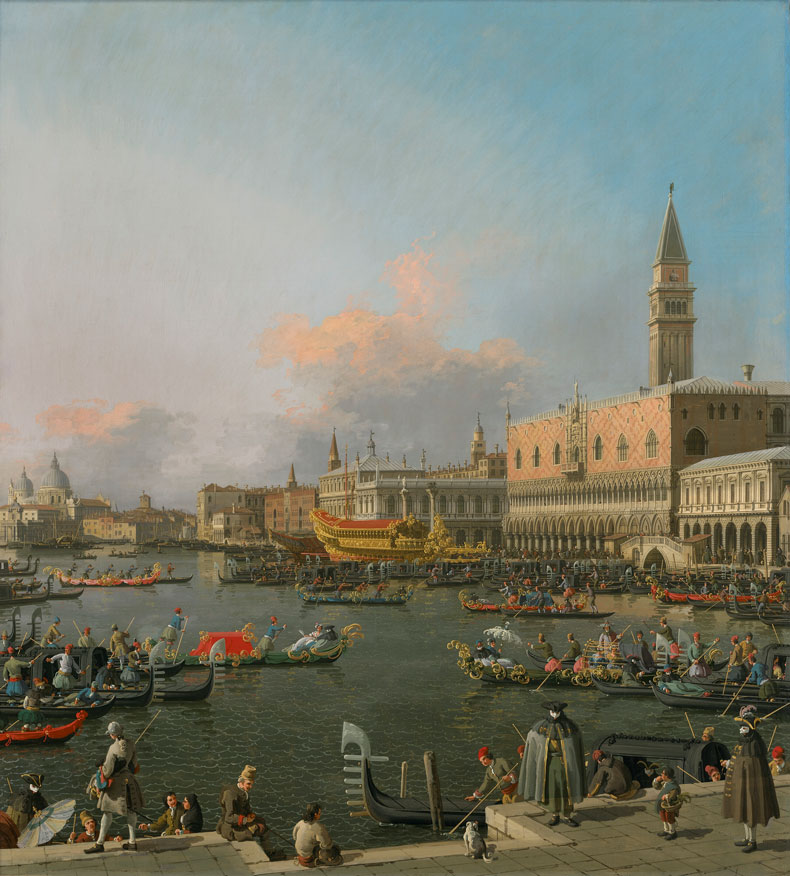
Today it is still the best of these sparkling views of the city that lead the market for 18th-century Venetian paintings internationally. The most sought-after Canalettos are usually early vedute or rare and exceptional works such as the theatrical Venice, the Bucintoro at the Molo on Ascension Day (c. 1754), set to lead Christie’s Old Masters sale in New York in February, expected to fetch around $30m. This work, the last version of the subject first painted by Canaletto in 1731–32, was commissioned around 1754 by the Earls of Lovelace and executed while the artist was in England. As Andrew Fletcher, Christie’s global head of Old Masters, puts it, ‘Canaletto is one of those artists that has never fallen out of favour. They are so easy to understand, easy on the eye and visually impactful reminders of somewhere everybody loves.’ They often appeal to collectors across traditional collecting categories: Fletcher says that ‘every one of those five bidders last July was principally active in the field of modern art’. For him, the eager bidding in the summer reflects a newly energised Old Master market more generally, even if this may not be reflected in auction sales figures. Whereas the value of the Old Master market used to be made up of roughly 20 per cent private sales and 80 per cent public auctions, now that ratio is closer to 50/50. The strength within that market of Venetian pictures was signalled in 2017 when Christie’s sold Guardi’s magnificent Venice: the Rialto Bridge with the Palazzo dei Camerlenghi, the pendant to the Sotheby’s picture, for £26.2m. It was the second-highest priced Old Master that year, eclipsed only by Salvator Mundi, attributed to Leonardo da Vinci.
Charles Beddington, an expert and dealer in Venetian painting, is more cautious. He says, ‘At the moment there is a lot of demand for Canaletto. But people do not want a nice Guardi.’ There is, however, still demand for a great Guardi of a popular subject. He came to the fore in Venice during the period when Canaletto was in England, at first influenced by his predecessor but later developing his own style. Beddington cites the artist’s atmospheric Venice, the Bacino di San Marco, with the Piazzetta and the Doge’s Palace (c. 1780), from the collection of Baron Henri de Rothschild, which sold for £9.9m against an estimate of £8–10m at Christie’s London in 2014. ‘They sell to a slightly different client,’ he suggests, have a wide price range and are particularly popular in France. He says that the market in views by Michele Marieschi is lacklustre and that works by the Dutch-born painter Gaspar van Wittel, known as Vanvitelli, are less sought-after, owing to a dip in demand from Italian private collectors, though ‘very good ones do still achieve high prices’. He will offer a Vanvitelli for £400,000 at TEFAF Maastricht this year at his Venice-themed stand. Despite the disappointing result at Christie’s London in 2021 for View of Verona with the Ponte delle Navi (1745–47), by Canaletto’s nephew Bernardo Bellotto, which fetched £10.6m against a lower estimate of £12m, Beddington says that ‘people are actively looking for Venetian-period Bellottos’ – from before he left Italy in 1747 aged just 25. His View of the Campo and Church of Santa Maria Formosa (before 1740) sold for $3.4m at Sotheby’s New York in October 2020 (estimate $3m–$5m). His early Venice, The Grand Canal looking North from the Rialto Bridge (c. 1738), however, estimated conservatively, achieved £1.2m on 2 December at Christie’s London – down from the £2m it achieved as recently as 2017 at Sotheby’s London.
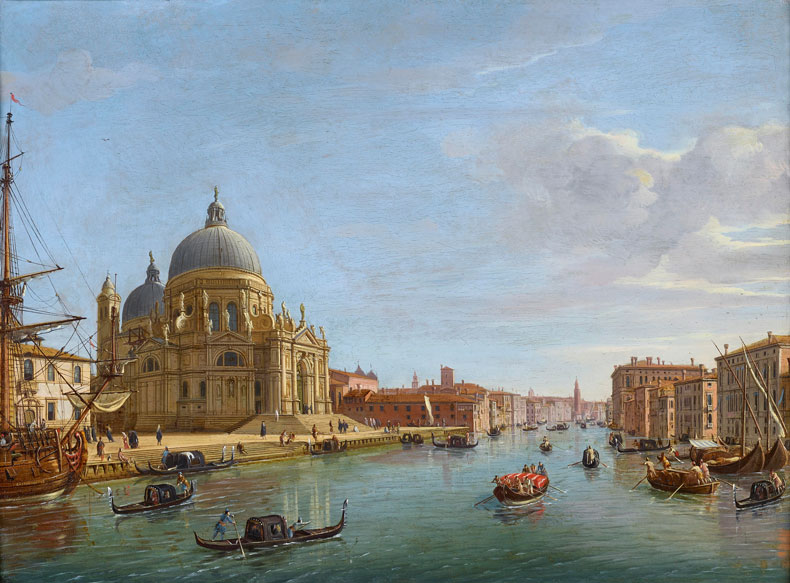
Cesare Lampronti, of Hartford Fine Art Lampronti Gallery in London, confirms that the hierarchy of Canaletto, Bellotto, Guardi, with Marieschi, Carlevarijs and others behind, has remained since the 18th century. Generally, he says, Venetian views have not suffered the decline in popularity of other Old Masters. Rarity and the popularity of the specific view – the Rialto Bridge, for instance, or St Mark’s Square – boost value in this field. While Italian collectors used to be strong in this market, today it is much more international. Lampronti will take a work from Canaletto’s London period, Capriccio of Piazza San Marco from San Marco Basin with the church of the Redentore (1744–45), to BRAFA at the end of this month.
Carlucci Gallery in Rome will also show a Venetian veduta at BRAFA: A view of Piazza San Marco (n.d.), attributed to Francesco Albotto. The gallery’s co-director, Marco Lafuenti, suggests that beyond the major vedutisti there is a modest market for works by 18th-century Venetians such as Pietro Longhi, the Riccis and Rosalba Carriera, whose pastels are highly sought after in certain markets. He says that the gap between the most highly valued works and the rest is growing: ‘There has been a shift away from speculative buying toward more discerning, connoisseur-driven collecting. Collectors today value quality, provenance, condition and rarity over “flipping”. As a result, works that don’t meet high standards (secondary studio pieces, or those with poor provenance or uncertain attribution) have a harder time finding buyers, or sell at relatively modest prices.’
Christopher Apostle adds that besides Carriera, there is also interest among keen collectors in the intense late baroque paintings of Giulia Lama. However, ‘Of the figural painters in Venice in the 18th century, first place must go to Tiepolo. A masterpiece by Tiepolo would be highly desirable on the current market.’
From the January 2026 issue of Apollo. Preview and subscribe here.