From the June 2026 issue of Apollo.
In post-war Vienna, soldiers from the Royal Engineers dug a tunnel beneath the cellar of a boarded-up shop on Aspernstrasse, near the main rail freight line. It had been reported that Soviet cables from the Red Army’s HQ ran through the British sector of the occupied city and so the British decided to establish a clandestine listening post there, codenamed Smokey Joe’s, in order to gain an advantage in the Cold War. All the excavated soil was transported to a large modernist house in the Hietzing district, not far from the British army’s main barracks in Schönbrunn Palace, which was rented by another Intelligence Corps unit and used as a Field Security Station.
The striking villa at Wenzgasse 12, one of the finest examples of Viennese modernism, was hardly an inconspicuous place for a Field Security Station, but it had a sizeable garden where the earth could be hidden. The house had been designed by the architects Josef Frank and Oskar Wlach in 1930 for Julius Beer, managing director of a company specialising in rubber-soled shoes, and his wife Margarethe, a pianist trained at the Vienna Conservatory. Like Frank, the Beers were members of Vienna’s liberal Jewish community, and helped finance Hietzinger Synagogue, completed the following year just around the corner, also in the modernist style (it was destroyed soon after the Anschluss in the Nazi pogroms of November 1938).
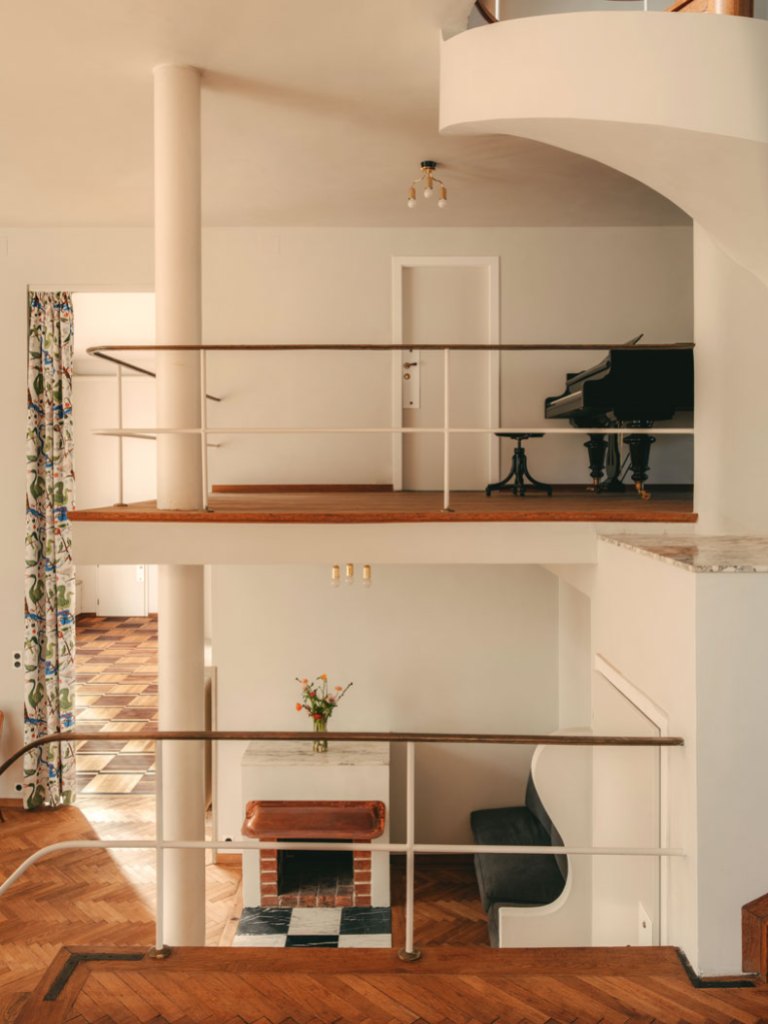
The asymmetric facade of Villa Beer, which has recently been restored and opened to the public after years of neglect, features a large porthole window on a two-storey projecting volume, under which was once a red lacquered front door. A portico over the equally grand servants’ entrance resembles a sentry box. One enters the house through a small antechamber, a cloakroom dominated by a large round mirror that echoes the window above, and an unassuming door leads into a dramatic double-height space dominated by an enormous bay window giving on to the garden. The central hall, with its botanical curtains, has the irregular geometry of an artist’s studio: ‘The modern house aims to liberate people from their plain bourgeois prejudices and to give them the possibility of a bohemian life,’ Frank promised.
Frank, who did his doctorate on Leon Battista Alberti, designed the house as if it were a pre-modern city, and the double-height hall was intended as a central square from which one could easily navigate the rest. ‘A well laid-out house,’ he wrote in his essay ‘The House as Path and Place’ (1931), ‘is similar to one of those old towns, in which the stranger knows his way instantly, and in which he can find the town hall and market square without even having to ask for it.’ On a mezzanine that juts out above was Margarethe’s Bösendorfer grand piano and one can imagine the villa, with its sweeping staircase and succession of spatial surprises, filled with music and light.
‘The Beers are already living in the house and have furnished it like a corner grocery,’ Frank wrote in September 1930, only a year after breaking ground. ‘It’s good that they have a son who breaks a lot of the art, there is still plenty left.’ In the official architectural images that were published of the house, the walls are empty and there is little trace of the Beers’ three children. However, despite the snobbery, Frank was not a dogmatic formalist or functionalist. He was the only Austrian architect to have been invited by Mies van der Rohe to participate in the Stuttgart Weissenhof Estate built for the Deutscher Werkbund exhibition of 1927. His interiors there, with their floral furnishings, were seen as provocatively conservative compared to the tubular steel aesthetic of his peers, and were dismissed as ‘Frank’s bordello’.
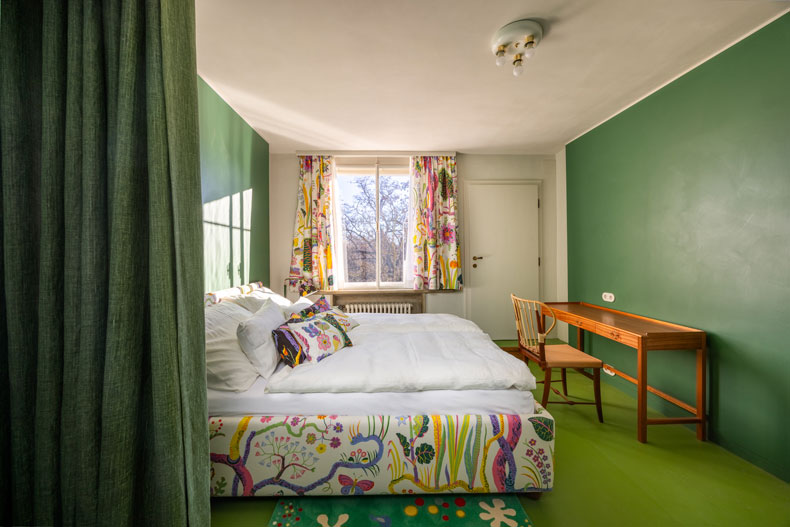
Villa Beer was the largest private commission for Frank and Wlach, who had together established the prolific design agency Haus & Garten. At the same time as building it, Frank was overseeing the construction of the Vienna Werkbundsiedlung, a modernist model housing estate only a couple of miles away that similarly expressed his critical stance to the International Style. ‘Every human being needs a certain degree of sentimentality to feel free,’ Frank said, arguing against the modernist puritanism that made exhausting moral demands of objects. ‘Every great work of art must skirt the edge of kitsch.’ Frank designed his comfortable interiors, with their oriental carpets and easy chairs decorated in flamboyant, organic textiles, to evoke the ‘unbelievably soothing effect’ of bygone eras, casually layering objects so that they looked assembled by chance (in 1958 he would label his aesthetic ‘accidentalism’).
The Beers’ tenure was short-lived. In 1932, Julius Beer lost his job and the family tried unsuccessfully to sell the house. The following year, because of rising antisemitism in Austria, Frank left for Sweden, his wife’s home country; the couple emigrated to New York in 1941, but returned to Sweden after the war. To make ends meet the Beers rented the house to a succession of celebrities, including the opera singer Richard Tauber and his wife, the British actress Diana Napier, as well as to the Polish musical star Jan Kiepura and his wife, the actress Marta Eggerth. The house was repossessed in December 1938, but the Beers continued to live there until 1939, when they moved into a caretaker’s apartment in Eitelbergergasse.
Despite the exodus caused by the increasing persecution of Jewish people, the Beers stayed in Vienna as long as they could, hoping to secure a visa for their daughter, Liesl, who had impaired mobility because of polio. In May 1940, having secured free transport from the Vienna Jewish Association, the Beers left for Manhattan. Because of her disability, Liesl was denied entry to America and the family was forced to leave her behind. In 1981, all her older sister knew about her fate was that she had been taken to Minsk by train in 1942. Subsequent researchers of the Holocaust discovered that she left Vienna on Transport No. 23 with a thousand other Jews. After arriving in Minsk, they were transported in trucks to the Blagovshchina forest where they were shot by soldiers of the Waffen SS and left in freshly dug pits.
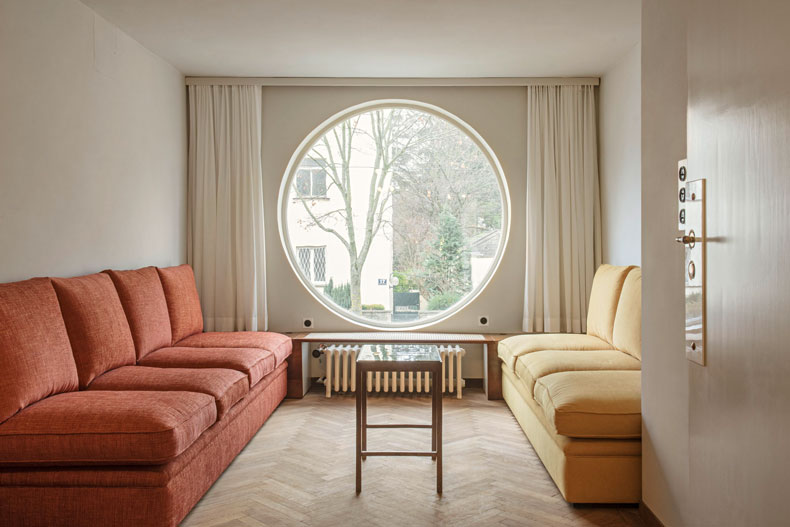
In 1941, having been vacant for a few years, Villa Beer and its contents were bought at auction by Hertha Pöschmann, the wife of a textile manufacturer. After the war, the British intelligence service rented it until the Austrian Republic was established in 1955. In 1987, after Frank’s work was rediscovered in his homeland, the house was declared a protected national monument. The Museum of Applied Arts and Design (MAK), which has many of the original furnishings from the house in its collection, considered turning it into a museum of modernism. In 2021 it was acquired by the philanthropist Lothar Trierenberg, who established the non-profit Villa Beer Foundation to oversee its meticulous restoration. All that was left of the British occupation of the house was a burnt circle of parquet flooring, where a makeshift stove had been added to the dining room.
From the June 2026 issue of Apollo.