From the May 2026 issue of Apollo.
I was ready to pan the Whitney Biennial until I saw it a second time. It was then I realised that the show is not an incoherent hodgepodge; it only feels like one. In recent years the only unifying factor in this exhibition, something like a State of the Union Address for American art, has been that the works included should be in some way about the United States. Now, even that qualifier has been abandoned as the curators’ definition of ‘American art’ is anything made by artists from ‘places marked by the broad reach of US power’. In other words, the whole world.
The theme is enough to provide some scaffolding to 56 artists working in every medium from planetarium shows to sculptures made of butter, but you have to work for it to make sense. Most of the works are installations – often taking over full rooms for single projects – making the exhibition more of a maze than a salon.
As I walked through, I had a hard time shaking a nagging checklist of US military conquests, as the work invoked one after another. José Maceda and Aki Onda’s chorus of retro radios play songs made with Filipino bamboo instruments – Philippines, check. Kainoa Gruspe’s sculptures made of scraps from golf courses and military bases in Hawaii – check. Anna Tsouhlarakis’s white fibreglass horse sculpture offers a not-so-subtle critique of Native American monuments – check.

If the curators pursued a more concerted argument, where each work of art built upon another, we might get somewhere. Instead, most of the works say nothing beyond the cliché that we live in unprecedented times. Michelle Lopez’s overhead video installation shows debris scattering in the wind to a soundtrack of sirens, alarms and other noises that fit its title, Pandemonium. It’s disorienting, but what kind of chaos does it refer to? Zach Blas’s CULTUS places a glowing orb in the centre of a pitch-black room, where a monstrous face talks about how it wishes to ‘suck’ and ‘slob’ and ‘pump’ you for its overlord. Blas wants to critique ‘the tech industry’s drive toward domination’, as the wall text says, but why fabricate a sex-addicted illuminati à la Eyes Wide Shut when there are real criticisms one can make of big tech?
Yet the fitful logic that characterises this year’s Whitney Biennial is representative of a certain strain in the American art scene. The exhibition feels like a high-production-value version of a basement show in Bushwick – so, in that sense, it does have its finger on the pulse. It is one of the only art shows I’ve been to where taking an Instagram break hasn’t felt like heresy. The best work is chronically online, wandering between the digital world and the real one.
Leo Castañeda’s video game, Camoflux Incendio Igapó 360, fixes the game controller so close to the screen that you can’t see anything else in your peripheral vision as you navigate a mystical swampland populated by frog people. A soundtrack of bubbling and rumbling completes the feeling of diving under water: full immersion in a fake natural environment. Erin Jane Nelson’s sculptures likewise blur the line between the virtual and the tactile. They look that way: misshapen, oozing stoneware decorated with dots and big eyes reminiscent of anime. They function that way as well, punctured with pinholes for cameras, allowing Nelson to compress any surroundings into photographs displayed on an adjacent wall so you never have to touch real grass.
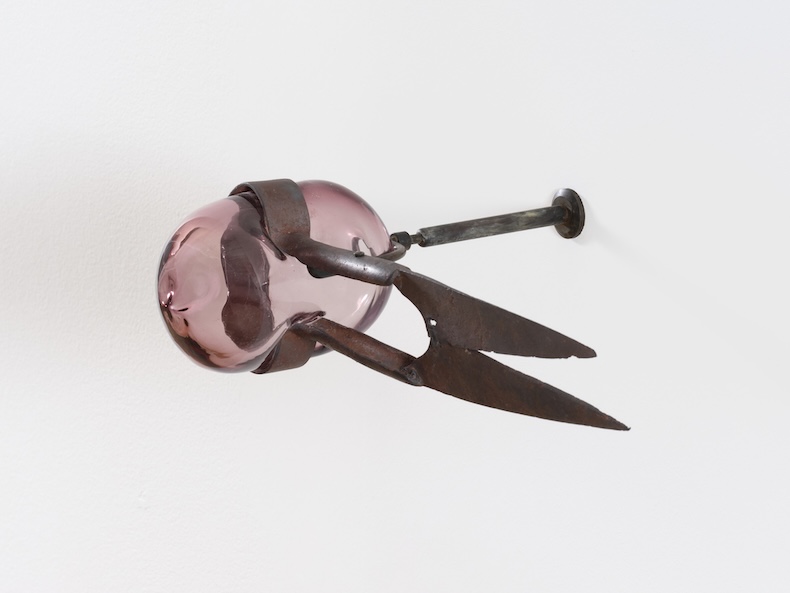
Sula Bermudez-Silverman’s hyper-sensual sculptures, where blown glass is constricted by callipers and scissors, feel like a pinch on the leg, a reminder that we still have bodies. Watching tools squeeze the glass lets us imagine the sensation of touching the soft rounded surfaces – with just enough violence to change their shapes and just enough care to keep them from shattering.
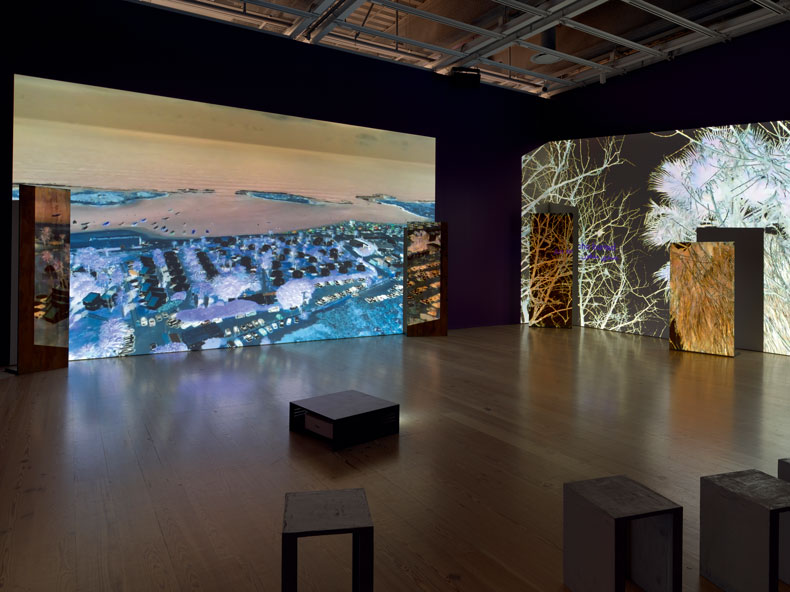
Basel Abbas and Ruanne Abou-Rahme’s Until we became fire and fire us invites viewers into a cavernous room with three simultaneous projections of videos taken during the war in Palestine – ceremonial dances, fires ablaze, flashes of branches and forest greenery. Sometimes the colours are inverted – dark eyes become a ghostly white, blue skies shine radioactive pink. The sound of a wailing siren intensifies and wanes. Poems in English and Arabic pepper the screens, asking what is lost when a civilisation is razed: ‘our bodies rooted in the land’. Rootless as I was – standing in a white cube in Chelsea – the conflict felt more palpable there than anywhere else in the show.
But 20-minute workout (WIP) by the film collective kekahi wahi and Bradley Capello quickly dismisses anything sacred, as a woman in pink spandex thrusts her hips into the air and spreads her legs, instructing us to follow along. The film was shot at Kealakekua Bay, where the Hawaiian high chief Kalani‘ōpu‘u escaped capture by Captain Cook. Now we have to escape TikTok tourist hell.
Just steps away, Isabelle Frances McGuire’s Satan in America and Other Invisible Evils: Experiments in Public Sculpture – epoxy resin sculptures made from 3D medical scans of dead bodies – provides a sobering dose of mortality, but death, too, is folded into farce as McGuire pairs them with sculptures of sinuous red demons modelled after video-game characters that evoke death more successfully than the human bodies do. Cooper Jacoby’s Estate sculptures suggest that even death will not set us free. Doorbell intercoms with spherical cameras watch and react to their surroundings based on the impulses of an AI model trained on the social media posts of dead people. ‘You were my best friend,’ it said to me as the machine looked from left to right as if it were shaking its head.
If the dead can still talk and the digital world is more real than the physical one, what use are we, the living and breathing? The Biennial, at its best, forces us to confront such difficult questions. More could have been said. But the fact that this thread is left hanging – lost amid the noise of apocalyptic warnings and a world falling apart – is a nice analogy for where we find ourselves now.
The Whitney Biennial 2026 is at the Whitney Museum of American Art, New York, until 23 August.
From the May 2026 issue of Apollo.