From the June 2026 issue of Apollo.
Though Willem de Kooning ran with the Abstract Expressionists, in drawings such as Two Women’s Torsos the figurative was never far away, explain Kevin Salatino and Mel Becker Solomon of the Art Institute of Chicago.
When Willem de Kooning left Rotterdam for New York in 1926, stowing away on a freight ship crossing the Atlantic, the 22-year-old had three goals in mind: to play tennis, meet girls and make some money. He had apprenticed for a decorating firm back home and planned to do the same in the United States. But by the mid to late 1930s, after working as a house painter, a window-display designer and a magazine illustrator, he decided to focus on his own art.
A lover of art history, de Kooning was constantly at the Metropolitan Museum of Art, taking in Bruegel, the Le Nain brothers, Ingres and the many female sitters who appeared through the ages. He was a competitive man: besides Picasso, his chief rival, the ones to beat were Rembrandt, Rubens and Titian. Having trained at the Academy of Visual Arts and Technical Sciences in Rotterdam, he was well practised in refined, traditional portraits and, although he quickly tired of these in New York and began working on abstracted interiors instead, he couldn’t resist returning to the figure. After a period spent mainly depicting men – often using himself as a model, since he couldn’t afford to hire professionals – he fixed his attention on women, dissolving art-historical tropes to an almost absurd point of abstraction.
This method reached its apex in the summer of 1952. Staying at the home of the art dealer Leo Castelli in the Hamptons, de Kooning spent the warm months drawing on the porch. He painted a little, but mainly stuck with drawing, as he often did when he was on the road. From this period we have dozens of these heavily worked, vibrant drawings in pastel, a medium he used prolifically between the late 1940s and early 1950s, especially when drawing women. They’re filled with colours and layers and erasing and smudging.
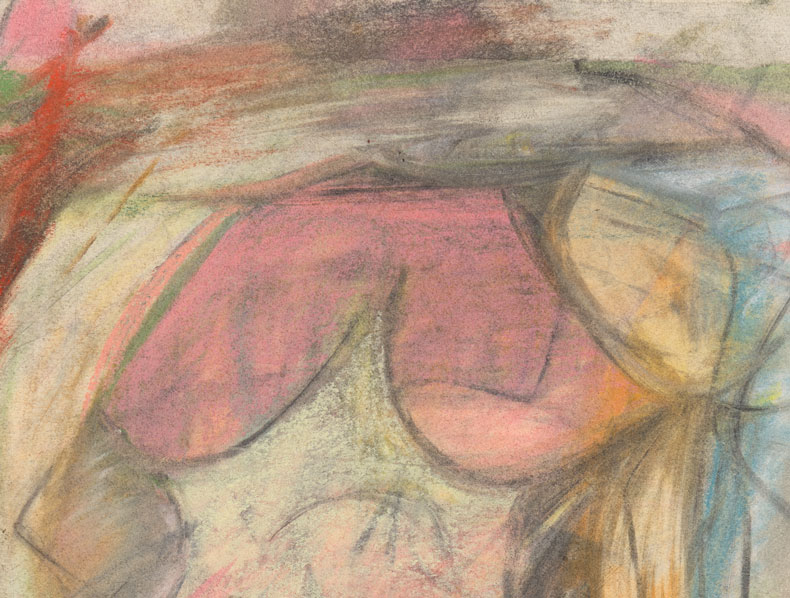
A year later, these works – as well as several large paintings also of women – were exhibited in ‘Willem de Kooning: Paintings on the Theme of the Woman’ at Sidney Janis Gallery in New York, which became a watershed moment in the artist’s career. Among the drawings is Two Women’s Torsos, which the Art Institute of Chicago (AIC) acquired from the gallery three years after it was made. The acquisition was led by Katharine Kuh, then the AIC’s curator of European art and sculpture, who also drove the purchase of de Kooning’s abstract painting Excavation (1950). There was a lot of pushback from the board, but Kuh knew how important these works were.
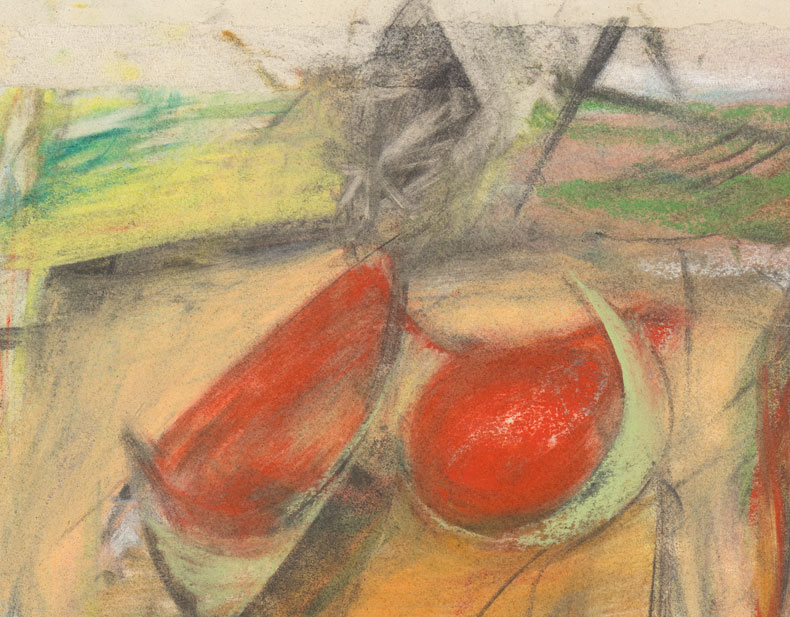
In this drawing de Kooning has used pastel, charcoal and graphite pencil. These are cheap, American-made pastels rather than fancy French ones, but he knew how to use them and how to avoid making them muddy on the page. Next to the right red breast of the figure on the left, there’s a passage of green that looks almost like paint. When we got it under the microscope we realised he’d made paint by combining pastel and fixative. The conservator working on the exhibition, Margaret Holben Ellis, made many discoveries, but this was the most fundamental – that de Kooning used fixative as a medium, not just to set. He always fixed his drawings, especially when using highly friable materials such as pastel, but realised that he could use the fixative to liquefy his materials and move them around with either a brush or his fingers. These watercolour-like passages appear across the drawing, especially on the left side.
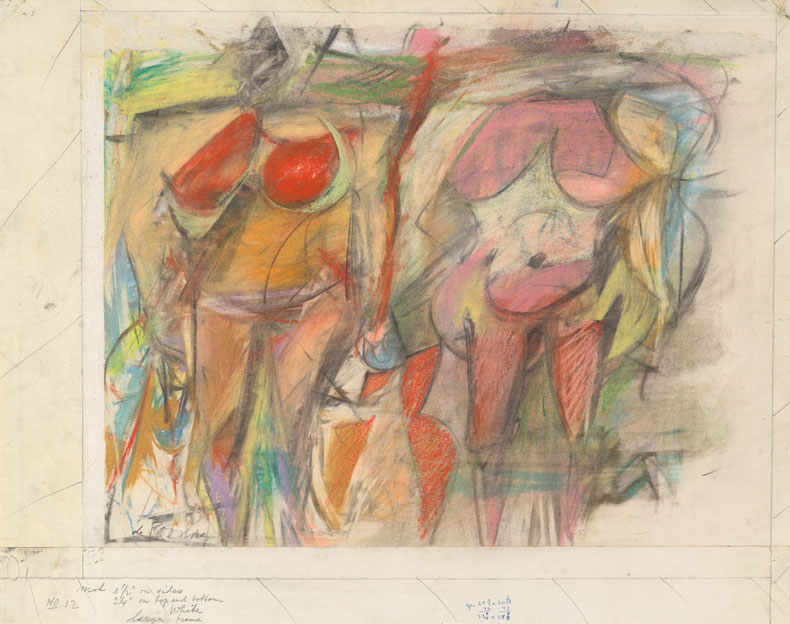
Electric green is set against orange, yellow against blue, and though the use of colour is incredibly creative – almost Fauvist – you never question the verisimilitude of the figures. They feel fleshy, corporeal. De Kooning once said that ‘flesh is the reason that oil painting was invented’, as the medium’s luminous qualities are well suited to capturing subtleties in colour and texture. He manipulated the materials in this work to obtain this quality. The woman on the left is a little more orange; perhaps she’s got more of a suntan. The woman on the right has this combination of pink colouring with a torso rendered in a whitish yellow. The bright tones hint at the women being in bathing suits at the beach, somewhere in East Hampton. We call this work Two Women’s Torsos but we’re not convinced that there isn’t a third figure: between the two women there seem to be a pair of legs and a head concealed by the red lightning bolt coming down the centre.
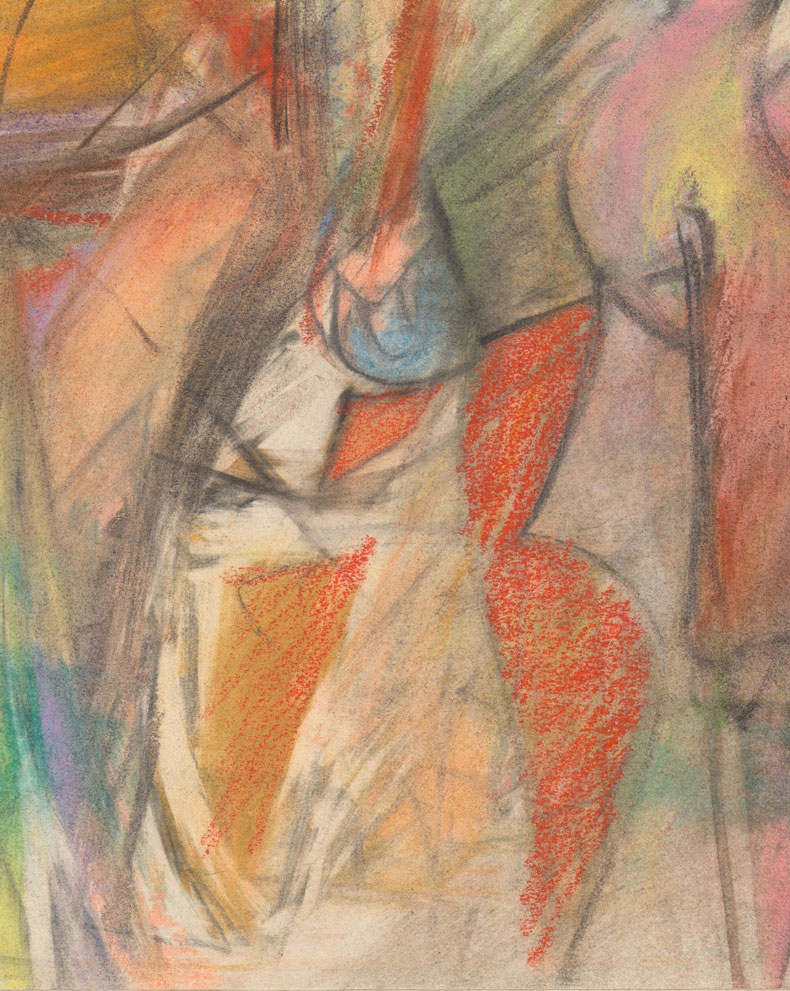
The composition really focuses on the body. The main two figures have only the most rudimentary heads, which gives them a powerful, idol-like quality, reminiscent of the Venus of Willendorf. But they’ve also got incredibly broad shoulders, like American football players. The bodies that materialise in de Kooning’s work are often ambiguous – sometimes they’re labelled as women, as he knew they would sell for more, but they’re very gender-fluid. An essay in the exhibition catalogue by Christa Noel Robbins – drawing on the work of fellow art historian Fionna Barber – acknowledges that while these works may be read as ‘mere traces of a misogynist mind’, they are much more than this. ‘You can’t always tell a man from a woman in my painting,’ de Kooning said in one interview; in another, he said that in an early phase of his practice, ‘Maybe […] I was painting the women in me.’ As Robbins puts it, ‘To deny the material rupture through which the theme of the woman is put in de Kooning’s practice is to deny the ambiguity that he names.’
Much like paintings such as Woman I (1950–52) – now held by the Museum of Modern Art in New York – which he scraped back over and over, Two Women’s Torsos shows de Kooning working in layers. Its several compositions are collapsed on to one another. Where the head would be on the figure on the right, there’s a lot of erasing. Eraser crumbs are embedded in the mixture of pastel and fixative. Under this are tiny pinholes. These are traces of another part of his practice: often, to figure out the composition, de Kooning would cut out parts of other drawings – a head he liked, a limb – and pin them on to the sheet he was working on. It’s like he’s playing with paper dolls, testing out what will look best. The bottom section of the drawing showing the figure’s feet, for example, has been sliced off and reattached backwards, controlling the composition.
This sense of control extends to the edges of the sheet, where small markings and notations specify exactly how he wanted the drawing to be presented. He had the mind of an ad man, informed by his experience as a commercial artist. He set out a window for the drawing, knowing it would be matted and framed. This isn’t the case in all of his drawings, many of which were done in notepads just to work out ideas, but you can see it in more finished works, where he wanted to see them the way he’d imagined them. We can’t say for sure that the framing notations are de Kooning’s, but they appear to be in his hand.
It’s often said that de Kooning didn’t make studies for his paintings, but that’s a bit misleading. He didn’t make preparatory drawings the way Raphael did, but his drawings were used as tools, working out an idea that may or may not have become a painting. Asking whether they were studies for a painting is inevitable – it’s the million-dollar question – but it’s the wrong thing to ask. These are finished works of art in themselves, though he did return to them when making later works. We know of at least one instance in which he sold a drawing and then said he needed to keep it in his studio to work from. Robert Rauschenberg took photos of de Kooning’s studio, and in one shot you can see a very finished Woman drawing placed in front of a Woman painting in progress. Clearly he’d worked something out in that drawing that he wanted to replicate.
He may have referred to Two Women’s Torsos in later works; in it he established a kind of resolution, something he also seemed to find in Woman I. He learned from Picasso that constant reinvention is the secret to success as an artist – not just professional success, but success at its core. Reinvention became his mantra. Once he solved a problem, he moved on.
Nowhere was this more evident than at the exhibition at Sidney Janis Gallery, where Two Women’s Torsos was first shown. At that point de Kooning had been known for a selection of black-and-white abstractions. Then he mounted this show filled with monumental women that verged on silliness, with their abstracted features and cartoon eyes and mouths. Critics and contemporaries were shocked: they had expected the black-and-white works but found intimidating women staring back at them in full colour.
People couldn’t understand why he was doing this when he’d received extraordinary kudos for those earlier works. During the Abstract Expressionist movement, in the mid 20th century, figuration was not looked upon kindly. The thing about de Kooning is that he didn’t really care. He did what he wanted to do, and hated ‘isms’ and being boxed in. When he found success, he was almost uncomfortable with it, and wary of the risk that it might lead to complacency. His artistic background was very different to that of most of his contemporaries – in Rotterdam he had trained in an academic tradition that had its origins in 17th-century France. He really was the last of the Old Master painters and saw himself as separate from the artists who were trying to break completely with the past.
That’s why you see imagery in his work that is inconsistent with what an American artist would have done during this period. It’s very de Kooning – he didn’t want to be defined, he didn’t want to be part of a team, and that’s truly what made him unique. He was closely linked to the Abstract Expressionist artists – Rothko, Newman, Krasner, Pollock, Frankenthaler – and they would often get together at the Cedar Tavern in Greenwich Village to discuss their work. But de Kooning rejected their attempts to identify what they were doing as a group.
De Kooning’s career continued for another four decades, until his death in 1997. His later works are characterised by abstraction but he never truly left the figure behind. Even in the busiest abstraction, you can spot an eye or a limb; what may have started as a hip is so altered by its fourteenth iteration that it no longer looks like a part of the human body, but it’s still there. It’s a visual vocabulary that endures.
As told to Lucy Waterson.
Kevin Salatino is chair and curator of prints and drawings at the Art Institute of Chicago. Mel Becker Solomon is associate research curator at the Art Institute of Chicago.
‘Willem de Kooning Drawing’ is at the Art Institute of Chicago from 14 June–20 September.
From the June 2026 issue of Apollo.