From the February 2026 issue of Apollo. Preview and subscribe here.
William Nicholson (1872–1949) has always been difficult to place in the history of 20th-century art, not least because the many movements that shaped that history seem to have passed him by. An exact contemporary of Aubrey Beardsley, and at one point seen as his successor as Britain’s leading graphic artist, he turned instead to painting, producing many striking portraits, superbly delineated landscapes and dazzling still lifes, until in 1945 persistent ill health forced him to stop working. In the 1920s, declining an invitation to become a Royal Academician, he wrote: ‘The idea of a label of any sort scares away from me all desire to paint,’ and his reluctance to theorise, or even talk about, painting has led in the past to his work being undervalued. The fact that his son Ben Nicholson became a leading figure in modernism and abstraction emphasised Nicholson’s own apparent artistic stasis as an essentially Edwardian figure.
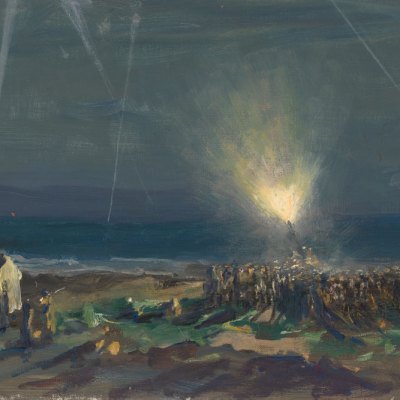
Among the many strengths of this exhibition at Pallant House is that it places Nicholson in context and shows the full range of his work, including graphic art, book illustration and theatrical costume design, alongside the paintings for which he is best known. His first success was An Alphabet (1897), a marvellously characterful series of coloured woodcuts published by William Heinemann, for whom he would go on to illustrate a number of books. This was followed by similar sets, notably London Types (1898), and Twelve Portraits (1899), which alongside depictions of such public figures as Queen Victoria and Gladstone included a witty likeness of Whistler. One of the earliest paintings in the exhibition, Lady in Yellow (1893), is both tonally and in its arrangement clearly indebted to the American artist. Although later portraits, particularly in their virtuosic painting of fabrics, suggest an affinity with Sargent, Whistler continued to be an important influence, notably in Armistice Night (1918), a distinctly uncelebratory and murky nocturne in black and grey, dominated by huge field guns and dimly illuminated by a spatter of white fireworks.
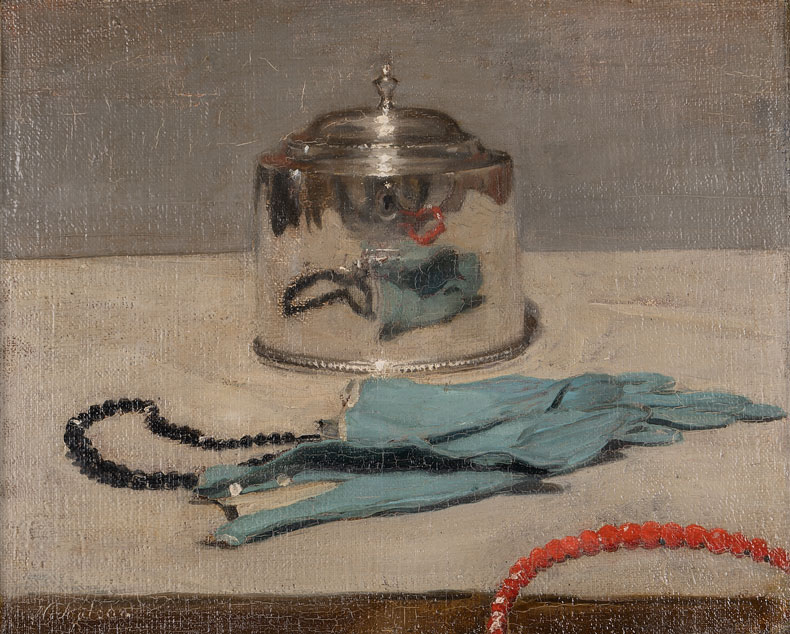
If generally untouched by trends in painting, Nicholson’s work often reflected the age in the same way his London Types did, with its late Victorian newsboys, barmaids, street hawkers and costermongers. He paid homage to leading literary figures of the 1890s in the shape of portraits of Max Beerbohm and J.M. Barrie, while the revival of interest in English folk traditions, led by Cecil Sharp in the early years of the 20th century, is marked by Nicholson’s paintings of some Oxfordshire morris men. Whereas the near monochrome palette used to portray the writers suggests a relationship with the woodcut portraits, colour bursts into Nicholson’s work in the morris men’s elaborate costumes, notably in the scarlet of their ribbons and rosettes, a colour he frequently used thereafter to dramatic effect, especially in such still lifes as Chairing the Feathers, Miss Simpson’s Boots and The Silver Casket (all 1919).
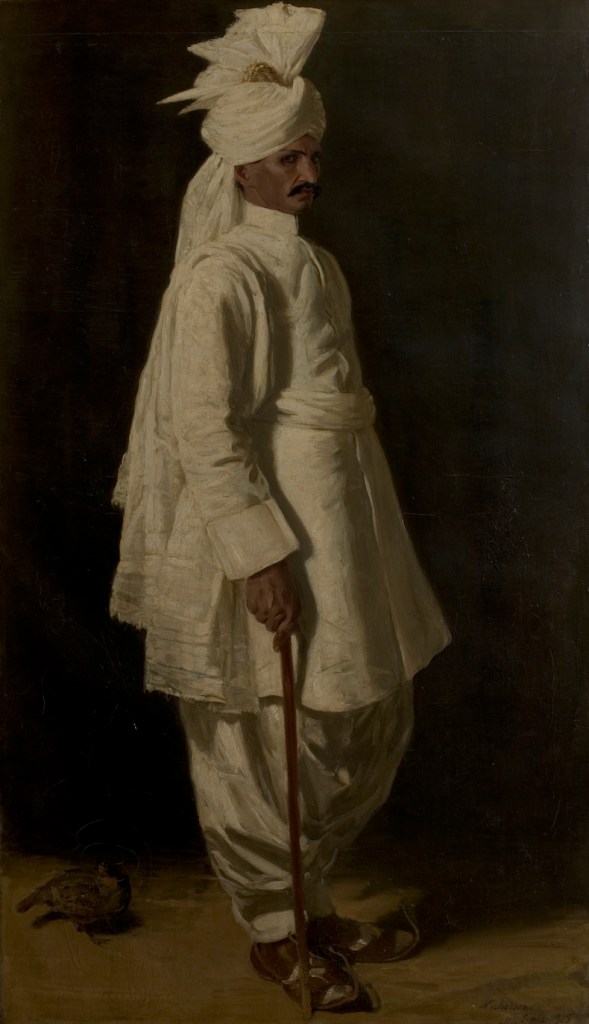
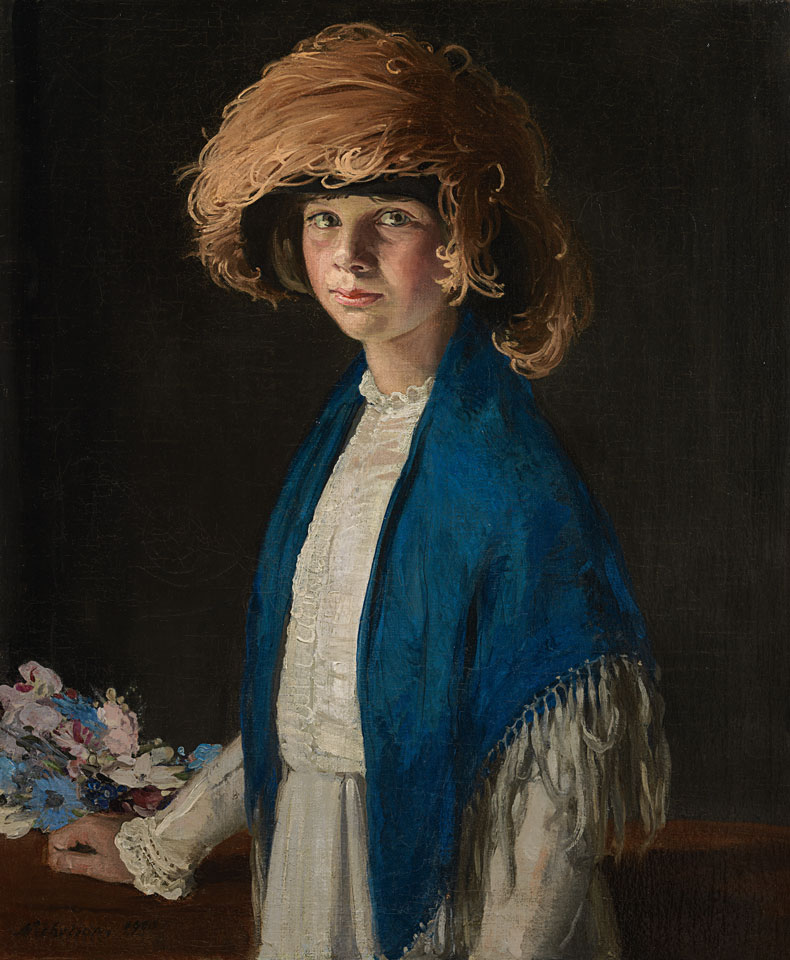
It may not have helped Nicholson’s reputation that he was as much a showman in his person as he was in his painting. He adopted early on the appearance of a dandy, favouring canary-coloured waistcoats and elaborately patterned dressing gowns, which perhaps gave the impression of a dilettante and flâneur rather than the serious artist he was. He also enjoyed dressing up his subjects, particularly children – the exhibition includes a spectacular and rarely seen portrait of his 11-year-old daughter Nancy in a bright blue shawl and a hat bedecked with gorgeous pink ostrich feathers (1910). The military-looking coat worn by the six- or seven-year-old Ben in an unfinished portrait of 1901 may not be as striking as the Highland costume he donned as a miniature laird for the closely related Hawking (1902), but nevertheless gives the picture a distinctly theatrical air. It is unsurprising that, commissioned in 1915 to produce a formal portrait of the frock-coated Viceroy of India, Viscount Hardinge, Nicholson had a much more enjoyable time, and much greater success, painting The Viceroy’s Orderly, in which Duffadar Valayat Shah is splendidly attired in traditional Punjabi dress topped by an elaborate white puggaree.
Nicholson’s many landscape paintings are well represented here. Those of the Sussex and Wiltshire Downs are particularly effective. Great sweeps of subdued greens, blues and greys economically and brilliantly evoke huge expanses of land and sky, their scale emphasised by the frequent inclusion of tiny figures dabbed in with a couple of brushstrokes, as in Snow in the Horseshoe (1927). Paintings of the English coast, such as Mending the Nets, Rottingdean (1909), are equally atmospheric; this work, with its minimally created but superlatively realised human figures set against wide bands of greys and browns, once again shows the influence of Whistler, particularly his paintings of the Thames.
An exhibition catalogue of the mid 1990s suggested that Nicholson had no further ambition than to ‘convey his pleasure in both what he is painting and in his ability to paint it’, rather as if technical skill and the giving of pleasure were disappointingly frivolous aims for a major artist. In fact, Nicholson’s deft rendering of the reflective surfaces of ceramics and metalware in such paintings as The Lustre Bowl with Green Peas (1911) and The Silver Casket and Red Leather Box (1920) is not only unrivalled in 20th-century art but brings out the ‘thisness’ of the objects, making them as much portraits as the ones he did of people. In this they resemble Miss Jekyll’s Gardening Boots (1920), which evokes the character of that doyenne of English horticulture even more than his conventional portrait of her does. That Nicholson was indeed a major artist was clear from Patricia Reed’s invaluable catalogue raisonné of the oil paintings (2011), which ran to 866 items. While a display on that scale would obviously be impossible for a gallery, the generous selection of Nicholson’s work at Pallant House confirms the artist’s stature, as well as providing a hugely pleasurable experience for the visitor.
‘William Nicholson’ is at Pallant House Gallery, Chichester, until 10 May.
From the February 2026 issue of Apollo. Preview and subscribe here.