From the November 2026 issue of Apollo.
Fifty columns ago, I began writing here about the relationship between wine and art. I wanted to investigate how they are intertwined through sensorial experience and how both build culture through sharing. The link between the two may seem like a recent marketing invention, but it reaches back thousands of years in representations of pleasure and abundance. Each can enrich the other – but wine is often shortchanged when the bill arrives.
What I have been trying to prove in this column is that wine is a cultural activity that both illustrates and carries creativity, rather than simply a consumable product. I’ve gathered evidence on countless vineyard journeys, from the pristine First Growth chateaux of Bordeaux, including the blue-chip art collection of Château Latour; to surreal cellars of chalk cut by Roman hands and those of pumice cut by a volcano (Ruinart’s crayères in Reims and Basilisco’s tunnels in Basilicata, respectively).
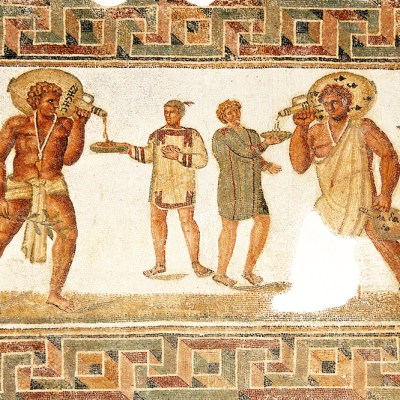
Wine has helped me time-travel to ancient Carthage, trying wines from grapes grown in the same terroir as that depicted in third-century mosaics in Tunis; and it has taken me to regions including Lebanon and Mexico, where producers use art to help explain their craft before the rest of the world has quite worked out which wine shop shelf to place them on. Art has proved useful in explaining wine just as wine has repeatedly proved useful as a way of explaining art.
The best wine requires the same sensorial apparatus we use to analyse art. The analogy can be stretched too far but not entirely dismissed. What has stayed with me is how unstable the idea of value can be in both. Wine and art share secondary markets, fashions, reputational economies, bubbles. Fine wine, like fine art, can operate as cultural artefact, investment, social signal and entry ticket to a community of the like-minded all at once.
The growth of art partnerships in wine has been impossible to miss. Since I began this column in April 2022, four Champagne houses, Ruinart, Perrier-Jouët, Moët & Chandon and Dom Pérignon, have produced at least 17 artist or designer limited editions, ranging from Jean-Michel Basquiat (posthumously) to Damien Hirst (a known teetotal now). Ruinart presents its annual artist commission at more than 30 international art fairs a year.
Charitable giving has followed a similar route, through what I call oenophilanthropy. In the past four years, there have been at least a dozen wine-led charity auctions at Sotheby’s, Christie’s and Bonhams benefiting artistic programmes, museums and artists, from Ornellaia’s ‘Vendemmia d’Artista’ sales for the Guggenheim to Christie’s ‘Barolo en Primeur’, which has paired successive vintages with artists including Michelangelo Pistoletto and Susan Philipsz. Artist-designed labels have supported causes ranging from Villa Lena’s residencies in Italy to education in South Africa through the Norval Foundation wine club.
All of this tells us that art has become extraordinarily useful to the wine industry. But, like art, wine needs responsible patronage. A winemaker, like an artist, is compelled to make something new and contribute to craft and heritage, even when the market is neither asking nor fairly paying for it. Connoisseurship is more than consumption: it means attention, respect, support and a willingness to pay for work made with intention and vision. We understand instinctively that artists need buyers and patrons if serious work is to survive. Wine needs them too.
We readily accept that a painting, building or piece of sculpture can embody human inspiration. Wine can do this too, yet it is still treated as an indulgence. Too often it is an afterthought for those same art lovers who support other creative forms through spending and collecting. Wine gathers value as it moves away from the vineyard, while the maker receives only a fraction of the final price (try less than 5 per cent). If connoisseurship means anything, it should extend to how that value is distributed. We need to ensure that cultural esteem is matched by economic reignition. Winemakers are artists (even if they don’t always like being called that), working around material constraints and contributing to creative history. Supporting worthy producers is part of cultural stewardship. I will continue to bring this Dionysian reminder to the Apollonian in many more columns to come.
From the November 2026 issue of Apollo.