From the June 2026 issue of Apollo.
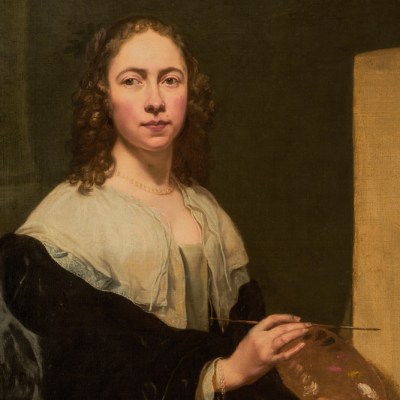
The Triumph of Bacchus (c. 1655–59) by Michaelina Wautier, currently on display at the Royal Academy in London, is full of flushed revellers and loose behaviour. On the far right of the painting, a female figure stands out, bare-chested and looking out to the viewer with a haughty gaze. This is the artist, setting herself apart from the scene but taking control of the Bacchanalian imagery.
The maenads (‘raving ones’) were female devotees of the god of wine, Dionysus (later Bacchus for the Romans). They became possessed after drinking wine and followed the god across the lands. What they drank was not the refined wine served at symposia; this was undiluted, raw, taken in volume, a dark and resinous liquid. To be a devotee meant to prance barefoot and wear animal pelts and unbound hair adorned with garlands of ivy and vine leaves.
Many male artists have unsurprisingly been drawn to the subject. Titian’s The Andrians (1523–26) is full of reclining female figures and vessels of wine. Rubens returned to the subject repeatedly, his Bacchantes tumbling across canvas after canvas, overturned cups and running wine amid tangled limbs. From Poussin to Picasso, there are countless painters who have tried to contain women going wild on canvas.
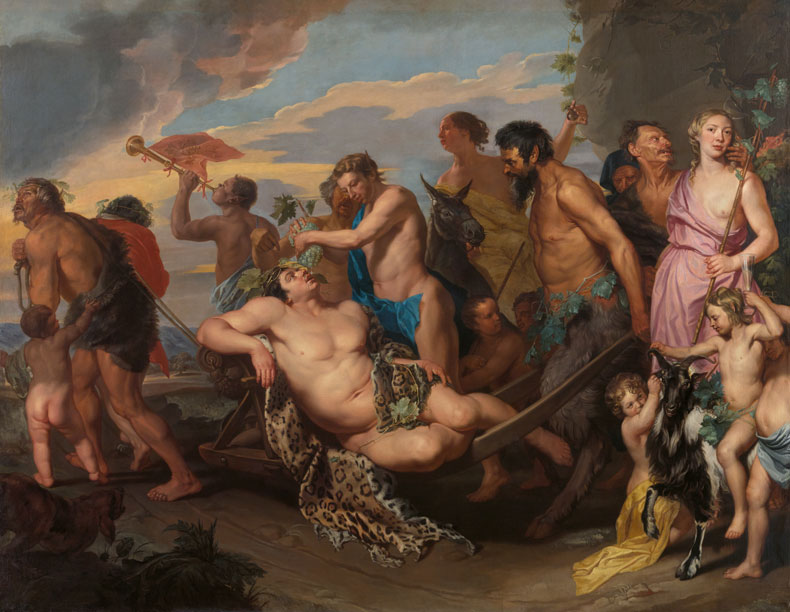
Wautier offers a slightly different vision of the bacchanal. With The Triumph of Bacchus, she became one of the first women artists to paint life-sized male nudes, at a time when women were barred from life-drawing classes. But her work is more than a riposte to male dominance. The maenads in Greek mythology were not outcasts but ordinary women who left homes and looms to join the band before going back to daily life. The rite was a process of departure and return. Does the fact that Wautier depicted herself as a maenad suggest that she saw painting as a suspension of ordinary life?
Angelica Kauffman, one of only two women among the Royal Academy’s founding members in 1768, approached Dionysian subjects with a controlled neoclassical style. Yet she too painted herself as a Bacchante in 1764. At just 23, she is dark-haired and composed but wearing the vine wreath, a memento of that other realm. Her Bacchantes (c. 1785) is also subversive despite its composure. Three women rest together under a tree, robed in airy tunics and garlanded with vine leaves. One of them carries Dionysus’s emblem, the thyrsus, a staff of fennel topped with a pine cone. In The Bacchae by Euripides, a messenger stumbles upon Theban women on the slopes of Cithaeron and watches one strike her thyrsus against the earth, from which wine then springs forth.
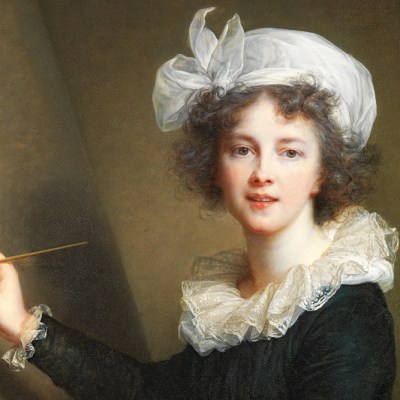
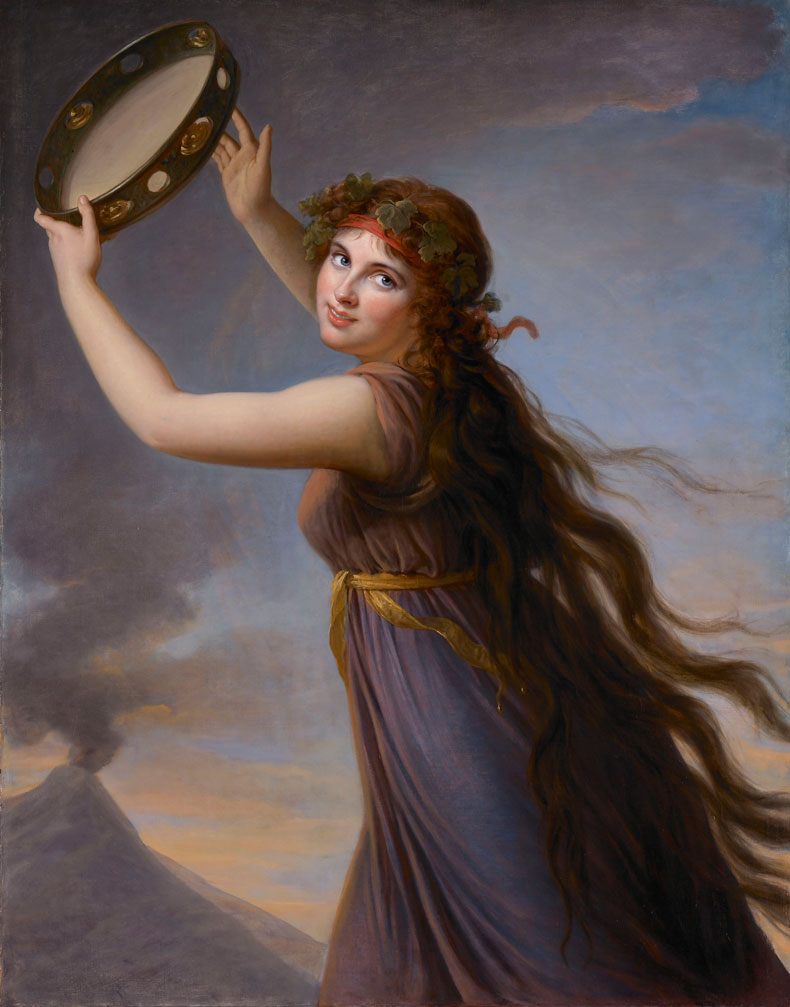
Élisabeth Vigée Le Brun returned to the subject several times. In her Bacchante (1785) at the Clark Art Institute in Williamstown, the figure is rosy-cheeked and jolly, with the garland of vines on her head. Another Bacchante from the same year, in the Musée Nissim de Camondo in Paris, takes a classical approach to the female form – long tumbling hair and ivory skin – but the leopard skin gestures to something more untamed. Lady Hamilton as a Bacchante (c. 1790–92), her portrait of Emma Hamilton, dancer and mistress of Nelson, also mixes poise and revelry. She is depicted dancing before the smoking silhouette of Vesuvius, a tambourine raised in one hand, her chestnut hair loose and moving below a garland of vine leaves and red headband. Seemingly in the process of turning away, Hamilton is neither fully herself nor fully myth, caught between her identity as a woman of high society and the Bacchante she is becoming.
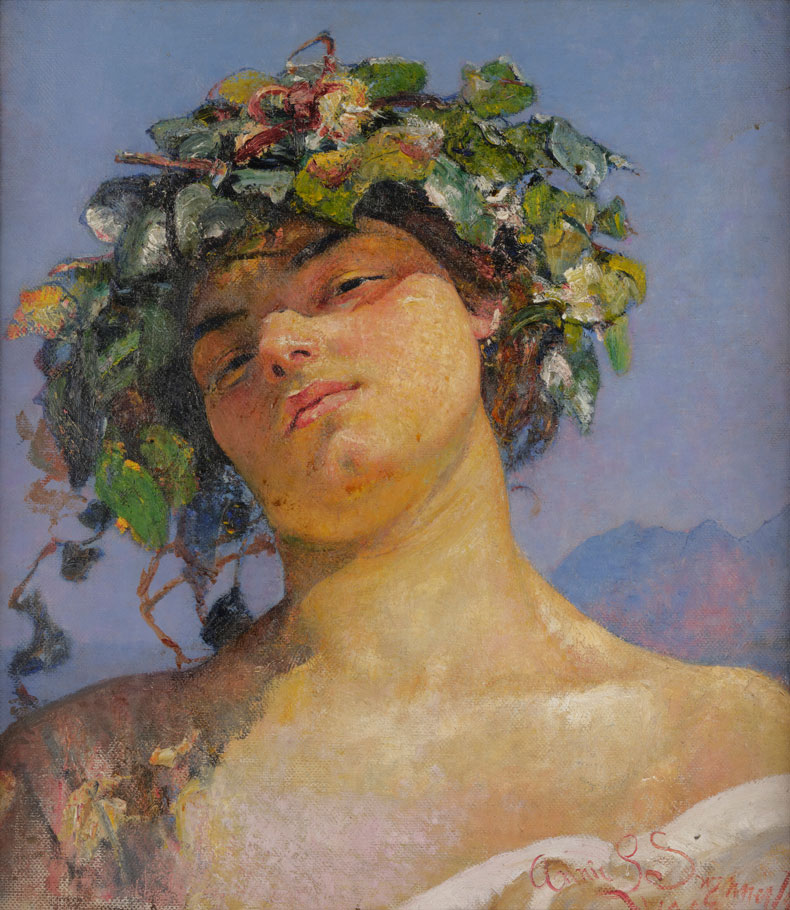
The figure of the maenad appears in work by women in the late 19th and early 20th century too: Evelyn De Morgan, for example, and Louise Abbéma, who painted Sarah Bernhardt, a friend and possibly lover, in this guise. Annie Louisa Swynnerton, who at the age of 78 became the first woman elected to the Royal Academy, painted Head of a Bacchante in 1903, which depicts a resting maenad. Euripides wrote of how, after the wine and frenzy and the culmination in sparagmos (the dismemberment of a human or animal that was said to accompany Bacchic ritual), the women wash the blood from themselves at the spring and lie back among the oak leaves.
Some sources claim that the early Bacchanalia were open only to women. So seriously did the Roman Senate take these gatherings that in 186 BC it passed legislation placing the entire cult under state control, requiring official permission for any rites to be held at all. The stated reason was fear of conspiracy. The real anxiety was surely simpler: a suspicion of women gathering and drinking, unsupervised, at night. When Wautier and artists after her took up the subject of the Bacchanalia, they too were performing this ancient ritual: drinking deeply, going into and coming back from the dark.
From the June 2026 issue of Apollo.