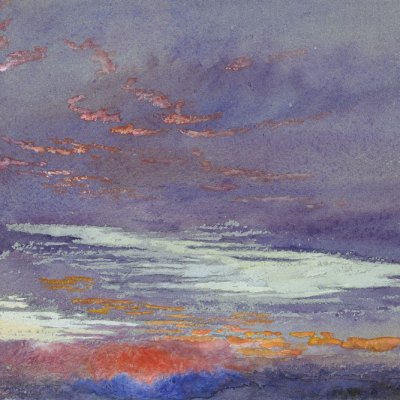
On his deathbed, J.M.W. Turner is said to have exclaimed: ‘The Sun is God.’ His painting Going to the Ball (1846) captures both the radiance of the sun and its associations with endings: it shows the sun, having burned its way down through the sky, about to set on a Venetian lagoon. It’s an intense example of sun-worship, and it shows the sun not as an orb but as a great glowing track of light spilling over the water, with the buildings on every side appearing to dissolve in a magical suspension of land and sea.
Going to the Ball is one of the works on show in ‘Yellow: Beyond Van Gogh’s Colour’ at the Van Gogh Museum in Amsterdam. Yellow has wide-ranging cultural signficance in the Netherlands, where the growth of yellow tulip and daffodil bulbs in the spring accounts for nearly three quarters of the world’s bulb trade; the colour symbolises the rebirth of the land. There is something melancholic, though, at the heart of this show: a palette made up of a spectrum of different yellows will lose some of its glow over time. Chrome yellow in particular, the dominant tone in Van Gogh’s Sunflowers (1889), will darken slowly and eventually grow dull. More than a century after the painting’s completion, that gives the canvas a look that is very different from the effect initially intended, which was to capture the onrush of vitality in nature that is kindled by the sun.
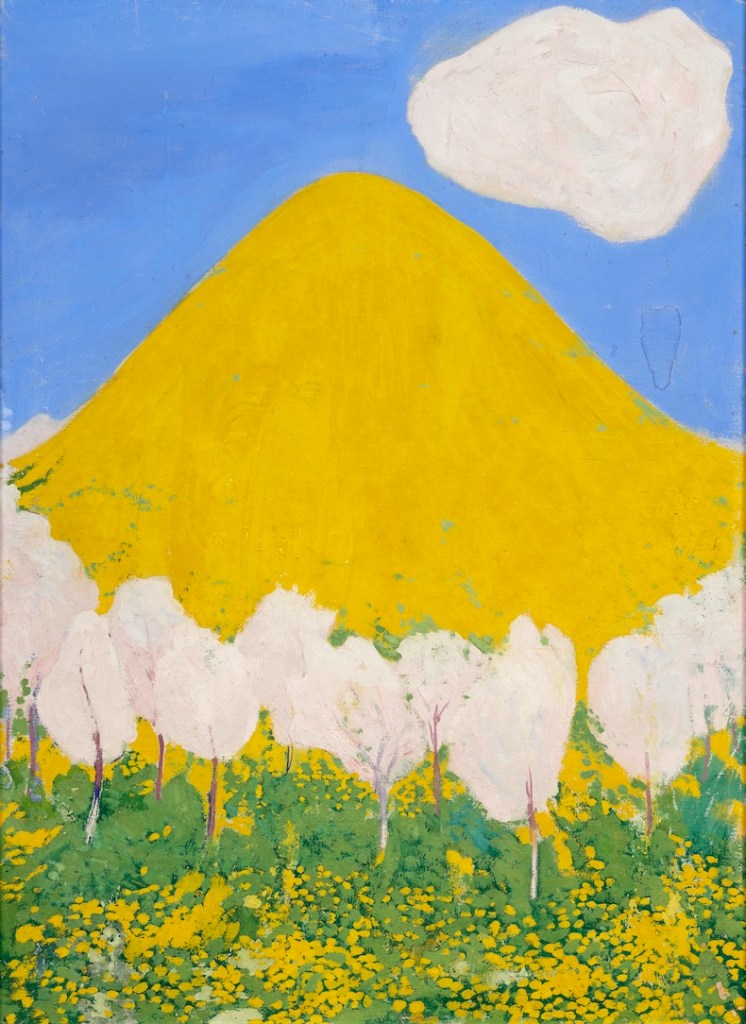
‘Yellow’ is a small, focused exhibition, but the range of styles of painting, artistic movements and media gives us an insight into the scope of artists’ obsession with yellow, particularly in the late 19th and early 20th centuries (the 1890s emerges as the yellowest decade of all). There are works here by artists including Chagall, Malevich, Kandinsky, Mondrian, Gauguin, Signac and Aubrey Beardsley, whose cover designs for The Yellow Book are on show, as well as examples of ‘yellowback’ novels – cheap 19th-century paperbacks that were regarded as synonymous with decadence and immorality. There is even a sample of yellow wallpaper produced by William Morris’s company, allowing the curators, Edwin Becker and Ann Blokland, to draw a connection with Charlotte Perkins Gilman’s genuinely terrifying story ‘The Yellow Wallpaper’ (1892), in which the protagonist, driven mad by the restrictions of her marital life, becomes convinced that there is another woman – an alter ego – trapped behind the wallpaper in her bedroom. Russian artists of the early 20th century are also represented, but they are guest appearances in what is fundamentally a northern European affair. Van Gogh comprises the bedrock of the show, of course, just as yellow was the most frequently used colour in his palette.
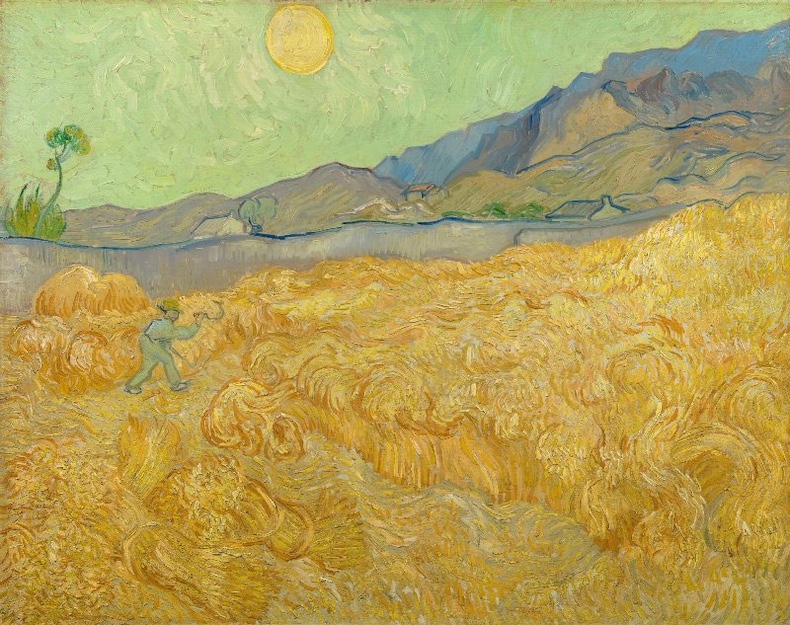
Think of a Van Gogh landscape painting and the chances are that a field full of golden wheat will spring to mind. In Wheatfield (1888) the crop takes up perhaps seven eighths of the painting, with a red-roofed white building, a distant line of hills and a few isolated poplars squeezed into the narrow horizontal band at the top of the canvas. Wheatfield with a Reaper, painted the following year, allows more space in the background for a strip of lake, a line of hills and a distant blue mountain ridge, but the lower two thirds consist of a great stormy sea of wheat, with the sheaves cresting and tumbling under their own weight. There’s a solitary blue-overalled reaper waving a sickle, but he is no match for the great yellow turbulence in front of him.
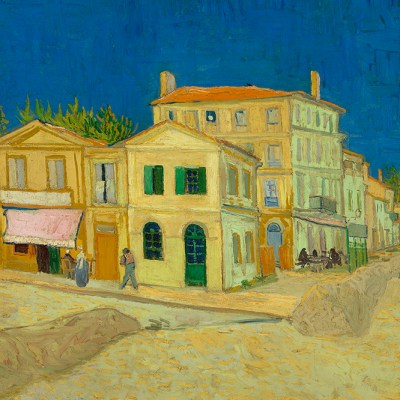
Those two years from 1888–89 were a high point in Van Gogh’s life as an artist: it was then that he lived and worked in the Yellow House in Arles. Judging from his painting of the same name, it was only one such house in a predominantly yellow street. And even when the painter stayed indoors, he remained fixated on yellow, as his yellow-framed canvas Quinces, Lemons, Pears and Grapes (1887) demonstrates. These fruits are not presented on a dish, as you might expect, but are surrounded by a great swirl of golden wheat. Neither work can be said to come to rest in the colour yellow; the Yellow House glows against a dark blue evening sky, while the glinting pile of fruit is convincingly animate, just as the wheat fields appear to revel in the attention paid to them.
The majority of works in this show are paintings on canvas, but perhaps the largest space allotted to a single artist is filled with abstract sculptures and lighting installations by Olafur Eliasson. I was stunned by Eliasson’s ‘The Weather Project’ installed in the Turbine Hall at Tate Modern in 2003 – especially the great illusory sun disc suspended in an artificial mist. The exhibition at the Van Gogh Museum culminates in a wall installation of multiple discs surrounding the viewer with a spectrum of colours that all seem to refer back to a bank of yellow spheres, alongside an overhead schematic installation of yellow light tubes. It’s true enough that this makes us feel physically immersed in yellowness, but the stakes are not very high by comparison with either ‘The Weather Project’ or some of the paintings here.
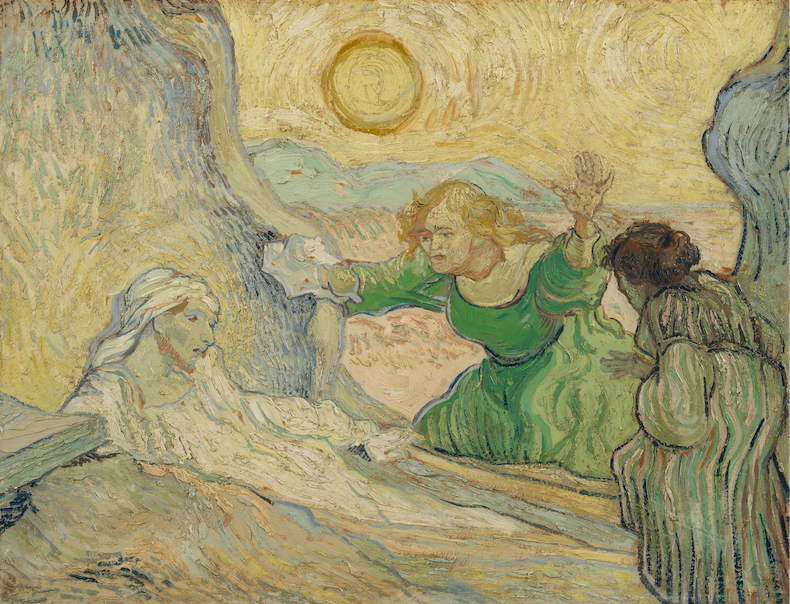
Compare Van Gogh’s astonishing work The Raising of Lazarus (after Rembrandt) (1890). The title’s parenthetical nod to Rembrandt is misleading, because there could not be a wider divergence between the arrangement of figures and the ambience specific to each of these works. Rembrandt’s scene takes place in a dark burial vault that accentuates the fall of torchlight on to the rather ghostly arm of Christ, as he raises it to conjure life back into Lazarus’s corpse. Van Gogh places the tomb in the open air, with what looks like a Provençal landscape in the background. Two women, here to grieve, are seen recoiling in astonishment at what is taking place. At the centre of the painting is a flaxen-haired woman in a bright green dress (the colour suggestive of life as organic growth) raising both arms at once. But there is no Christ available to revive the corpse and instil new life into it; only the great glowing yellow disc of the sun. It is stirring life back into motion – in the rather greenish face of the reviving Lazarus, but also in everything else in this miraculously reanimating landscape – for as far as the eye can see. The Sun is God, after all.
‘Yellow: Beyond Van Gogh’s Colour’ is at the Van Gogh Museum, Amsterdam, until 17 May.