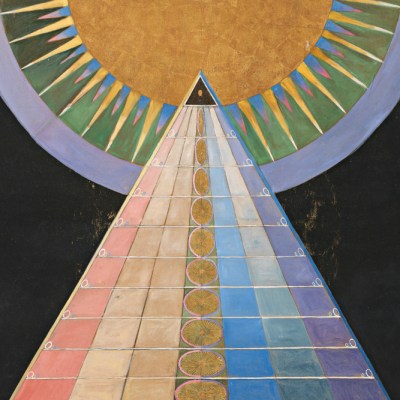
In the autumn of 1986, the Los Angeles County Museum of Art opened ‘The Spiritual in Art: Abstract Painting 1890–1985’, billed as one of the first exhibitions exploring the influence of magic, mysticism and the occult on the development of abstract art. Kandinsky, Klee and Pollock were among 100 artists whose work was on display: of that total, you could count the women on the fingers of two hands. Among those was Hilma af Klint – entirely obscure since her death in 1944 and then in the early stage of rediscovery. Though some saw her work as a revelation, not everyone was a fan: one critic wrote off her inclusion as tokenistic, describing her paintings as ‘essentially colored diagrams’ that were ‘not very good’.
The critical reception of af Klint and her popularity has soared since then. On any given day, it seems possible to track down an exhibition of her art (her first in Ireland opened two weeks ago) and the once dismissed ‘diagrams’ are now treated as trailblazing experimental works, produced in what af Klint believed was communion with the spirit world. Fixed as she now is in the canon of modern art, she’s often labelled as an outlier. In reality, many of her northern peers had a similar penchant for the mystical. This is the premise of ‘Arcana Borealis: Northern Women and Esotericism’ at the Ateneum in Helsinki. The show seeks to right an art-historical wrong by presenting 200 works by 50 women artists from across the Nordic countries and Sápmi, the region inhabited by the Sami people.
Here, ‘esotericism’ is something of a catch-all term, with the works treated collectively, as representations of their makers’ handling of ‘rejected’ forms of knowledge. Some of the exhibits were made as recently as this year, but the oldest is from the 1890s, a period when people sought spiritual guidance to make sense of discoveries such as the X-ray.
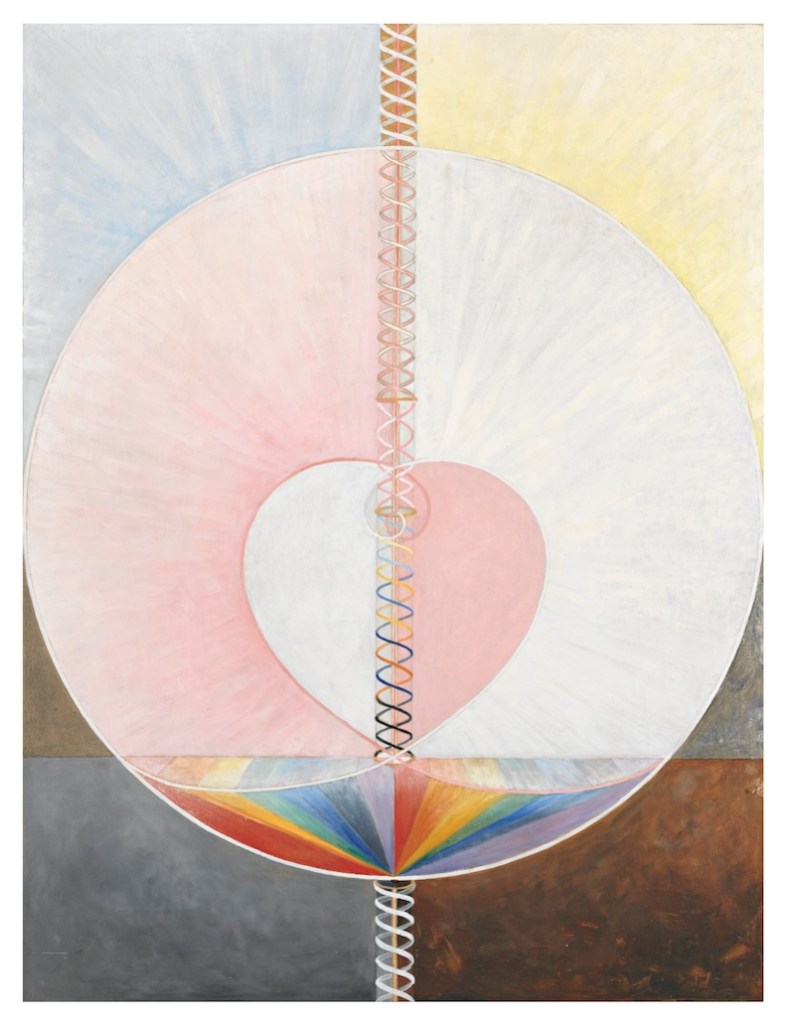
Stepping into the moody first room of the exhibition, af Klint’s The Dove no 1, Group IX, Series UW (1915) is the first work on the inky-blue walls. From this relatively familiar starting point, the exhibition unfurls rapidly; the works are loosely grouped by theme, subject matter or stylistic similarities rather than chronologically. The belief systems each is grounded in chop and change as you work your way down the walls. Beavvit (Rising Together) (2019), a textile hanging by Sámi artist Outi Pieski sits between two paintings by Finnish painter Iria Leino. Leino’s Murder (1967) resembles a vortex of molten lava and suggests an interest in unseen forces that culminated in her conversion to Buddhism in the late 1960s. Meanwhile, Pieski’s work is rooted in Sámi tradition, linking to the crafts of a people whose lives depend on the natural world around them.
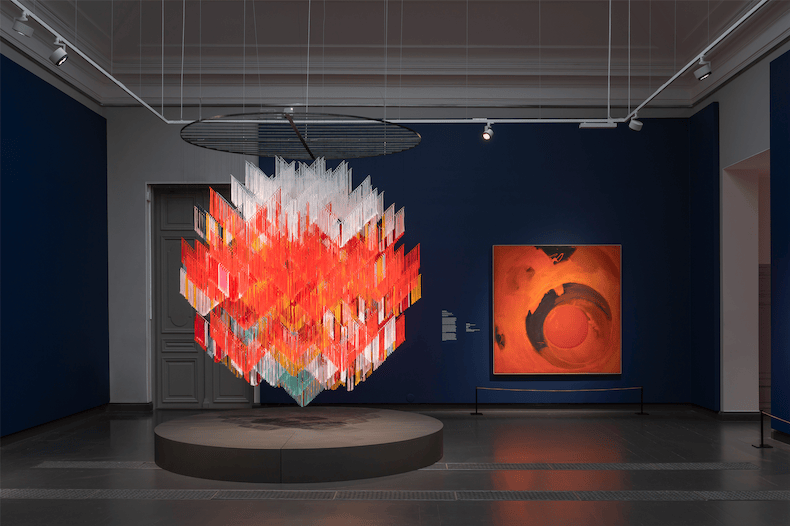
Bouncing between entirely different spiritual structures can make each one difficult to digest, but this is inevitable in an exhibition with such a broad theme. Things are more focused in subsequent sections. A bubblegum-pink room displays works by af Klint and Anna Cassel, both members of the secret ‘Five’ group that met to produce automatic drawings ‘guided’ by spirits encountered in seances. Another section introduces figures who experimented with Surrealism such as Elsa Thoresen, an American expat who settled in Denmark and showed work in André Breton’s Exposition Internationale du Surréalisme in Paris in 1938.
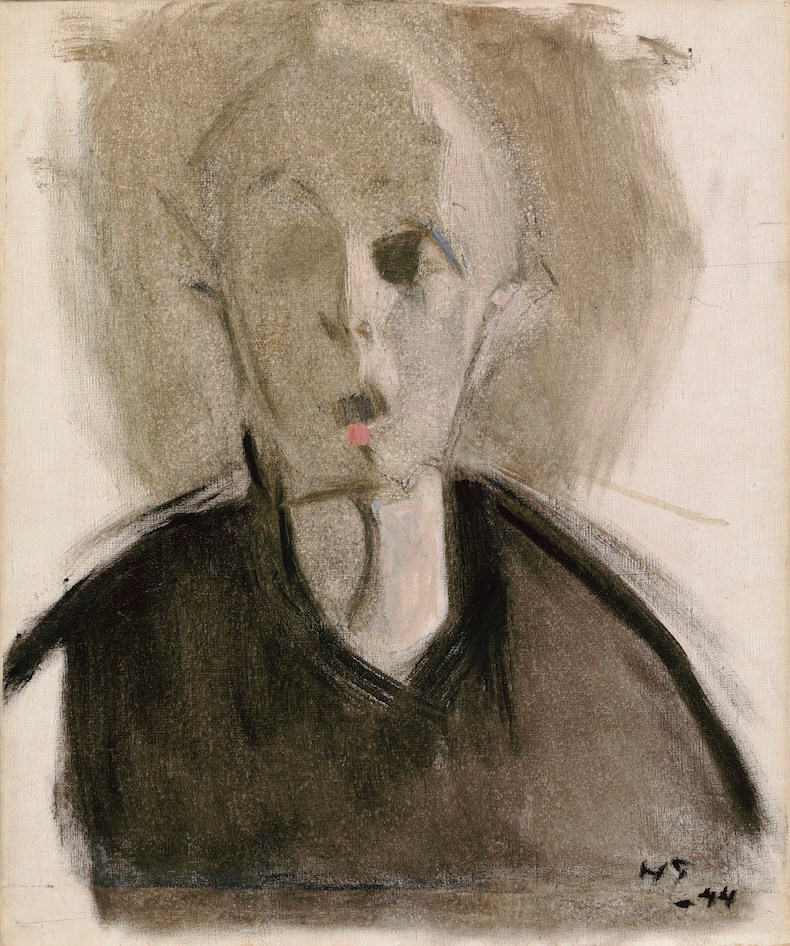
In an exhibition with so many works by so many artists, the quality of art varies considerably. For example, crude still lifes by the esotericist Meri Genetz suffer next to more sophisticated work. Much more intriguing is Helene Schjerfbeck’s spectral Self-Portrait with Red Spot (1944), in which the Finnish artist captures her own likeness in strokes of brown with a fleshy pink dab where her mouth would be. The latter’s connection to esotericism is a little tenuous, however, whereas Genetz’s is much more explicit – see the crystal ball in the lower left corner of Still Life (1930s).
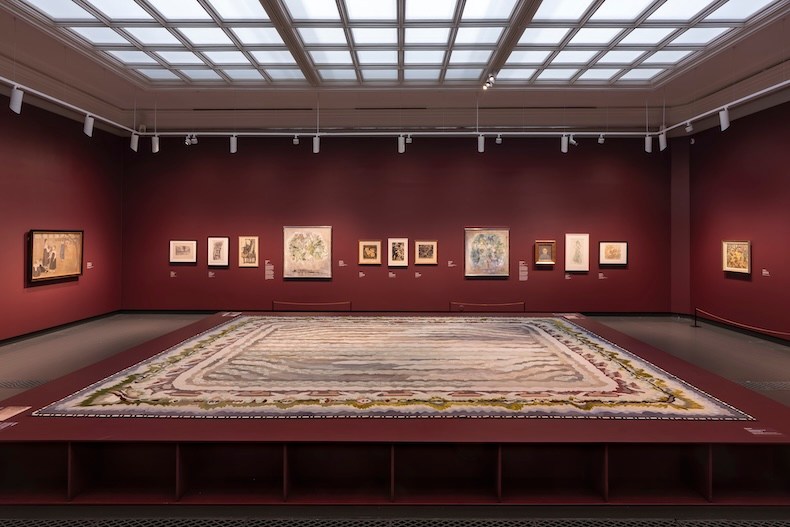
One of the most impressive aspects of the exhibition, arguably a necessity for a show this large, is the breadth of mediums on display: as well as paintings and drawings, there’s sculpture, embroidery, reliefs, stained glass and more. A contemporary recreation by Åsa Elzén of a rug depicting a field in fallow by Maja Fjæstad (1873–1961) is a welcome circuit breaker, planted on a platform in the centre of a room about esotericism and nature. Intriguing figures emerge in the sculptures of Laila Pullinen and Sigrid af Forselles. In Pullinen’s bronzes – some sections possessing a dark patina, others polished to a glittering gold – the refraction of light represents what the artist called a ‘divine blessing’. A plaster relief from af Forselles’s The Development of the Human Soul (1887–1903) captures the Finnish sculptor’s ideal of a spiritually evolved society that found freedom through art. It is said to have been made in communion with the Italian masters who inspired her.
‘Arcana Borealis: Northern Women and Esotericism’ is at the Ateneum Art Museum, Helsinki, until 28 February 2027.