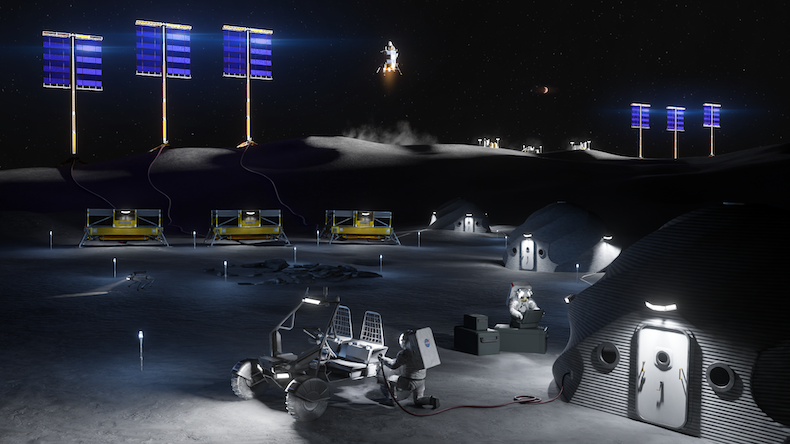
Following Artemis II’s successful lunar flyby in April, NASA published an intriguing document called ‘Moon Base User’s Guide’. This short overview, available online, is the latest in a series of moon base ‘architecture definition’ documents published annually since 2022, but while its predecessors were rather dry and technical, the user’s guide is much more accessible and gives a picture of the work needed to establish a permanent presence on the Moon. It was followed, at the end of May, by a series of renderings showing what a base might look like.
An architecture guide for the Moon? It sounds very promising. Sadly NASA is using (and perhaps over-using) the word ‘architecture’ to mean systems design, mapping out the technical and procurement hurdles that must be cleared to reach a Moon base. One of the previous documents states that the process is to ‘architect from the right and execute from the left’, meaning – once we’ve recovered from that first verb – figure out where you want to end up and then plot how to get there from what you have now. And the place NASA wants to end up is Mars.
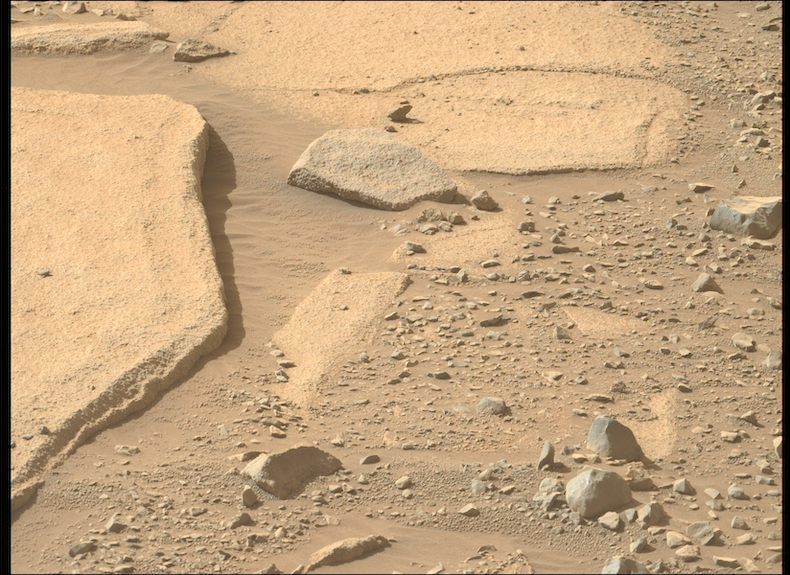
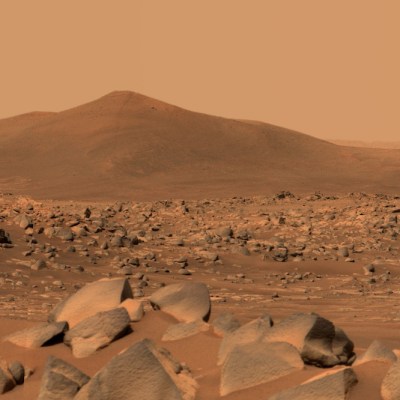
Five years ago I wrote in this place that years of images of the landscapes of Mars, transmitted by the Opportunity and Perseverance rovers, had brought the red planet closer to us. This wealth of imagery and its picturesque qualities meant that Mars had started to feel familiar and within reach, more so even than our closest celestial neighbour. But Artemis II has shifted the focus back to the moon, not least because of the slew of beautiful pictures taken on the trip. Unexpectedly the moon was given a new hue, appearing less monochrome and more suede than we are used to. Unlike Mars, people were actually there taking the photos, for the first time in more than 50 years, showing how close a visit to the surface might be. And as the user’s guide spells out, if we want to get to Mars, we’ll have to start on the moon, using it as a launch pad and a (relatively) accessible testing ground to work on some of the formidable engineering challenges involved in life on lifeless planets.
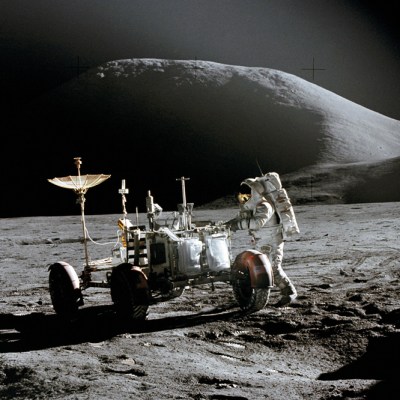
These challenges are laid out in A City on Mars by Kelly and Zach Weinersmith, a chatty and entertaining book that won the Royal Society Science Book Prize in 2024. I say entertaining, though it’s also very annoying in the jolly, matter-of-fact way it crushes the reader’s naive Dan Dare fantasies. The Moon’s lack of an atmosphere turns out to be a relatively trivial problem. There’s also no magnetosphere to protect against solar radiation. Two-week-long days are followed by two-week-long nights – the monthly cycle of waxing and waning we can see from Earth – and so the surface temperature veers between pitiless heat and pitiless cold. The surface itself, a layer of pulverised rock and glass called regolith, comprises razor-sharp, electrostatic particles that pose grave hazards to equipment and the lungs of Selenites. Further issues arise the longer we stay. Prolonged exposure to low gravity wastes away bone and muscle and could, after a time, make return to Earth deadly. There are degrees of ‘permanence’ in a Moon base – humanity has a permanent presence in Antarctica but people don’t live their whole lives and raise families there. If the aim is for people to live on the Moon, the catalogue of health challenges is potentially immense. This applies particularly to infants and children, who will be needed if a settlement is to be truly self-sustaining. Children are not guaranteed, however, as conception and pregnancy have never been attempted in low gravity.
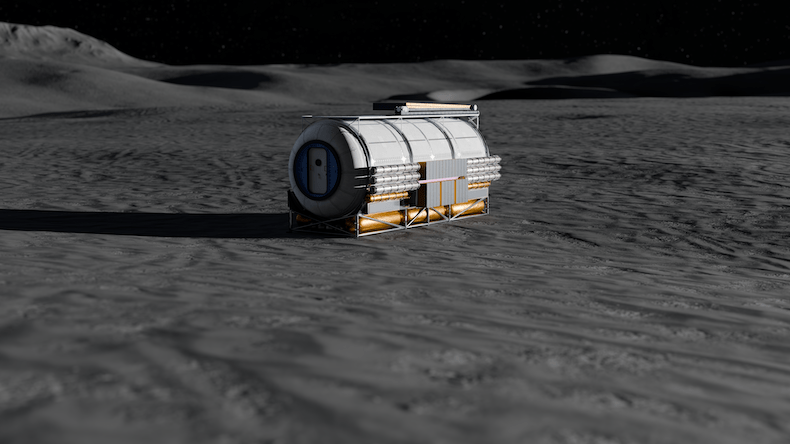
Engineering fixes do exist for all these problems – even the last, courtesy of a structure the Weinersmiths call the ‘pregnodrome’, a sort of massive childrearing centrifuge. Not very appealing perhaps, but it does show how engineering might ultimately dictate some unprecedented architecture. The suggestion that lava tubes – large, naturally occurring tunnels under the lunar surface – might provide ready-made shelter also provides some tantalising chthonic hints. But for the time being we must wait for a lunar architecture (in the traditional and, in the UK, professionally regulated sense) to emerge. Following Vitruvius, such an architecture would necessarily rely on commodity and, to a lesser degree, firmness in its clusters of lightweight, modular surface buildings, such as those depicted by NASA – essentially grounded space capsules. There wouldn’t be much room in the payload for delight. The Moon doesn’t attract the utopianism that Mars does. The most detailed recent fictional portrayal of human life on the Moon has been in Apple TV’s For All Mankind, now in its fifth season. In the alternative history played out in the show, the Soviets get to the Moon first, with the result that the Apollo missions are not prematurely cancelled and the space race continues at full speed. Rival Moon bases are established and Mars is reached by the 1990s. While For All Mankind gets a bit silly on Mars, its depiction of the Moon is wonderfully plausible: difficult, dangerous, dusty and doable. Not very delightful.
Gritty (or regolithy) realism is salutary, but with this return to the spacefaring ambitions of the 1960s and 1970s, a little delight might be needed to maintain enthusiasm. In the 1960s, NASA had veteran industrial designer Raymond Loewy – who at the start of his career had styled streamlined steam engines for the Pennsylvania Railroad – design the interiors for Skylab, bringing a bit of dignity and humanity to a necessarily utilitarian environment. The Artemis programme does include some applied art: the Axiom space suits, which will be tested on Artemis III, have been styled by Prada. But more could be done. In the mid 1970s, the engineer Gerard K. O’Neill hosted ‘summer studies’ at the NASA Ames Research Center, a programme to develop space habitats that could house thousands of people. Among those present were Rick Guidice and Don Davis, two artists whose magnificent paintings of lush, enclosed, suburban landscapes curving away into an idyllic future have coloured our view of human prospects in space ever since – setting a few unrealistic expectations along the way, to the chagrin of the Weinersmiths. Space Settlements, Fred Scharmen’s delightful book of 2019 exploring the background and effect of these images, looks at how the ‘space habitat’ proposal was a way of combining the functional engineering challenges and systems involved in space travel with other human systems – social, cultural, ecological. It becomes the design ‘of existence itself’, and to express that, art – quite visionary art, while also being cutely domestic, with its cycle paths and cocktail parties – was a way of integrating and expressing it all. ‘After the engineers have gone through and set the technical specifications,’ Scharmen writes, ‘innocent artists arrive and do their dreaming in paint. Who can blame them for the compelling nature of their pictures?’