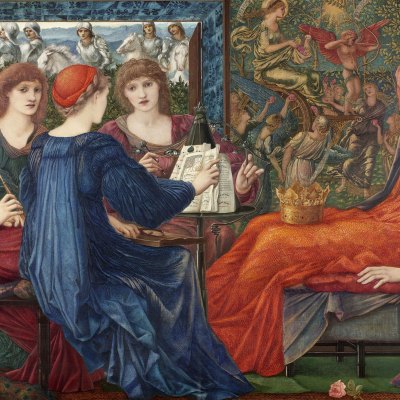
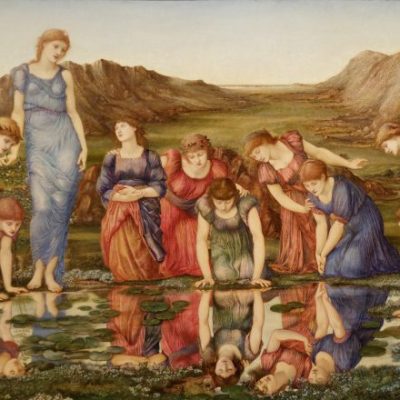
‘A Call to Art: William Morris and the Pre-Raphaelites’ is a visually delectable display of a rich selection of works drawn from the Fitzwilliam Museum’s exceptional collections of fine and decorative arts – along with some important loans. But it is also a provocative, even revisionist examination of the ideals of these key figures in 19th-century British art and design and the human story that lies beneath the legend.
At the centre of the exhibition narrative lies the complex relationship between Morris and the charismatic poet-painter Dante Gabriel Rossetti, under the spell of whose work Morris and his lifelong friend and collaborator Edward Burne-Jones first fell in the mid 1850s. Rossetti’s distinctive vision of a romanticised past confected from colourful medieval imagery and the spirit of early Italian poetry chimed with their own discovery of Chaucer and the Morte d’Arthur and inspired them to abandon early undergraduate aspirations to the church in favour of a life devoted to art.
After a brief introduction to Morris’s conventional background, the first main section of the exhibition convincingly evokes the seductive world into which he and Burne-Jones were drawn. Here, hanging against a sombre red background, are watercolours, oils and drawings by Rossetti, his Pre-Raphaelite Brothers and others of their wider circle. A telling inclusion in this group is April Love by Arthur Hughes, the obsessively detailed, vividly green and violet scene of thwarted lovers which Morris – as a rich young man – was able to buy almost on a whim from the Royal Academy show of 1856. (In later years he would turn against paintings; preferring to live with walls hung only with his own wallpapers and textiles, he sold almost all the pictures he had, even the jewel-like watercolours that Rossetti painted on Arthurian themes from Morris’s own poems.)
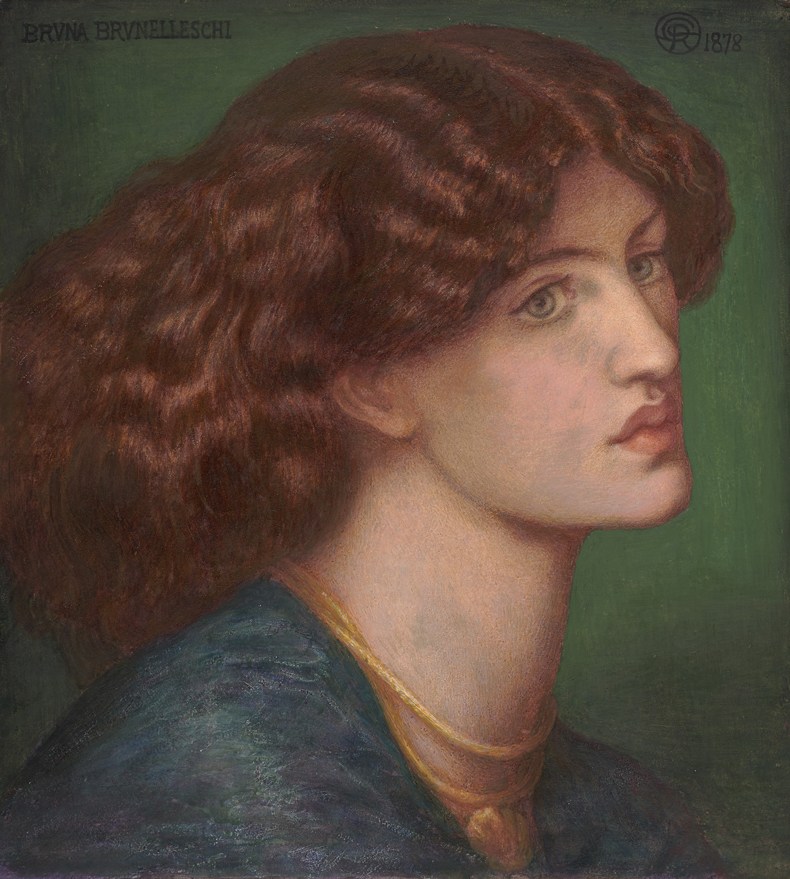
An illuminating gallery of portraits, among them some beautifully sensitive drawings, places Morris in his wider context, introducing a cast of intriguing characters whose paths will cross and re-cross over the years. This serves as a prelude to the section of the show devoted to Red House at Bexleyheath. Designed by Philip Webb for William and his new wife Jane as their first home, Red House became the crucible of the whole ‘Morris Movement’. Despairing of the ‘impossible’ state of modern furniture and fabrics, Morris gathered his friends to paint walls, stencil ceilings, embroider hangings and embellish cupboard doors with chivalric scenes.
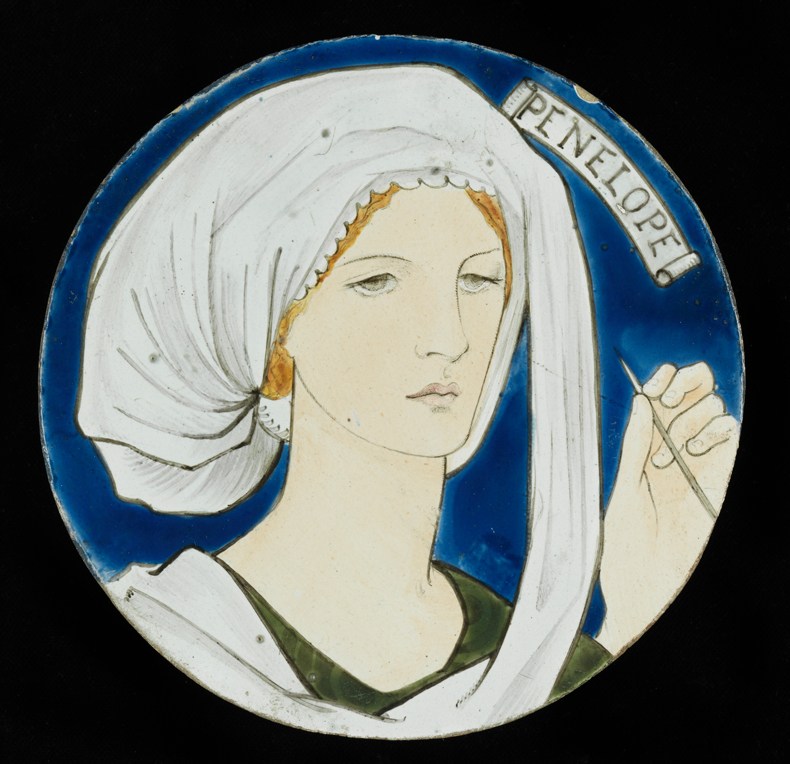
It was not long before these creative weekends led to the idea of banding together as ‘art workmen’ in a novel, though at first amateurish, commercial venture. ‘The Firm’, as they referred to it, was founded in 1861, just in time to exhibit their earliest wares – to somewhat less than universal acclaim – at the 1862 International Exhibition in South Kensington. In the current exhibition, against a backdrop taken from a bold Red House stencil pattern, we can see examples of their productions, including early stained-glass panels and painted tiles. A centrepiece, imaginatively displayed in a structure that recalls Webb’s great chimneypiece at Red House, is a painted cabinet which later stood in the Burne-Joneses’ dining room, while nearby hangs one of the very first pieces of the cloth hangings embroidered by William and Jane for the house. Of plain blue stuff, sprigged with flowers based on an illumination in a medieval Froissart manuscript, it was later preserved at Kelmscott Manor and, even now, retains a fresh, spring-like charm.
Jan Marsh and Karen Livingstone, the curators of the exhibition, draw particular attention to the women whose presence as active and influential participants in the group’s enterprises they have each done much to reveal. Traditionally, most important among these are the two iconic figures of the entire Pre-Raphaelite story: Elizabeth Siddal, an artist herself but ultimately always more celebrated as Rossetti’s muse and model, and Jane Burden, whose contrastingly dark, unconventional beauty first captivated Morris but gradually came to obsess Rossetti, thereby creating the rift that alienated the two friends.
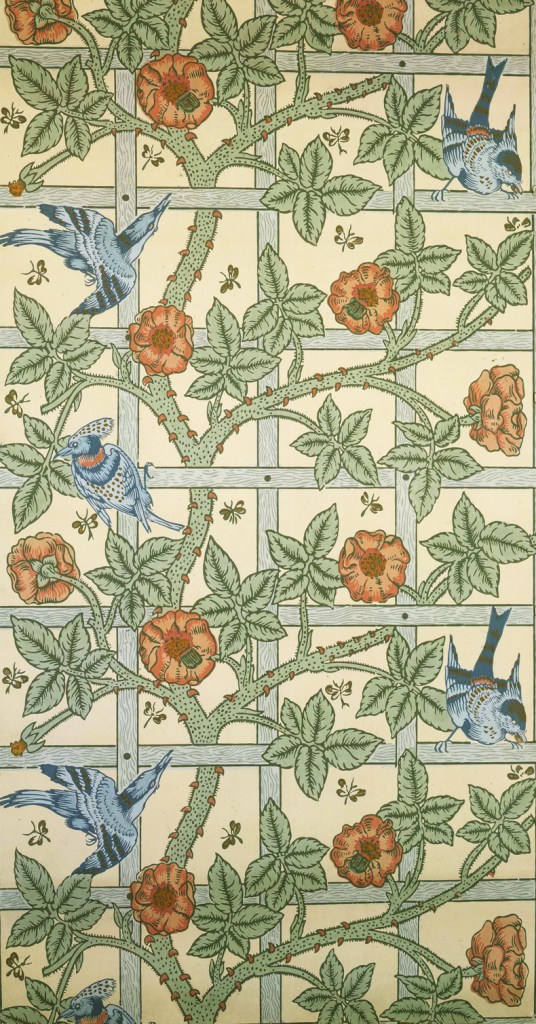
But here too we encounter less well-known figures whose agency in the wider Arts and Crafts movement has not previously been fully appreciated. May Morris, William and Jane’s highly talented daughter, has already been emerging from her parents’ shadow (with an illuminating recent exhibition in Liverpool devoted to her own achievements). ‘A Call to Art’ also champions Jane’s sister, the embroiderer Elizabeth ‘Bessie’ Burden and especially Lucy and Kate Faulkner, the sisters of Charles Faulkner, one of the early partners in The Firm. Kate is revealed as a prodigious talent; from painting tiles, cutting woodblocks and other less creative tasks, she was singled out by Morris for her ability as a designer and drew the first wallpaper designs other than his own which he put into production.
With growing interest in the ‘Morris look’ among grander, aesthetically minded patrons, the firm entered a more expansive phase, as reflected in some of the most significant pieces in the show. The Artichoke Hanging, a huge embroidered panel almost ten metres in length, and elaborate commissions for churches, colleges and private houses reveal the increasing scale of Morris’s operations in the 1870s. But with commercial success Morris began to question his ideals. The story of his growing social awareness and espousal of the early Socialist movement is not new, but the exhibition allows us to chart that development through actual objects. In his vast poetic compendium of mythological tales, The Earthly Paradise, he had once written asking of himself, ‘the idle singer of an empty day […] Dreamer of dreams, born out of my due time, Why, should I strive to set the crooked straight?’ But now, increasingly, he became troubled by the contrast of his espousal of hand-craftsmanship and his rosy view of happy workers under a medieval guild system with the hard realities of Victorian urban industrial society. In a lecture he could suggest ‘I do not want art for a few, any more than education for a few, or freedom for a few’ while complaining more privately that ‘I spend my life ministering to the swinish luxury of the rich.’
This paradox that so troubled him is vividly expressed in two curatorial tableaux towards the end of the exhibition in which a simply stitched banner for the Hammersmith Socialist Society (which Morris supported and funded) is juxtaposed with a sample set of luxurious silk brocade window hangings designed and woven for The Firm’s redecoration of St James’s Palace (but rejected as too costly) and various exquisite collectors’ pieces such as Italian Renaissance ceramics and a fine antique coffer with which Morris furnished his own rooms. Close by – and in some ways expressing the theme of the show in a single object – is Morris’s own copy of Marx’s Das Kapital, well-studied but sumptuously bound in finest blue leather and tooled in gold with an elaborate, Morris-like design of leaves by Thomas James Cobden-Sanderson.
‘A Call to Art: William Morris and the Pre-Raphaelites’ is at the Fitzwilliam Museum, Cambridge, until 3 May 2027.