From the February 2026 issue of Apollo. Preview and subscribe here.
Niccolò dell’Arca (active 1462–94) is not a name that often springs to mind. This is, as much as anything, down to the evolution of national borders. He is not easily thought of as an Italian artist – one, for instance, whom tourists have come to love – but as an artist of unknown heritage. Dell’Arca was probably born in Bari in Puglia, but spent his formative years on the Dalmatian coast, in what is now Croatia. He doesn’t quite fit in. His training seems to have come from the Dalmatian sculptor Giorgio da Sebenico. Yet he is the author of a minor masterpiece.
Niccolò’s Lamentation occupies a corner of the Church of Santa Maria della Vita in Bologna. The work comprises seven figures in terracotta. Lying at the centre of the composition is a dead Jesus. He is surrounded, as is typical, by the Virgin Mary and the three Maries. Less typical is the presence of Saint John and a figure variously identified as Joseph of Arimathea or Nicodemus – the hammer in his hand unhelpfully lends credence to both identities. The figures are roughly life-sized, forcing the viewer to take seriously and realistically what is depicted. (The oratorio of the church confirms that softness is not something this church is interested in. Its ceiling contains wooden putti carrying leather whips that hang down towards the floor to show the order’s commitment to self-flagellation.)
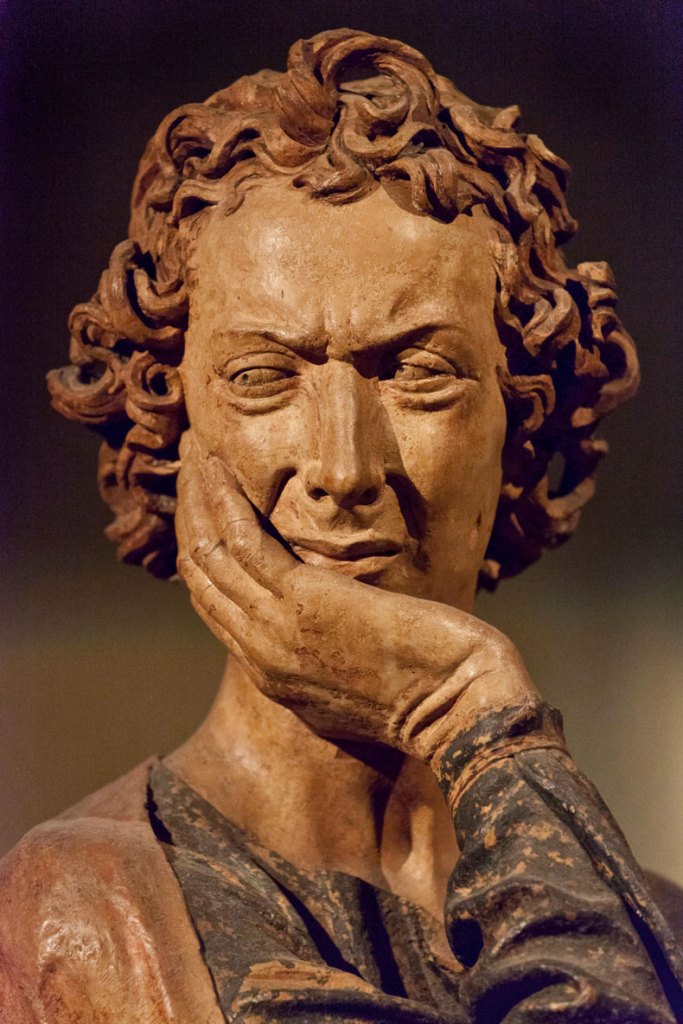
Mourning can be both culturally specific and woefully individual. The figures in Niccolò’s set of sculptures appear to be exclaiming their grief in entirely different ways. It is one of the many fascinations of the work that grief seems to be progressive from left to right, as though the viewer is reading a story of escalation. This reading, though, is undermined by the central figure of John, who looks more muted, his head resting in his hand in what might be disbelief. But the longer I looked at the figure of John, the more quietly devastating it became. The stillness contained in the figure at the centre of the terracotta audience suggests a response welling up through the clay. It is, in some ways, the most naturalistic aspect of these all-too real and all-too gothic works, while also animating a profoundly religious idea that through this particular grief comes the promise of life.
As with so much work of this period of the early Renaissance, part of its power is the surprise of technical prowess. To have produced self-supporting terracotta figures in such dramatic forms seems an almost impossible achievement. There has been academic debate around the dating of the work – the energy of the form has suggested that it dates from the 1490s, while the sculptor’s reputation in Bologna as a master of terracotta figures as early as 1462 could suggest the earlier date.
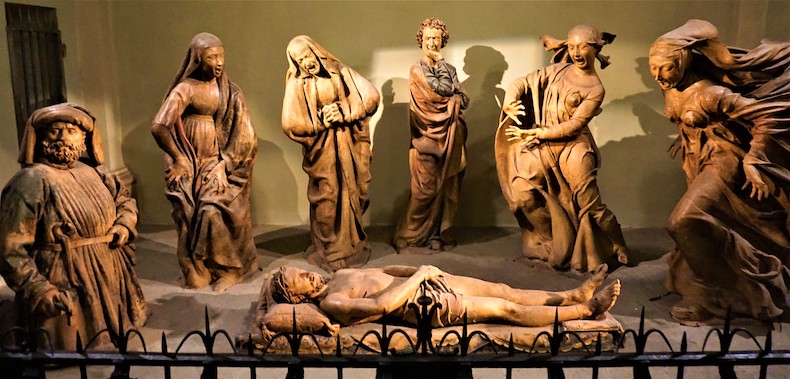
But there is another surprise at its heart. It is possible to read the fixed faces of the Lamentation not only as grieving but also as shocked. This single-minded work in the corner of a small church in Bologna offers a mix of emotions that hint at the surprise with which grief can preoccupy an individual and in doing so, it invites the viewer not only to contemplate the sacrifice at the heart of the Christian story, nor only the impossibility of grief, but also the many variations contained in a feeling, even in a single moment, and how those feelings might transform into something else: the co-dependence of shock and surprise, terror and sorrow. And so its own detail becomes an invitation to look more precisely at the work and confront the impossibility of precisely pinning down how we feel.
From the February 2026 issue of Apollo. Preview and subscribe here.