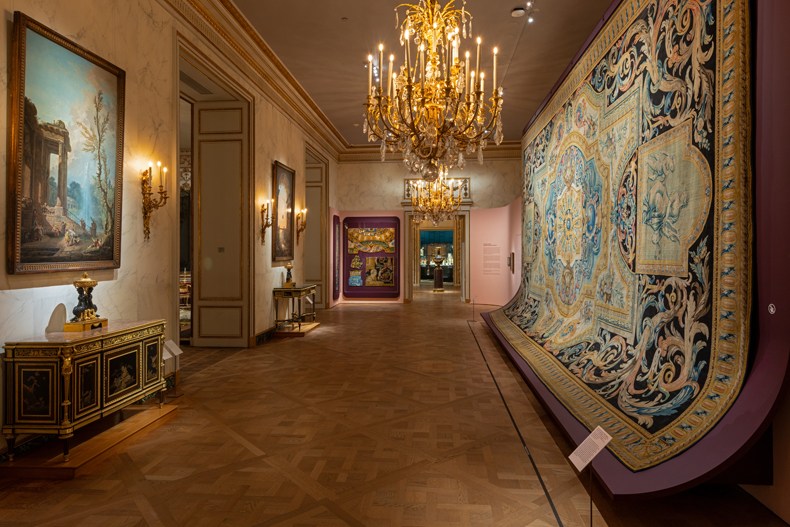
For one week in February, the Grand Palais in Paris revealed dozens of 300-year-old works of art that had never been seen in public: 32 carpets that were made to line a corridor that ran from the Louvre to the now-lost Tuileries Palace. Now the Metropolitan Museum of Art in New York is presenting four other carpets from the commission, three of them from its own collection, in an exhibition that explores how workers at the Savonnerie manufactory crafted these extraordinary objects. Ahead of the Grand Palais exhibition, curator Wolf Burchard talked to Edward Behrens about how the apogee of a new French art form ended up in storage.
Edward Behrens: Can you tell me how this exhibition came about?
Wolf Burchard: I got into studying these carpets as part of my PhD on Charles Le Brun, which discusses the versatility of the artist. He was trying to create the image of the king as it runs through all kinds of different media, from architecture, sculpture and painting to tapestries, furniture and carpets. And the carpet chapter is the one that I enjoyed the most, because it was about these amazing carpets made for a space that doesn’t really exist: the amazing long gallery of the Louvre that connected the Louvre to the Tuileries Palace, where the throne room was.
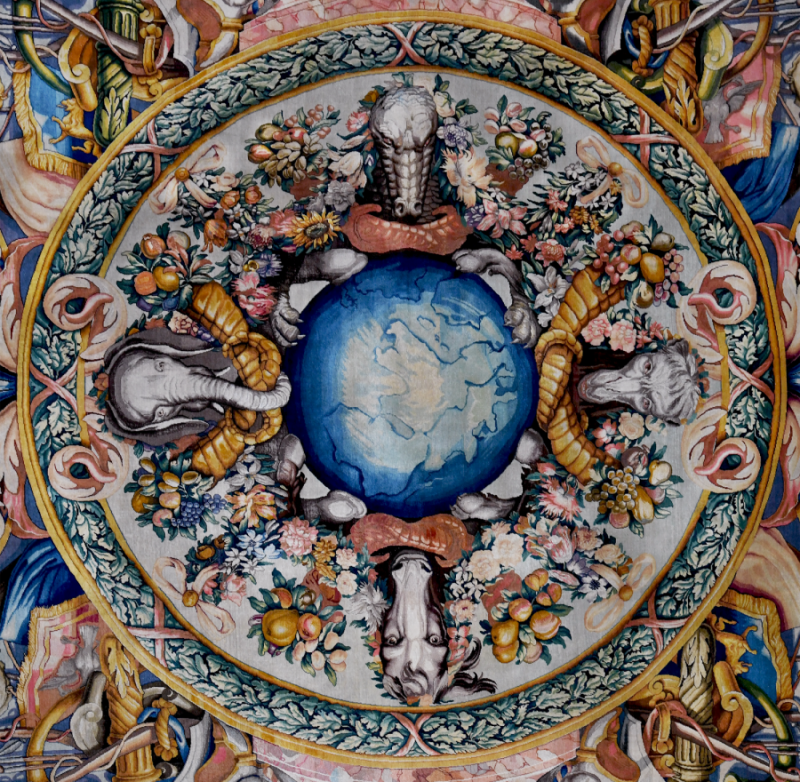
The idea was that an ambassador to the court of Louis XIV would have to walk through this endless gallery, almost half a kilometre, so that by the time they got to the throne room there would be no doubt that they were in the presence of the greatest monarch in the universe. And this is what these carpets were about: the iconography is about Louis XIV at the centre of the world.
Two years ago I was invited to come to the Mobilier National [the French government art collection], and we looked at every single carpet in their collection. In total, it’s 41 carpets. We’re showing only 32 in the exhibition, with four loans – two from the Louvre, one from Versailles, one from the Banque de France – and only the complete carpets from the Mobilier National. In June 2023 we examined and photographed everything from both sides, and I teamed up with two curators from the Mobilier National, Antonin Macé de Lépinay and Emmanuelle Federspiel. We set out to write a book about the history of the carpets, plus a complete catalogue with a history of every single carpet, including those that no longer survive. And then we said, ‘You know, this is one of the greatest treasures of the Mobilier National: wouldn’t it be wonderful to share it with the public?’
The first thing you notice when you arrive in the Grand Palais is the sheer size of these carpets. How did you manage to bring them in?
They prepared it all with military precision. I arrived on Friday night at the Grand Palais, and there was nothing. It was completely empty; it was totally magical. We walked into this enormous hangar and then they drove in with the lorries. I kept thinking, ‘This is so cool,’ because in a museum you can’t simply drive into the gallery and take the works out. They drove in with two lorries – there could only be two lorries in there at the same time because of weight restrictions – and then out the carpets came. Then we arranged them according to where they were going to go. There were two teams rolling them out and by half past midnight, all the carpets were in place. Neither Louis XIV nor Le Brun ever saw them rolled out together like this.
Why did you want to exhibit them all together?
You can’t really understand them if you don’t see them rolled out together. These carpets are a completely unique chapter in the history of art. The idea was to produce the largest carpet ever made, and there are so many elements that are so unusual. Four hundred years ago, in 1626, the Savonnerie manufactory was founded to create carpets in the Turkish or Persian style, with a symmetrical knot. They are emulating the visual language of Eastern carpets because it’s cheaper to produce them in France rather than importing them. And it was only in the 1660s, with the arrival of Le Brun and the first minister of state [Jean-Baptiste] Colbert, who was deeply interested in the promotion of the arts, that they said, ‘Okay, let’s make carpets that are more ambitious and that actually use a French design language.’ In a very, very short period of time, the Savonnerie manufactory suddenly began to produce much larger, more ambitious carpets, importing wool from England in line with the mercantilist idea that you import primary goods and produce luxury goods. And in this time they reach dizzying heights in terms of scale and quality – heights that they would never achieve again. It’s a unique moment in history when they say, ‘We’re going to create the most ambitious carpets in Europe,’ and they do, and then they stop.
Over 20 years they produced those 92 carpets plus 10 reweaves, because the king started giving them away as diplomatic gifts, so they had to be replaced. And the tragedy is that those carpets were never rolled out in their entirety in the Grand Galerie, because Louis XIV moved to Versailles and lost interest in the Louvre.
Why didn’t they find another home for them?
They could have used them in the Hall of Mirrors at Versailles, but they didn’t. This is my interpretation but I’m absolutely sure that it was Le Brun himself who didn’t want to roll them out for the Hall of Mirrors, because that was his great masterpiece and he wanted people to look at the ceiling. Had he laid them out on the floor, people would have been looking only at the floor.
You have this unbelievably ambitious and unique chapter in the history of art for which new technology was developed, looms were built, a new visual language was created for it. They’re really the root of all European carpets: every carpet you see in a hotel lobby, at the Ritz, for example, is in emulation of these carpets.
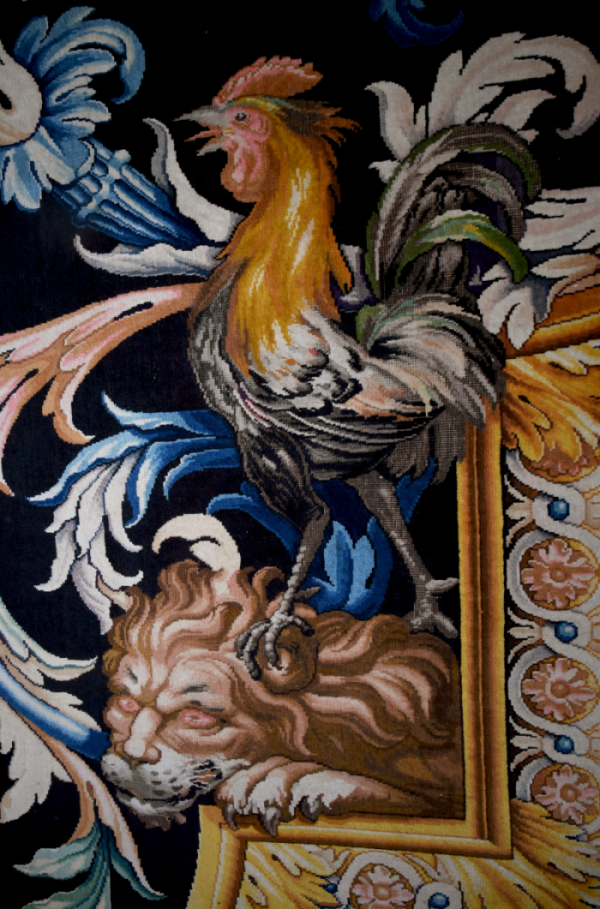
Can you tell me a little about the design?
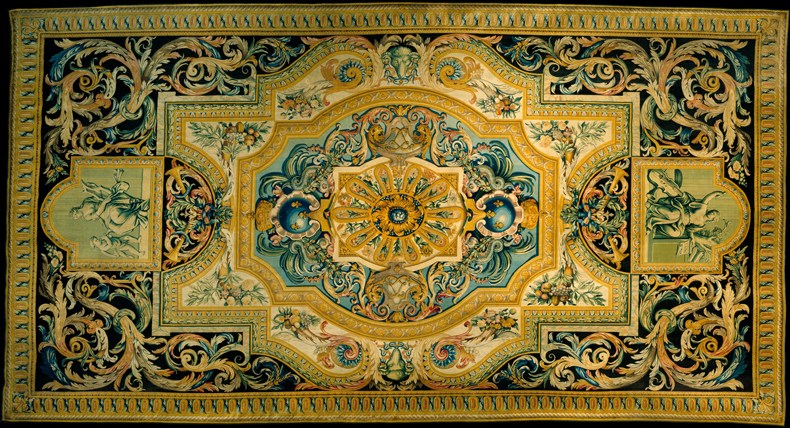
Well, they don’t have a narrative thread like you have in tapestries. The designers had to think, ‘How do you convey messaging in a carpet?’ You stand in the middle, and then you look left and right where you have allegorical figures celebrating the virtues of the king. Le Brun conceives the carpets themselves in dialogue with the Petite Académie, which was in charge of managing the image of the king; they developed a sort of intellectual language around the sun and the planets in which everything, an infinite universe, revolves around the king. Each rug is different because the design comes from Le Brun, who can always come up with new ornament. Admittedly there are some carpets that reuse certain elements, and others that are almost identical. But it’s the illusion of infinity and variety. If you’re an ambassador coming to the court of France, and you are walking down this endless gallery, nervously and with sweaty hands, you’re not going to stop at carpet 17 and say, ‘Hang on, this looks just like carpet five.’
I was struck by how loving and peaceful the images used in these carpets are. Can you talk about the absence of martial iconography?
Some rulers present themselves as peacemakers and Louis XIV was absolutely one of these. Despite bringing much destruction, particularly in Germany, he presented himself in iconography as the great peacemaker of Europe. It’s Louis XIV as this virtuous, magnanimous prince. He is the sun that brings light and beauty and peace to the world.
What happens to the carpets after their moment in the sun?
They will be rolled up again and go back into storage. Many of them were formerly in use in government buildings at the Élyseé and the Hôtel de Ville, but they are no longer being used, at least for now. They are normally taken out here and there for exhibitions. But on the whole they will live in storage where they’ll be beautifully looked after.
‘A King’s Carpet: Louis XIV and the Savonnerie’ is at the Metropolitan Museum of Art, New York, until 5 March 2028.
This article was first published on 6 February, shortly after the exhibition opened at the Grand Palais, Paris.