From the May 2026 issue of Apollo.
For all its millions of words of elevated prose, the New Yorker has always been famous for its cartoons. In October 1925, when the first issue was probably still sitting on some coffee tables, founding editor Harold Ross said it had been described as ‘the best magazine in the world for a person who cannot read’. This long record has meant the emergence of a distinctively New Yorker style of cartoon, which is easy to recognise but difficult to pin down. It is rooted in everyday life and its petty absurdities, and notable for its economy, telling the joke in a single line. One of the artists who guided the evolution of the New Yorker cartoon was Alan Dunn, who first sold a drawing to the magazine in 1926 and five years later had contributed 280.
The one-liner seemed to come naturally to Dunn, although his gags had to pass through the New Yorker’s legendarily exacting editorial process, so often bore numerous thumb-prints; however this may be one of the few places where butterflies come off the wheel refreshed. His early cartoons could often produce a laugh from their caption alone. ‘Lady, I’ll be honest with you,’ asks a real-estate agent in one. ‘Where else in the world could you get a better view of 183rd street?’
Dunn was born in 1900; via the army, he enrolled at Columbia University, where he studied drawing, and then went to the National Academy of Design and the Louis Comfort Tiffany Foundation. His earliest drawings for the New Yorker have a darkly shaded, expressionist quality: ‘Subway’ (August 1927) is a curving composition of rails below and struts and girders above, with crowded platforms pressing in at both sides, reminiscent of the woodcuts of the Flemish artist Frans Masereel. His themes were often architectural – inevitably, perhaps, in a city where building was reaching unprecedented heights and concentration. In 1937 a more suburban cartoon of a prefab house prompted an invitation to contribute to Architectural Record. From 1937 until his death in 1974, Dunn published more than 450 cartoons in that magazine and ultimately received the Architecture Critics’ Citation from the American Institute of Architects. This career is the subject of Alan Dunn: The Cartoonist as Architectural Critic, a new book by Gabriele Neri, which aims to cement Dunn’s critical reputation and that of the cartoon in general.
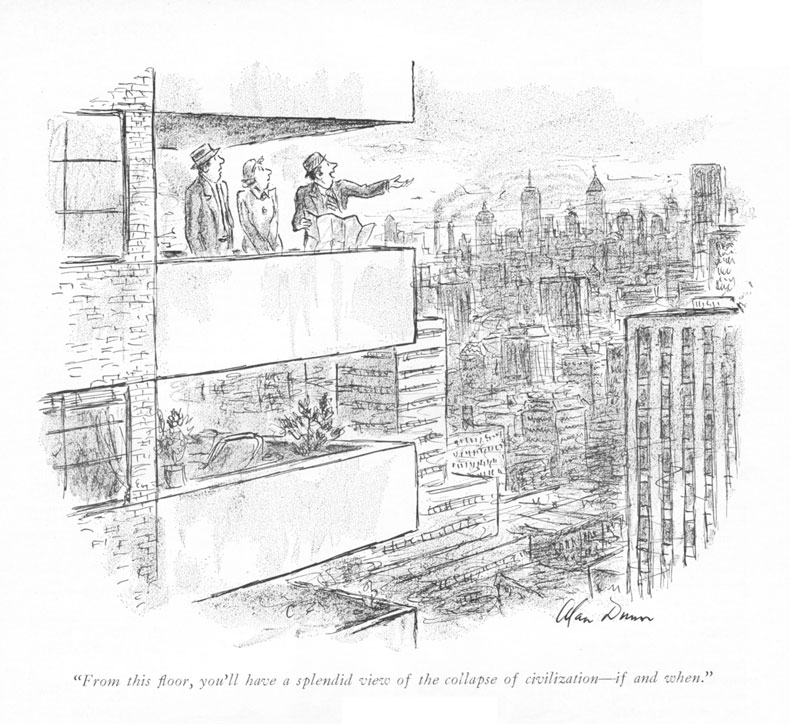
Under the editorship of Alfred Lawrence Kocher, Architectural Record had moved away from the Beaux-Arts tradition and become a staunch advocate of technology and modernism. This gave Dunn a constant supply of material for gags: glass walls, flat roofs, minimalist interiors, cantilevers, prefabricated components, climate control. ‘Well, we’re dated!’ complains the owner of an impeccable modern villa, all white render and Crittall-style corner windows. ‘That abstractionist next door built his house in space-time!’ The neighbour sits smugly on a bare slab supported by a spike, decorated with nothing but a platonic solid and a curl of spiral staircase.
The stereotype of the contemporary architect – visionary, controlling, unsentimental – was also a rich source. ‘I hope you understand, Madam, that my job is to look on you as an animal with a problem,’ an architect icily states in one cartoon. In another, a client complains: ‘I do wish the architect wouldn’t analyse my needs in front of the children.’
Dunn was far from the only cartoonist to produce architectural criticism, as Neri acknowledges. In Britain, Osbert Lancaster and William Heath Robinson were working similar territory; Neri could also have mentioned Norman Thelwell, who is better known for ponies but who shared Dunn’s fascination with privacy-destroying picture windows; or ‘Pont’ (Graham Laidler), who was trained as an architect and who knew the type: ‘Did I really understand you, Miss Wilson, to use the expression “a cosy nook” in connection with the house you wish me to design for you?’
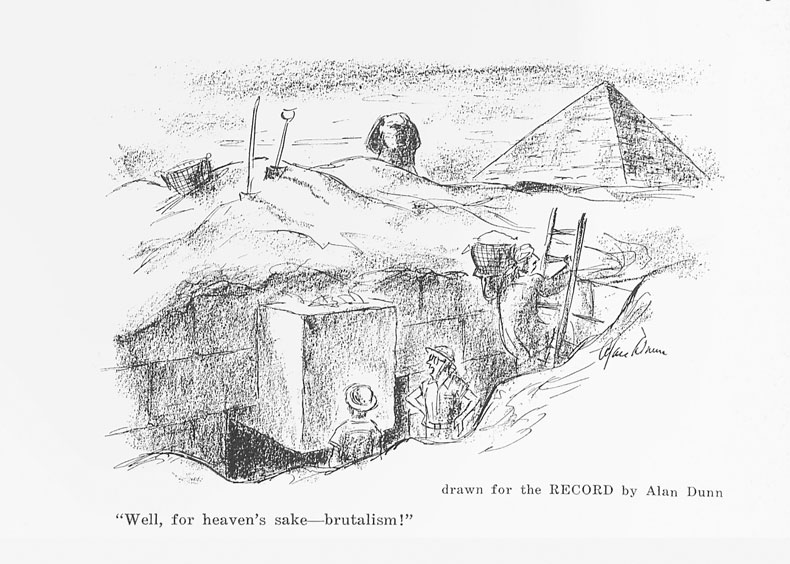
That so many original humorists could independently create rhyming work suggests that there was something inherently, primally funny about modern architecture. It was, in its own terms, an application of science and reason to the domestic sphere. This was the equivalent of splitting the atom for cartoonists whose humour depended on finding elements of the unexpected or absurd in the everyday.
Dunn’s pulpit at Architectural Record gave him the chance to thoroughly explore these themes and in doing so he produced valuable criticism. His ‘abstractionist’ cartoon, besides being funny, suggested that functional modernism, rather than being an imperishable end of history, was just as susceptible to fashion as anything else. A later cartoon, showing a Corbusian ‘machine for living in’ abandoned and boarded-up in the forest predicts the ‘haunted house’ phase of modernism – and incidentally predicted the fate, for a time, of the Villa Savoye and other trailblazing modern homes.
Dunn’s work became more rigorously architectural as his career went on. His working drawings (reproduced over several pages by Neri) might be taken for those of an architect, recording details, picking up forms and playing with them. Only on close inspection is it obvious that Dunn is searching for gags. In the first decades of his career, the buildings he depicted were generic modernistic ‘types’ set up to serve the joke. But in the mid 1950s he became more interested in specific buildings and architects. ‘Are they allowed to do that on Fifth Avenue?’ ask the subjects of a 1958 cartoon for the New Yorker – ‘that’ being the shocking spiral form of Frank Lloyd Wright’s Guggenheim, then freshly revealed. The next year, when the museum opened, Dunn provided a series of cartoons about the building and its quirks – its continuous ramp, its sloping floors, its clear views across the interior, its crowds – which was followed in the next issue by a strongly negative review of the building by famed critic Lewis Mumford. A lot more people will have looked at Dunn’s cartoons than read Mumford’s essay. But, Neri asks, how do they compare as criticism? Mumford’s essay has an argument and a conclusion. Dunn’s cartoons are more accessible, but more ambiguous. Conclusions are left to the reader.
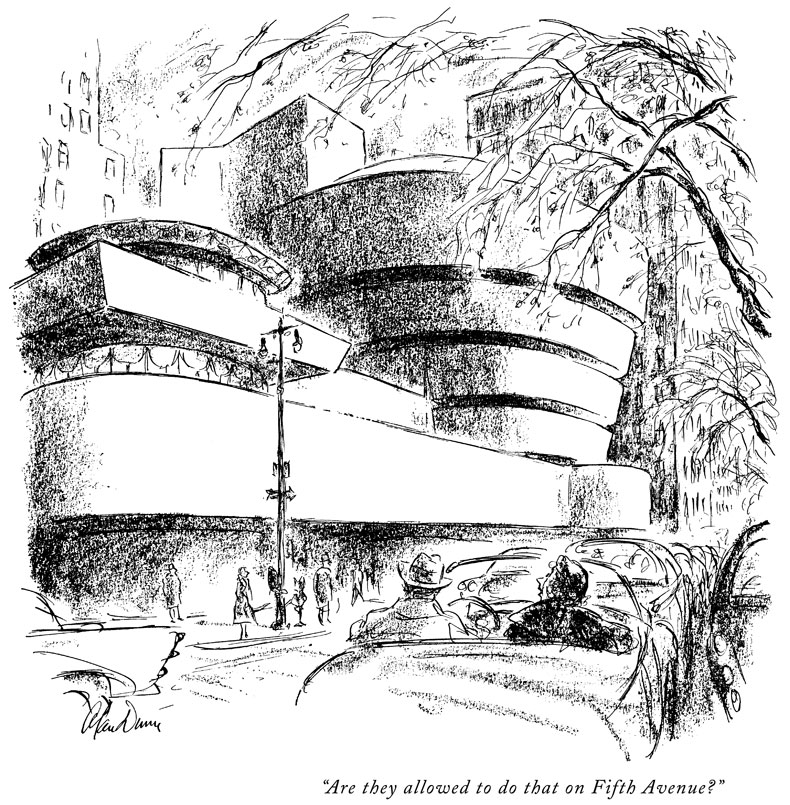
What Dunn achieved in these Guggenheim cartoons was certainly a form of criticism, a quicksilver form that is notoriously difficult to achieve in prose. He manages to convey what the building is like. That’s what the cartoon can achieve, through humour and observation: an emotional truth that transcends distance and experience and places you on a sloping floor.
Alan Dunn: The Cartoonist as Architectural Critic by Gabriele Neri is published this month by MIT Press.
From the May 2026 issue of Apollo.