On entering the exhibition of works shortlisted for this year’s Loewe Foundation Craft Prize at the National Gallery Singapore, the first thing you see are two dramatic black forms. The first is Nobuyuki Tanaka’s Inner side – Outer Side 2021 N (2021); the second is Liam Fleming’s Patterns of Pressure (2025). They are very distinct works but hint, in their different ways, at the ideas and values at the heart of the prize. More than two metres high, Tanaka’s vessel is imposing, but it is also an extraordinary example of the kanshitsu technique, in which dry lacquer is applied to a hemp core. The hemp is draped around a mould and covered in layers of black lacquer; the mould is removed and the inside is then similarly lacquered to create an even, five-millimetre-thick layer around the hemp. The outside is polished to a bright sheen while the inside is left matt, deepening the dark allure of a shape that hovers somewhere between strength and collapse.
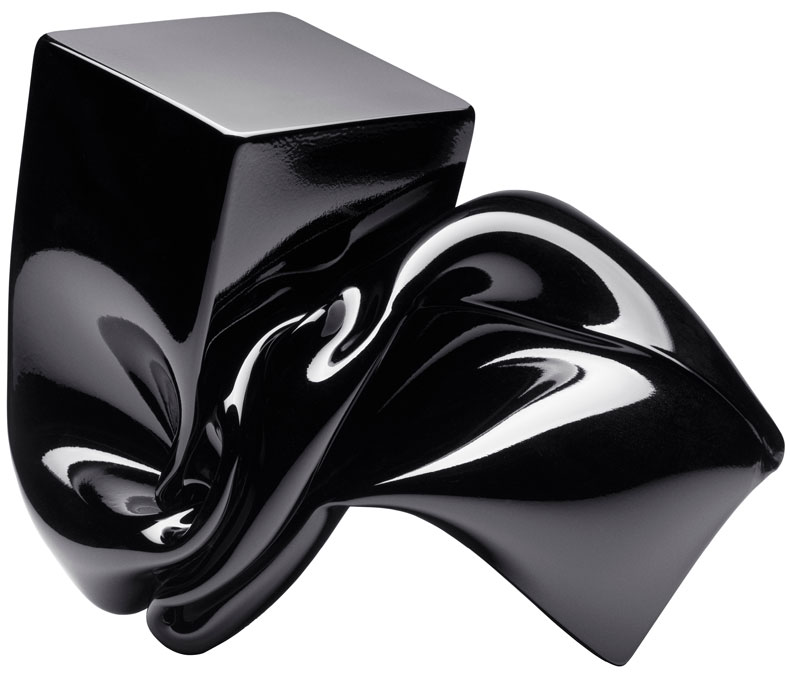
Patterns of Pressure offers a similarly shiny surface, but rather than being polished lacquer it is a twist of glass that looks like the most tempting black treacle toffee, or obsidian. Fleming perfected the application colour as he worked on his technique of mixing glass-blowing and mould-formed, kiln-fired glass. It is a mere 48cm high and it is mesmerising. Fleming is enlivened by talking about technique. Perfecting the process is both the basis of the work and the point: the virtuoso manipulation of geometry is as much what this work is ‘saying’ as how it was made.
This is why the Loewe Foundation Craft Prize is so important. It provides a platform for makers at the top of their field. It values skills and possibilities freed from the shackles of meaning. At its best, it is not about rivalling art or finding the art in production. It is about, to use a formulation coined by the novelist J.M. Coetzee, an other way of thinking about objects. Just as I said to Fleming that I was struggling to refrain from touching Patterns of Pressure, another finalist, Adelene Koh, popped around the display and said, ‘Of course you do, because we think through our hands.’
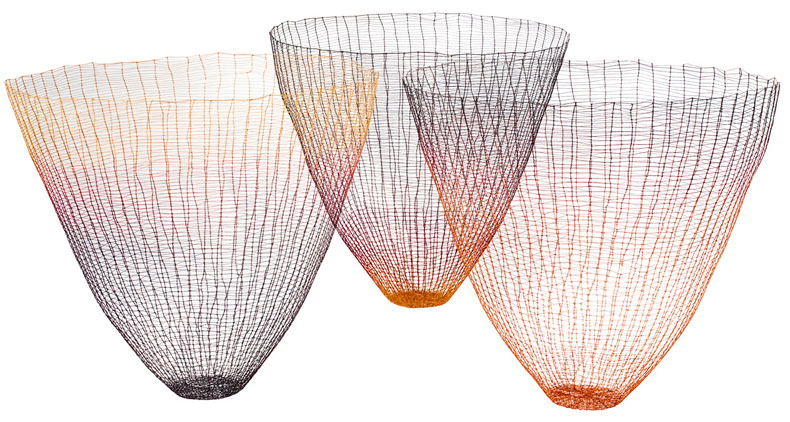
Not everyone in the exhibition has such reverence for process. When I approached one of my favourite works, the resin-fixed knitted baskets by Gjertrud Hals, she explained that she used a wheel made by her psychiatrist husband to knit the forms – because she needed a neater form than needles could provide. She then dyed them, fixed them in resin over a mould and, hey presto, Scala. I asked her how long this took, implying that it sounded painstaking. She told me it took only a few days and then said with disarming frankness, ‘It’s very easy, really.’ Though she also said that three days’ work was only possible because of 40 years of experience.
Experience of a different kind is present in Kirstie Rea’s Repose 2 (2024). Rea was Fleming’s tutor at the University of South Australia, and Fleming credits Rea for his interest in kiln-fired glass. She has created a ‘skin’ of exquisitely coloured glass that has the hues of the bush; it is a version of the landscape she experiences when bushwalking. But it is also an evocation of both the peace she feels in nature and also the fragility of the environment. Made by melting the glass over rods in a kiln and then allowing the glass to find its own draped form, the work stands as a quiet centre of the exhibition, a rich, beautiful object that could be made only by the most skilled craftsperson.
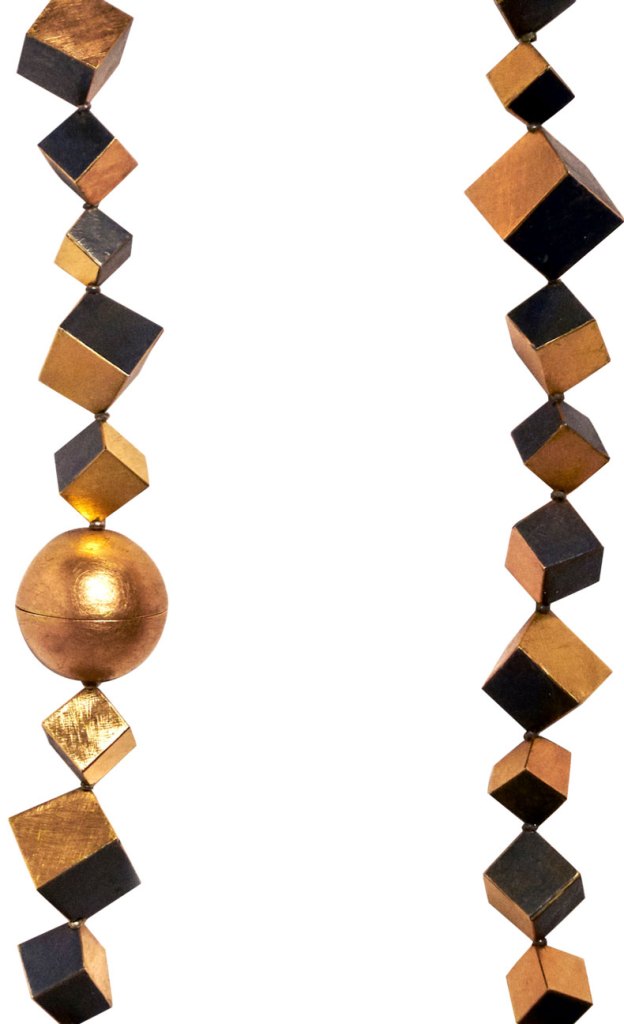
The winner of the prize, worth €50,000, was Jongjin Park for Strata of Illusion (2025), a chair made from sheets of paper coated with porcelain slip that collapsed in upon itself when it was fired. The special mentions went to goldsmith Graziano Visintin for two necklaces of gold decorated with niello, a black sulphurous alloy often used in the Renaissance, and to the Baba Tree Master Weavers and Álvaro Catalán de Ocón for a tapestry that abstracts satellite photographs of a Ghanaian village. The choices are testament to the inclusivity and internationalism of the prize. Traditionally, for a variety of reasons, there has been a tension between craft and art, but by valuing process and seeking out the world’s finest makers, the Loewe Foundation provides a great service in reminding visitors what human hands can do.
The Loewe Foundation Craft Prize exhibition is at the National Gallery Singapore from 13 May–14 June.