From the June 2026 issue of Apollo.
The United States of America has been seen as a land of opportunity for longer than we might think. ‘Everyone, of whatever trade he may be and who is prepared to adapt, can always get off to a good start here,’ wrote Adriaen van der Donck in his Description of New Netherland (1655), more than a century before there was a United States to speak of. Van der Donck was one of many 17th-century Dutchmen who sailed across the Atlantic and put down roots in the Dutch trading post of New Amsterdam, the southern tip of what we now know as Manhattan Island. This small settlement is brought to life in ‘Old Masters, New Amsterdam’ at the New York Historical.
The exhibition, curated by Russell Shorto and Arthur K. Wheelock Jr., proposes that paintings by Rembrandt and his peers offer glimpses of the customs, habits and goods of New Amsterdam’s early settlers. Combined with a selection of archival materials, these paintings are called upon to demonstrate the quiet persistence of Dutch values – religious tolerance, individualism, free trade and intellectual pluralism – during the United States’ formative years. In this way, the show commemorates two anniversaries: the semiquincentennial of the Declaration of Independence and four centuries since the establishment of New Amsterdam. The show is also a chance to display works from the Leiden Collection, the extraordinary group of Dutch paintings owned by Thomas S. Kaplan and his wife, Daphne Recanati Kaplan, supplemented here with loans from US museums and other private collections.

The exhibition invites us to visualise what the settlement may have looked like through the eyes of artists depicting life in the Netherlands at the same moment. Some of these painters are very well-known. Rembrandt, Frans Hals and Jan Steen all make an appearance. Others, including Gerrit Dou, Frans van Mieris, Jan Lievens and Gabriel Metsu, may be less familiar. With nearly 60 works on view, the range of this show is its own reward. These days it’s rare to see a large exhibition of Dutch 17th-century paintings that isn’t focused on a marquee name.
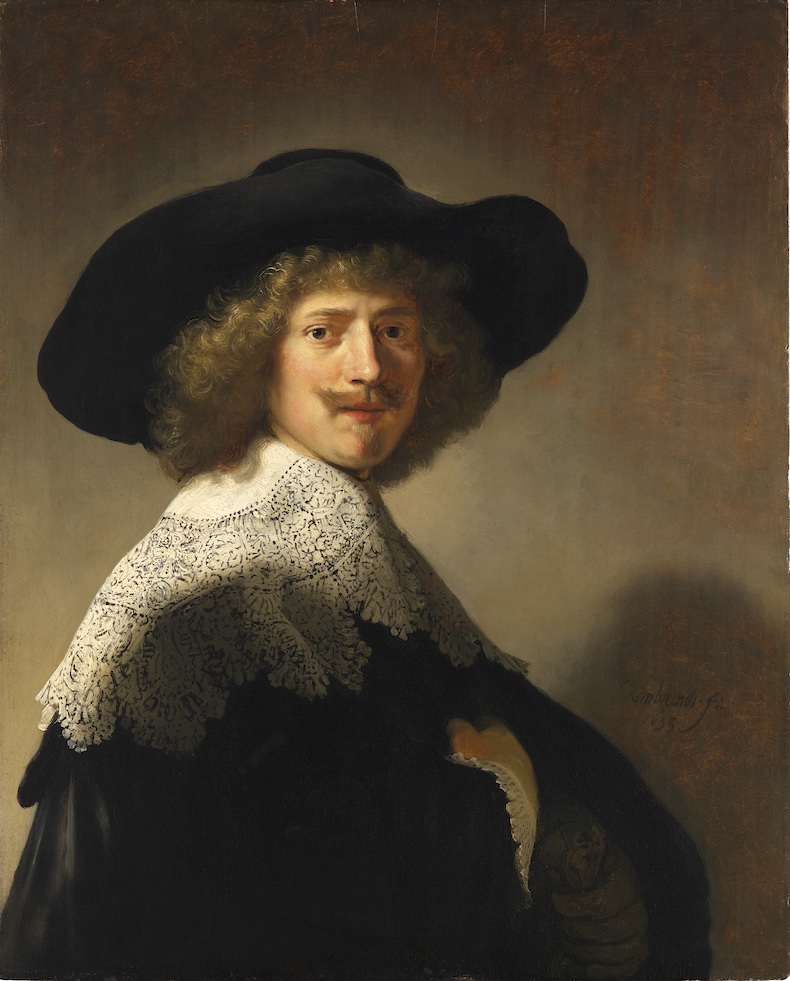
Visitors need not follow the show’s historical narrative all that closely; often the objects speak for themselves. Take for example the Portrait of Antonie Coopal (1635), a product of Rembrandt’s Amsterdam studio (issues of attribution, influence, style and technique are mostly set aside in this show). The sitter looks out with a direct, guileless expression, his face framed by a fashionable lace collar and a bob of woolly hair. Coopal was a young government administrator from Vlissingen – or Flushing, as it was called in English. Nearby, a case displays the Flushing Remonstrance of 1657, an early appeal for religious tolerance composed on behalf of a group of Quakers residing in a village that became part of the New York City borough of Queens. Through shared place names, materials and attitudes, one gets a sense of New Amsterdam’s place in the Dutch Atlantic world. Coopal’s portrait is painted on a tropical hardwood panel. An atypical support for Rembrandt, it might have been recycled from a packing crate shipped from Recife in Brazil to Amsterdam.
In Frans van Mieris’s Young Woman Feeding a Parrot, the artist captures the conflicted sense of wonder and trepidation associated with global encounters. A young lady extends a tiny morsel to her pet bird. She retracts her thimble-covered finger and pulls back needlework, fearing its pointy beak. The bird is identifiable as an African grey parrot, a species that arrived in Europe via Portuguese traders in the mid 15th century. But beyond its documentary interest, van Mieris’s painting shows off the technical skill of Leiden’s fijnschilders (‘fine painters’), known for the glossy finish of their upper-class domestic scenes: notice the sophisticated spatial puzzle of the bird’s perch or the exquisitely rendered textures of the girl’s expensive clothes, made of dusty rose velvet, white fur and buttery yellow satin.
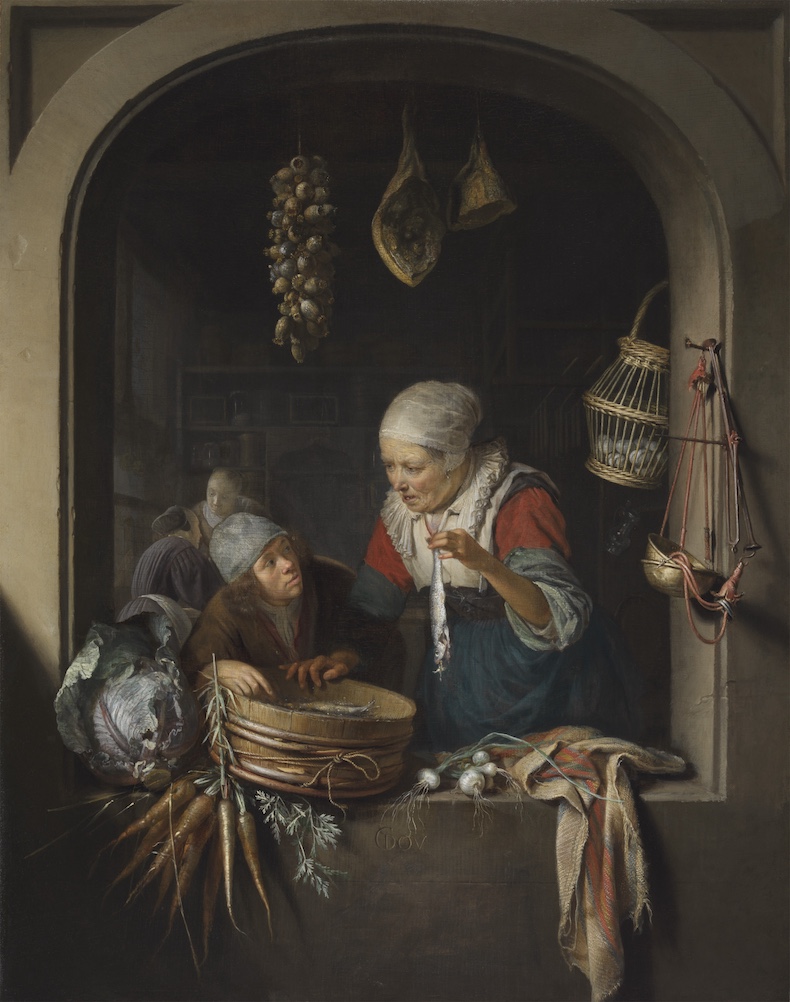
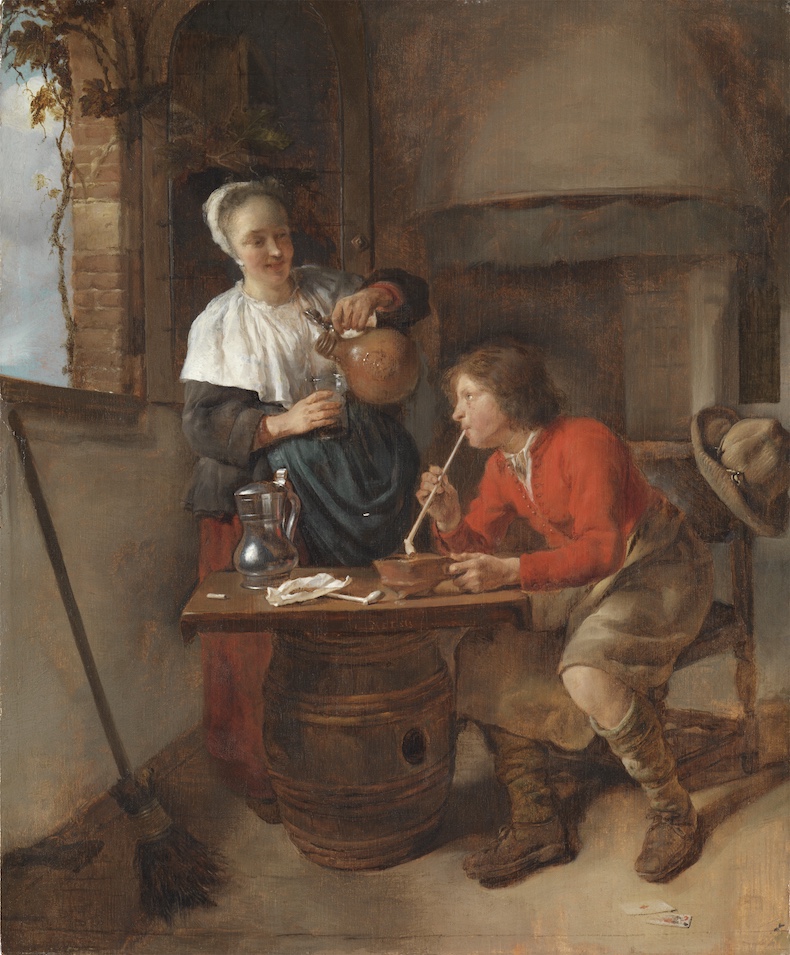
The wall labels don’t insist on the symbolic meanings of these genre subjects: birds, for instance, are not treated as sexually suggestive symbols but as exotic commodities. The emphasis throughout is on the real things, spaces and social situations that these artists depicted so carefully: clay pipes, candles and stoneware jugs in intimate tavern scenes, such as Gabriel Metsu’s Smoker Seated at a Table (c. 1654–57). Or the exquisite textiles, desk sets and tableware that appear in elite settings, including Cornelis de Man’s Portrait of the Pharmacist Ysbrand Ysbrandsz (1634/35–1705) in an Interior (c. 1667). Some works, for example Gerrit Dou’s Herring Seller and Boy (c. 1664), turn the scrutiny of commercial goods into a brief comic sketch.
For all their apparent veracity and humanity, these charming paintings reveal only so much. Van der Donck’s Description of New Netherland reassured Old World readers that all was well in New Amsterdam, despite tense and violent relations between Dutch settlers and the indigenous Lenape tribes. And all those shimmering pelts of fur, felted hats and tobacco-stuffed pipes conceal an exploitative system of land grabbing and forced labour operating out of frame.
A display of etchings by the Bohemian printmaker Wenceslaus Hollar show how the commitment to pictorial realism extended to the colonised. Hollar’s images of Black children in European dress and tattooed Algonquian figures are sensitive portraits. But the sitters are unidentified, as unknowable as the epistolary exchanges and daydreamers depicted in paintings nearby.
What emerges, then, is a frustrating but compelling point about what can and cannot be shown, both in the historical record of New Amsterdam and in the verisimilitude of Dutch paintings. It is a fact that Dutch artists of the 17th century confronted directly. The illusionistic stone arches that surround many genre scenes are meant to cue viewers that what’s inside the frame is a staged fiction. ‘Old Masters, New Amsterdam’ gently encourages us to acknowledge that both nations and paintings are imperfect inventions.
‘Old Masters, New Amsterdam’ is at the New York Historical until 30 August.
From the June 2026 issue of Apollo.