I skittered up the main avenues of the Giardini like a pinball on the first preview morning of the Biennale, propelled by the fear of queues to come. Despite their sombre tailoring, art people are basic. I knew any pavilion featuring nudity would have lines trailing back to the entrance within hours, so I needed to get in there fast. (For professional reasons, naturally.)
First stop: the Danish pavilion, in which Maja Malou Lyse ponders the crisis in male fertility that is coinciding (causally or otherwise) with the rise of the manosphere and online pornography. Putting the ‘tit’ firmly into ‘titular double-entendre’, Things to Come offers a grim perspective on contemporary sexuality and gender relations. On one side of the pavilion is a bank of semen transport containers from which small screens show footage of young men flexing their machismo by entering sperm races. On the other, adult movie performers in micro-bikinis play sci-fi scientists studying fertility rates.
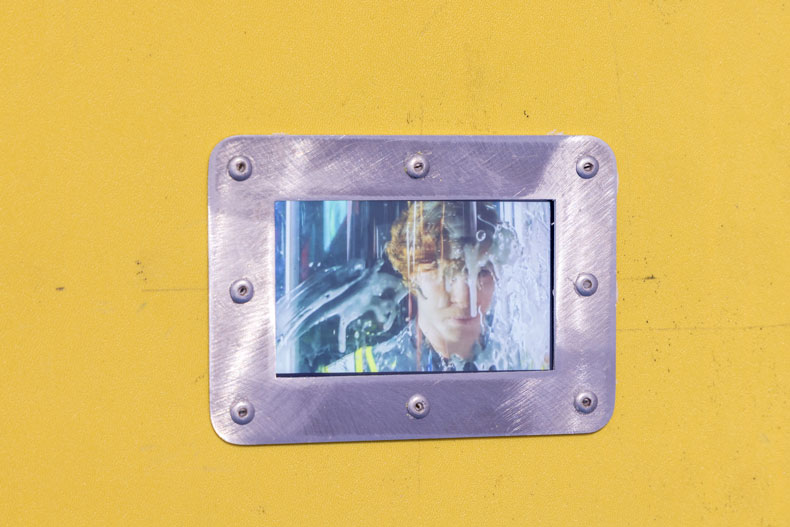
I have only so much tolerance for milky ooze and roiling silicone, so I rolled on to the Austrian pavilion, transformed by the experimental performer and choreographer Florentina Holzinger. Seaworld Venice is part temple, part theme park, part waste treatment facility. Its hour-long performance cycle is inaugurated by the tolling of a bell, with a naked woman suspended as the clapper. Inside the pavilion, athletic (and heavily muscled, bruised and scarred) female performers deliver aquatic and acrobatic stunts involving a jet ski, bow and arrow and climbing tackle: no supine nudes here. One member of the troupe stands submerged in a central tank, filled up with (real) treated water from the two adjacent Portaloos, which visitors are invited to use. Driving home the lavatorial point with faecal slapstick, a hapless, spattered, technician struggles to gain control of a (fake) sewage treatment unit in a state of permanent explosion in an adjacent gallery.
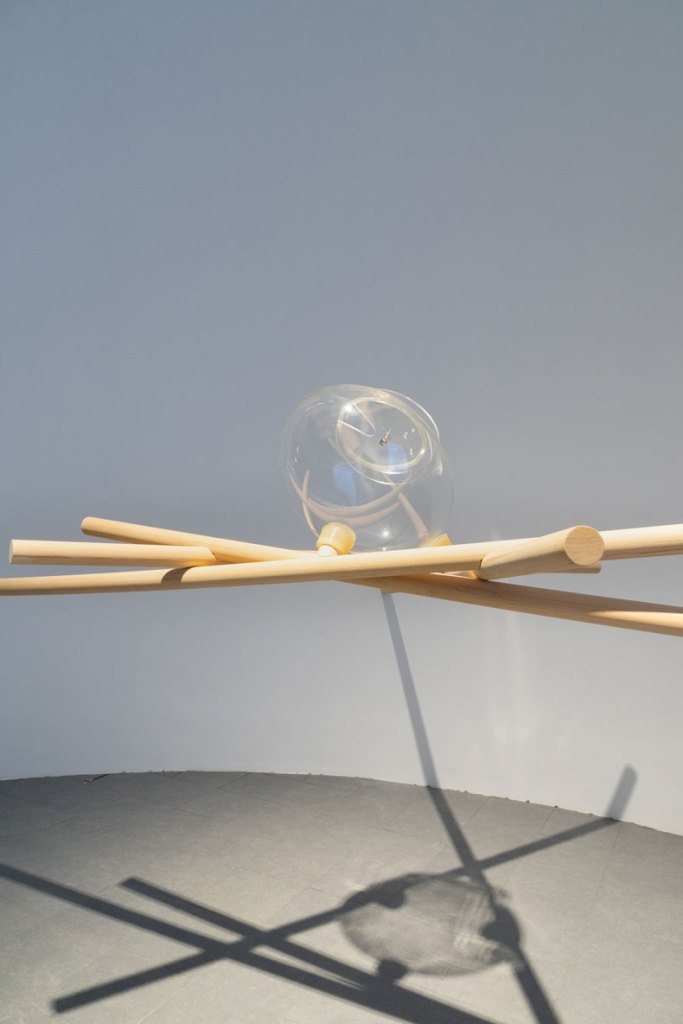
It feels a fitting moment for gallows humour, and a number of countries adjacent to Ukraine took recourse in the absurd, albeit with a melancholy edge. Representing the Czech and Slovak Republic, Jakub Jansa and Selmeci Kocka Jusko’s The Silence of the Mole features an ageing children’s entertainer playing to a world that has lost its innocence. In the Hungarian pavilion, Endre Koronczi walks for a year carrying a sigh trapped in a glass vessel on his back – an expression of exasperated endurance elevated to something of a national symbol.
The Dutch pavilion has become a less poetic (and, indeed, less subtle) metaphor in the hands of theatre director Dries Verhoeven. During a 25-minute performance, all doors, windows and ceilings are progressively shuttered off, leaving the audience in encroaching darkness with a performer delivering creepy Instagram platitudes in a slow zombie growl. In case the ‘fortress Europe’ symbolism is insufficiently clear, the work has helpfully been titled, er, The Fortress. I sat in the dark feeling like an extra in the Swedish artworld satire The Square (2017).
In the UK pavilion, Lubaina Himid delivers a more hopeful vision of co-existence, with monumental paintings punctuated with rivulets of hot colour, showing pairs of workers navigating their way through shared tasks and responsibilities. Chefs, architects, tailors and gardeners discuss, dispute and find ways to work together. Among other things, the display questions the meaning of ‘home’ and the idea of it being linked to a nation state, instead proposing belonging as an experience to be marked by building, growing, making things together and, crucially, sharing food.

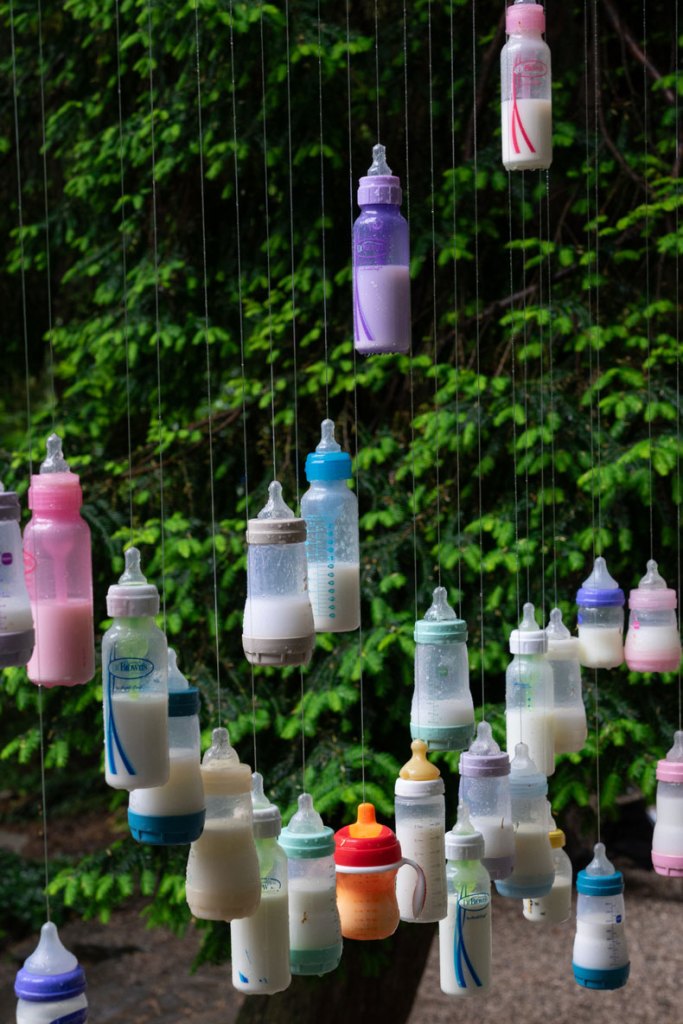
Much jollity at the Japanese pavilion, where Ei Arakawa-Nash invites visitors to ‘adopt’ a sand-weighted baby doll during their visit. A line of buggies is parked outside and bottles are dotted around. Nappy changes yielded a poem. I got a kick out of seeing Miyake-clad artworlders touting babies but, like their gestures of care, it was a tad performative. A corner of the main space was offered as a changing station for real babies. This seemed optimistic, if not naïve. The prospect of dealing with a wriggling child with a dirty nappy, and all the attendant sounds and smells, shielded from the rest of the pavilion by only a little curtain did not appeal.
Just outside the Giardini, I popped into the Estonian pavilion, housed in a chapel-turned-community-hall-turned-studio, its floor clad in painted tiles by the artist Merike Estna. Estna’s The House of Leaking Sky is an exercise in durational painting, for which she will be living in Venice with her extended family throughout the Biennale, completing a multi-panel painting the size of the building’s wall. Estna’s paintings are many-layered, so Venice will reveal the hidden process and labour involved. At least three real-life babies were in evidence – offspring of the curatorial team, their friends and visitors. Apparently the babies needed their own accreditation for the pavilion days. Truly, arts professionals are getting younger and younger.
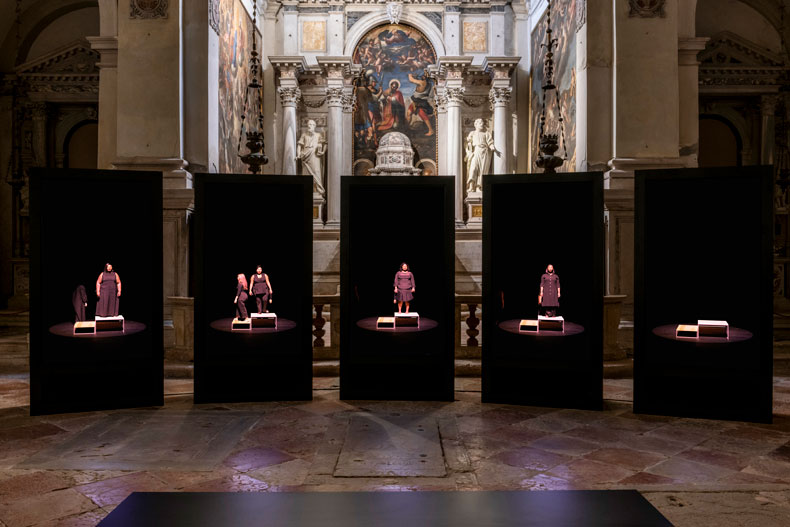
Arguably the best pavilion was the pavilion that never was. Gabrielle Goliath’s Elegy was commissioned for the pavilion of South Africa but cancelled by the country’s culture minister for being ‘highly divisive’. Now installed in the Chiesa di Sant’Antonin, the eight screens of Elegy broadcast three stagings of a performance by female vocalists. Clad in black, they step in turn on to a small platform, each holding a single vocal note, which is picked up by the woman behind her as she steps up to take her place. The first performance, in 2014, honoured the death of Ipeleng Christine Moholane, a South African woman. The second, two Nama women killed in the early 20th century. The third, the Palestinian poet Heba Abunada, who was killed in Gaza in 2023 at the age of 32. Within the church, the sung note frays, swirls and reverberates, inescapable: a collective call to mourning that transcends language or cultural divisions.
The 61st edition of the Venice Biennale runs until 22 November.