From the June 2026 issue of Apollo.
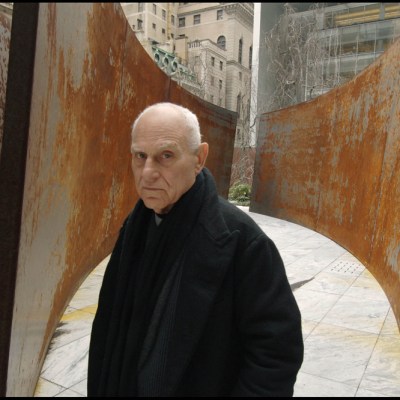
When we meet, Anish Kapoor’s exhibition at his foundation in the Palazzo Manfrin in Venice (until 8 August) has just opened to coincide with the start of this year’s Biennale. Before our interview begins, Kapoor can be found standing by the large, faintly scatological large clay presence of Ga Gu Ma (2012), being interviewed by a BBC crew. When that interview ends, another crew from Associated Press arrives ready for their slice of an artist who is now not only art-world famous but news-desk famous. Born in Mumbai in 1954, Kapoor began his art career in London in the 1970s, but was never a YBA. Yet his fame is on that scale, perhaps because he won the Turner Prize in 1991, becoming part of the ’90s London art scene that fascinated not only the broadsheets but the tabloids too. Certainly, talking to Kapoor, one gets the feeling that he knows he is being quotable.
As Kapoor discusses how he makes his work, it sounds playful. ‘I go to the studio and, I don’t know, sit on a sofa, sit on the chair, and go, “uh, what am I going to do today?” […] and then do a drawing, make a thing – play and let something emerge from that process.’ The critical point comes when he puts it up on a wall or does ‘whatever is appropriate with it’. He will ‘look at it, but look at it and take it seriously and let that be an opening for whatever comes next – whatever project or painting, or whatever it is going to be. And that is a process which I’ve been through thousands of times, and go through virtually every day, because I really believe in practice. And from it, weirdly, meaning arises.’
Aside from Venice, where Kapoor is showing around a hundred architectural models of his works, June sees the arrival of his second exhibition at the Hayward Gallery in London. He is one of only a few artists to have been invited back there for a second time. It is not, he is at pains to point out when we speak, a retrospective. ‘There are one or two older works, but it’s almost all new,’ he says.
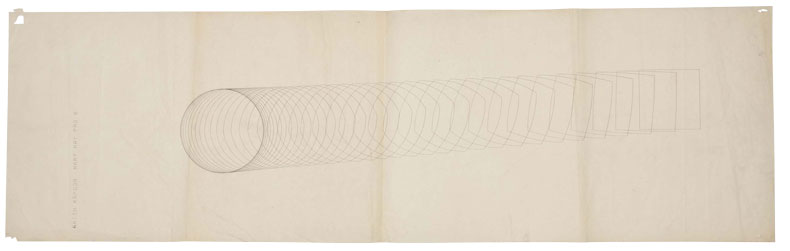
The first work that Kapoor records on his own website is from 1973. Circle to Square Drawing shows a shape that starts as a perfect circle, gradually manipulated until it becomes a perfect square. The long line of shapes seems to stretch through space, an illustration, perhaps, of a slice of infinity or a path into another dimension. Its concern with both space and form are typical of Kapoor’s work. Yet it lacks what is most often thought of as Kapoor’s signature: his use of colour.
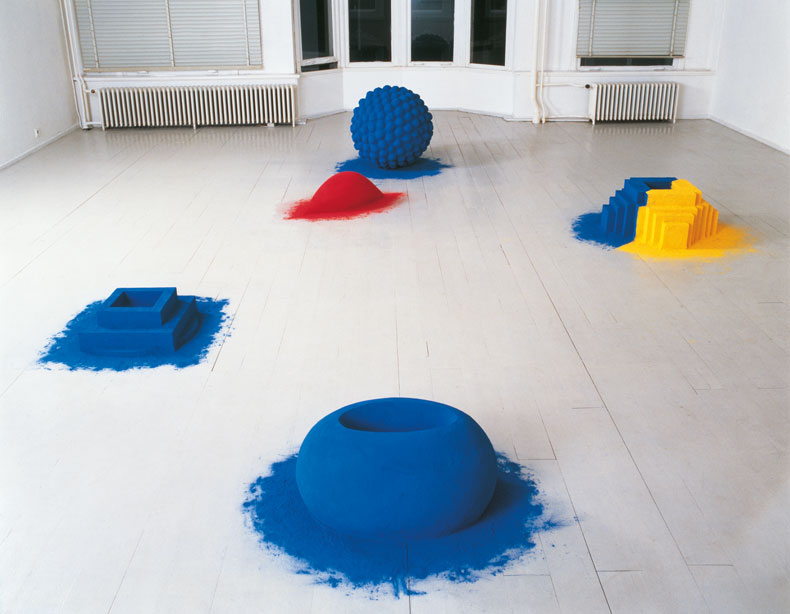
‘Anish Kapoor: Early Works’ closed at the Jewish Museum in New York at the start of February this year – Kapoor’s mother was of Iraqi Jewish descent. The first thing the viewer took away from this exhibition was most likely colour. Amid the drawings and gouaches were Kapoor’s pigment sculptures. These small works are charming in part because of their modesty. Two hollow cuboids are stacked upon one another, covered in a blue pigment that looks related to International Klein Blue, with a pool (or, in Kapoor’s words, ‘halo’) of pigment around the bottom. A sphere covered in bobbles and a torus have the same treatment. A more complicated shape, a hollow cube with square protrusions off each side, is bisected by colour. One half is blue, the other yellow. And next to the blue sphere is an exquisite arc of powerful red, also with a halo around where it meets on the floor.
There is something purely delightful about these shapes, as though the colour masks the difficult mathematics behind them. (Before moving to London to attend art school in 1973, Kapoor studied electrical engineering in Israel.) The halos add to this playful impression – who can resist the pleasure of making patterns with pigment on the floor or hoping that any mess they make might look so artful? Kapoor admits that his work ‘is absolutely not rationalised, it’s not thought through’. The image of the young artist earning a living from teaching art, using pigment swept up from the studio floor to make these works, seems all too vivid. Of course, this is the playfulness of the artist, not of the park football game, but Kapoor demurs. ‘You probably heard me say this 10 million times: I have nothing to say as an artist.’ Yet for an artist who has ‘nothing to say’, it speaks to a wide audience.
One of the great pleasures of talking to Kapoor is his use of quotations. Continuing the idea of pure meaning being detrimental to art, he says: ‘I do, for myself anyway, look to this strange place between meaning and no meaning. Another one of my horrible, stupid, endless quotes is Paul Verlaine. He said a bad poem is one that falls into meaning. “Falls into meaning!” I love it.’ The idea seems to freshly excite Kapoor merely by repeating the quote. He does not even need to be finding or making a good poem or good art; that is, art ‘that sits between meaning and no meaning, in that space in which we say, “is this art? Whoa, why? No it’s not art, I refuse to look at it,”’ until it can’t be resisted.
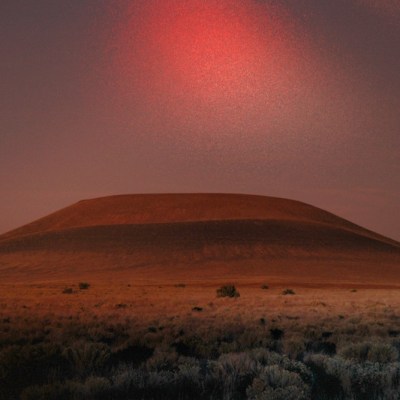
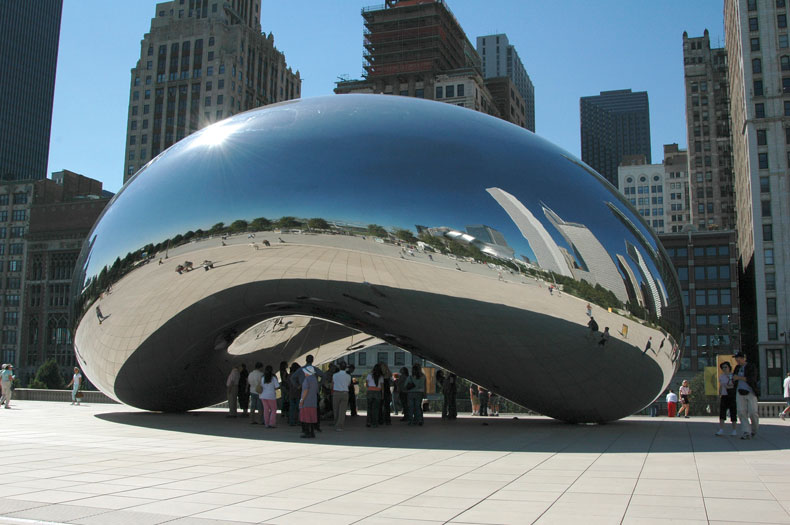
Increasingly, as his career has progressed, the works have got larger. The idea of being able to find space in his studio for, say, Cloud Gate (2004), the large stainless steel sculpture that has captured both the imaginations and the selfies of visitors to Chicago’s Millenium Park, has become somewhat difficult to do. With these big works, he says, ‘you’ve just got to jump in and go with it.’ But they don’t grow out of nothing. Models, he says, are important: to be played with, twisted and turned. Mount Moriah at the Gate of the Ghetto (2022), an enormous inverted mountain of red pigment and silicon first exhibited at Palazzo Manfrin and which will be shown at the Hayward, underwent this process. ‘I can’t even remember how I decided to put it upside down,’ Kapoor says. ‘It was a place and moment, obviously.’ He then adds, almost as an afterthought, the tantalising detail that ‘the title almost always comes afterwards’. Tantalising because it means ‘I’m not illustrating an idea’. He becomes interested in an object because of itself, and then ‘resonances occur’.
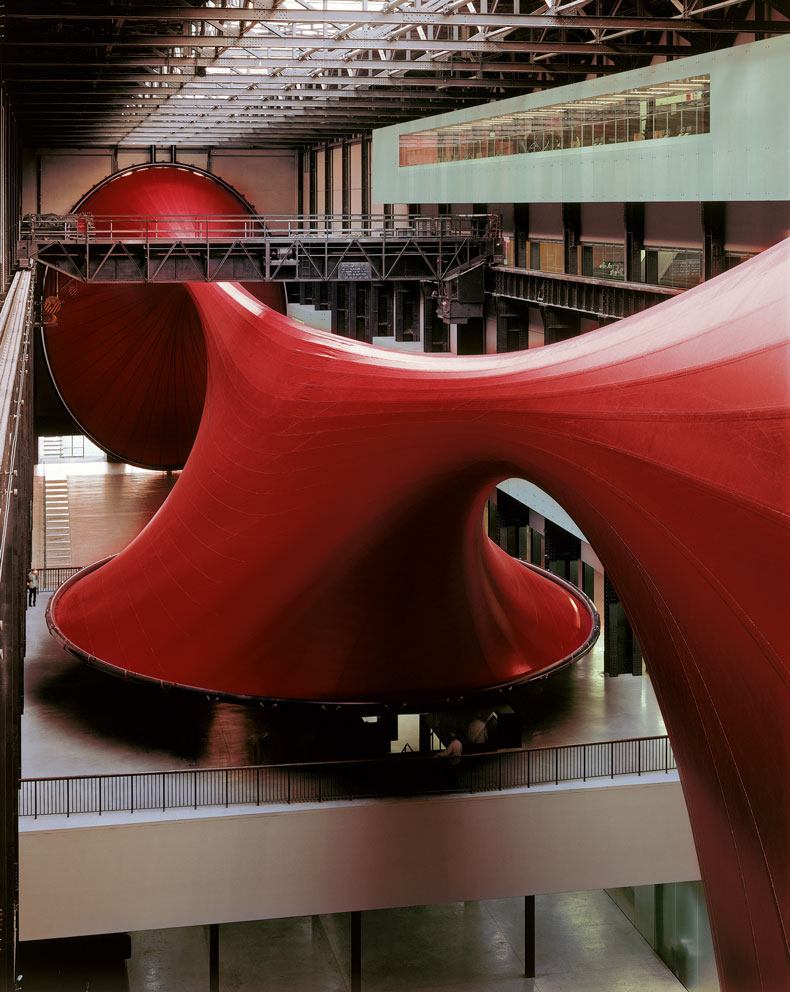
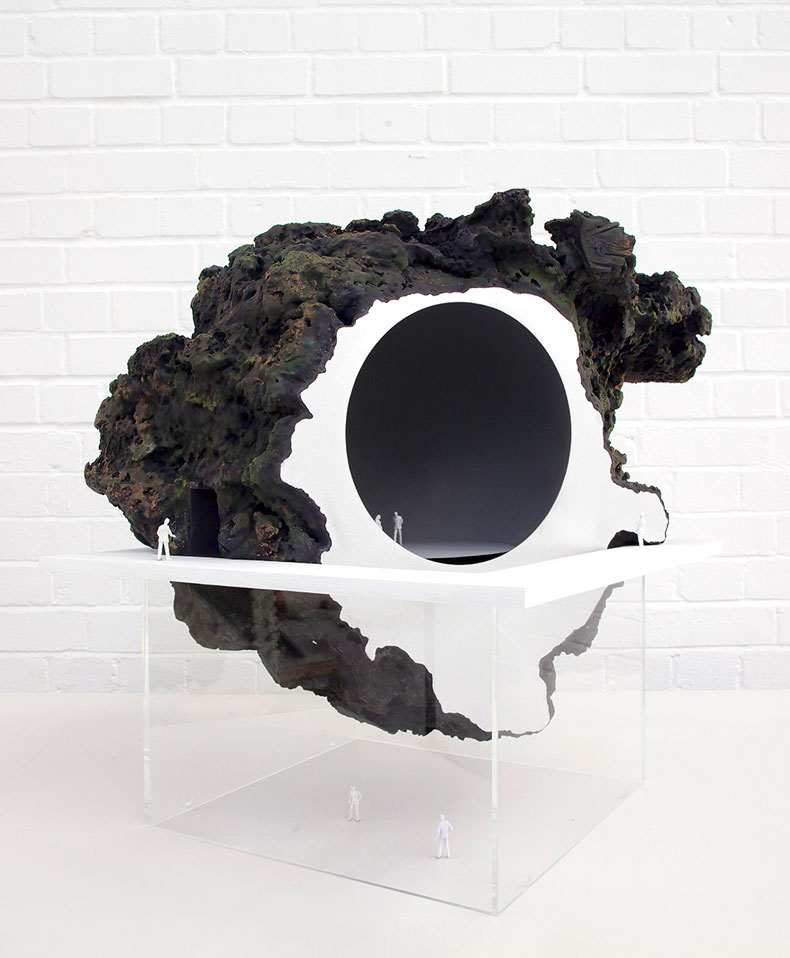
The question of models and scale is hard to ignore on a visit to Palazzo Manfrin, which includes both some of Kapoor’s best-known projects and others that were never realised. Marsyas (2002), three giant steel rings joined together by a tubular stretch of red PVC, was installed in the Tate Modern Turbine Hall. By contrast, Kapoor’s proposal (with Zaha Hadid) for a Holocaust memorial in London exists only as a model. The idea was to place a 60m bronze meteorite in Victoria Tower Gardens, next to the Houses of Parliament, that visitors would be able to walk into: it would have had a ‘rock-like surface – bronze does amazing things, we could do it pretty well’. The model for Marsyas makes it look so simple, like a sort of bright red hearing tube. My memory of the actual work was of a huge expanse of PVC that made it hard to take in everything at once. Standing beneath it, one had the feeling of being subsumed by its orifices; in the model it is much more graspable. ‘Scale is the most mysterious, strange, poetic thing,’ says Kapoor. ‘I mean, Barnett Newman said scale is a matter of meaning, not a matter of size. I am sure that is completely accurate.’ In our era, says Kapoor, ‘we are used to big spaces of all kinds, but big objects are still confusing.’ The title’s mythological allusion to the satyr Marsyas, who was flayed alive by Apollo, hints at the intended expanse of the work: the cosmos of Greek myth is meant to be ‘part of the scale too’.
A title, even if it comes after Kapoor has devised the form, cannot help but change the way a work is understood, nudging the viewer in a particular direction. I wonder if time has changed the way Kapoor sees his works, but he is reluctant to see things in such a binary fashion: ‘How can I put it? They live with me all the time. I keep going back to them.’ Not literally so, he says, but the ideas previous works contain have stuck with him. ‘I go back to them partly because of the colour. Then, because of the idea they are very simple objects sitting on the floor with a halo around them,’ he says. ‘The notion that always sticks with me is that they are like an iceberg. Most of the object is under the ground and invisible and part of the object is visible above the ground with this pigment on it. So [there’s] this idea, if you like, of the invisible present, and I keep coming to it again and again.’
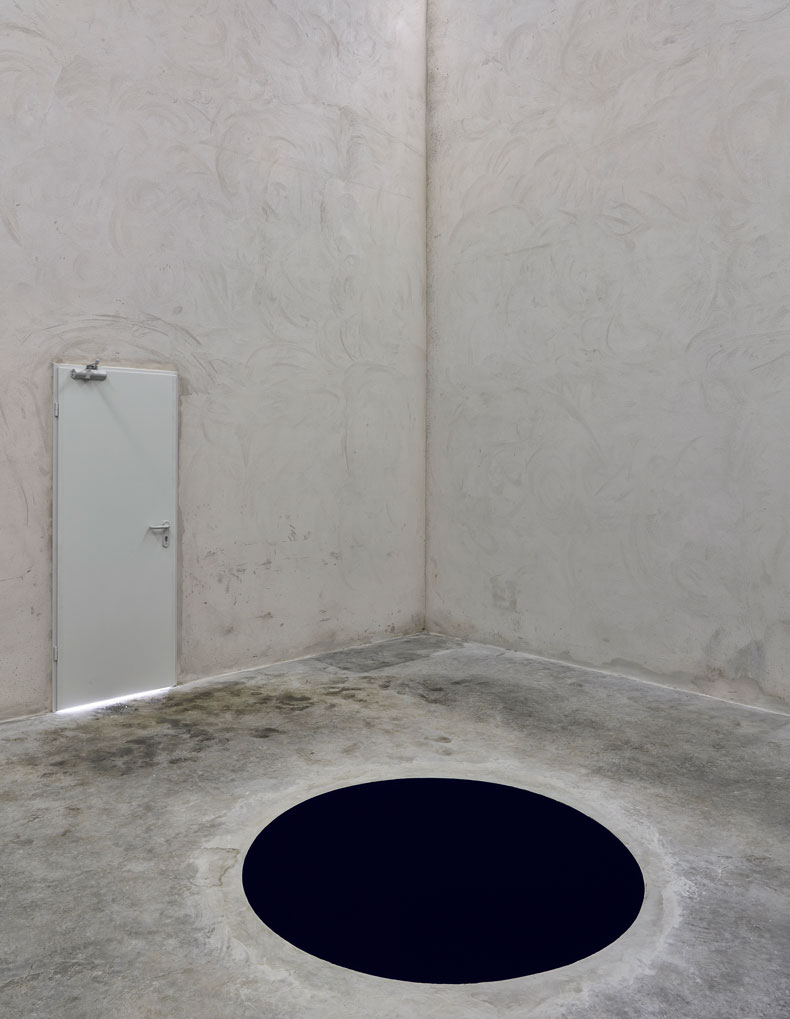
The invisible present is a constant theme in Kapoor’s work. One entire room of the Palazzo Manfrin is filled with a new version of At the Edge of the World, originally made in 1998. A pigment-filled dome is, in this iteration, filled with black pigment. It gives the uncanny sensation of not knowing what is above you, while being fairly sure that something is there. Or think of Kapoor’s 1992 work Descent into Limbo, where a two-foot hole, painted impossibly black, suggests a portal to somewhere beyond the imagination. The works vibrate with potential and possible readings, all deriving from what is unseen as much as seen.
Where this came from is hard to pin down. Kapoor identifies the time he spent at Chelsea College of Art between 1973 and 1978 as ‘the heyday of art school and art teaching’. Part of this ‘wonderful’ experience was down to his teachers. He first picks out Paul Neagu, ‘a refugee himself, who ran away from Romania, and in a way, a kind of outsider […] gave me, if you like, a huge gift of the sense that an artist could reach into other spaces’. But it was not only Neagu who made that time so special. ‘We had young Marina Abramović teaching, not for long, but she was there; Michael Craig-Martin, artists of all kinds. We had at least a different artist every other week, from somewhere not necessarily Britain. And it was fabulous to see all these different sorts of practice that artists were engaged in.’ It was also here that Kapoor was told to think about being Indian by Craig-Martin, ‘because maybe he too… he’s American, came here, lived in the UK and, in a way, formed himself completely again’. This is not a category that Kapoor is particularly looking to be placed in. ‘I have always refused to be referred to as an Indian artist. What’s important to me is to be referred to as an artist. I happen to be of Indian origin but that’s not my purpose.’
Part of the richness of this time was due to what many people now refer to as the ecosystem of the art world. ‘Five or ten artists made a living from selling their art. Nobody else did. Everybody taught, that was almost the only way to make a living.’ The point is not only that this brought in a vast range of different artists into the orbit of students but also that ‘if you like, the pressure on the object is non-existent’.
Kapoor sees this freedom as having run all the way through to the ’90s. ‘My generation was the first one when, I don’t know, Transavanguardia [the late 1970s and early ’80s wave of neo-expressionist painting] happened, when the figure re-entered the minimalist dictum. Suddenly the market woke up to something, and that was fine. It went all the way through the YBAs and so on. But there was still experimentation. An openness to newness in the way that things could be made was there.’ Kapoor now sees this as almost impossible to maintain, ‘I’d say 99 per cent of formal invention is behind us. So then what? You’re just left with your own little story. Oh my lord, how utterly fucking boring.’ It is not only a formal problem, but also one that relates to the market. ‘Given the horrors of capitalism, the way it’s taken over our art world, the way that younger artists are forced to make saleable objects to make a living, it’s not good for what it says, culturally.’
Despite his belief that formal invention is behind us, Kapoor continues to stake out new territory. In recent years, he has been playing with Vantablack, a super-black coating that is one of the darkest man-made substances on earth. It absorbs 99.965 per cent of visible light. Kapoor has made a series of sculptures coated in this substance, known as Non-Objects. These sculptures toy with the idea of invisible folds. ‘There was, in the Renaissance, in my view, two great discoveries,’ says Kapoor. ‘One of them has Greek origins and that is the fold; perspective is the other. We know about perspective, we won’t talk about that now. But the fold is most interesting because it is a sign of being. It is being itself, in a sense; often, especially in early Renaissance painting, the cloth was the persona.’ It is against this background that he makes works that contain folds ‘and the amazing thing about this black material is that when you put it on a fold, you can’t see the fold. So what it does is, to my mind, push the object into the fourth dimension […] that is to say, turn it into something perhaps less graspable. At one level, of course, all this is fiction, but what is the poetic object if not fiction?’
I can only imagine the hours of R&D it took to perfect the use of Vantablack. Even now the Vantablack sculptures have to be kept behind Perspex, much to the chagrin of the artist, as they are too vulnerable to human breath. But development of technique is nothing new to Kapoor. Many of his works are perfectly reflective planes of stainless steel. This might seem to be a precarious enough material to work with, but think of the concave forms Kapoor deploys and things become even more complicated. ‘A concave one magnifies everything and therefore it magnifies its surface,’ Kapoor explains. ‘So to get something made it doesn’t have to be perfect. It has to be way beyond perfect. It has to be so impeccable. You can’t see a weld; if you do, it’s dead.’ Perfecting this impossibility took Kapoor’s technical collaborators 10 years. ‘To get it intellectually, you can get it. Visually, you can get it. But to do it, whooo, nightmare!’
Kapoor says that it is about training the eye to use the available technology to produce materials at this ‘stringent’ level. ‘It’s, you know, fractions of a millimetre, teeny differences. You can see them.’ Behind these works that take in other dimensions and mythological possibility, it’s all about the detail. Those poor fabricators. ‘We’ve learned to work together over the years. It’s complicated, expensive.’
Like he says, each work is an iceberg.
‘Anish Kapoor’ is at the Hayward Gallery, London, from 16 June–18 October.
‘Make New Space/Architectural Projects’ is at Palazzo Manfrin, Venice, until 8 August.
From the June 2026 issue of Apollo.