‘Strawberry Thief’ printed cotton (1883), designed by William Morris. Photo: © William Morris Gallery, London Borough of Waltham Forest

‘Four things to see’ is sponsored by Bloomberg Connects, a free arts and culture platform that provides access to museums, galleries and cultural spaces around the world on demand. Explore now.
Each week we bring you four of the most interesting objects from the world’s museums, galleries and art institutions, hand-picked to mark significant moments in the calendar.
On 3 October 1896, 130 years ago this week, William Morris died at Kelmscott House in Hammersmith. The designer and poet had founded his decorating firm in 1861 and produced more than 50 wallpapers and some 600 designs for textiles, wallpapers and embroideries. He studied pattern wherever he could find it, poring over medieval millefleurs tapestries, Indian chintzes and Persian carpets at the South Kensington Museum (now the Victoria and Albert Museum) and campaigning for the institution’s purchase of the great Ardabil carpet in 1893.
Pattern and ornament have not always been so well regarded. In a lecture of 1910 the Viennese architect Adolf Loos argued that decoration belonged to earlier stages of civilisation and that a modern culture should do without it. But a repeating motif is rarely only decorative. Worked into cloth or jewellery, printed on walls, inked into skin or painted on pottery, pattern can mark regional and ancestral affiliation, record and display achievements and initiations, signal rank and status, and carry proverbs, codes and stories. This week we examine four works that are enriched by pattern.
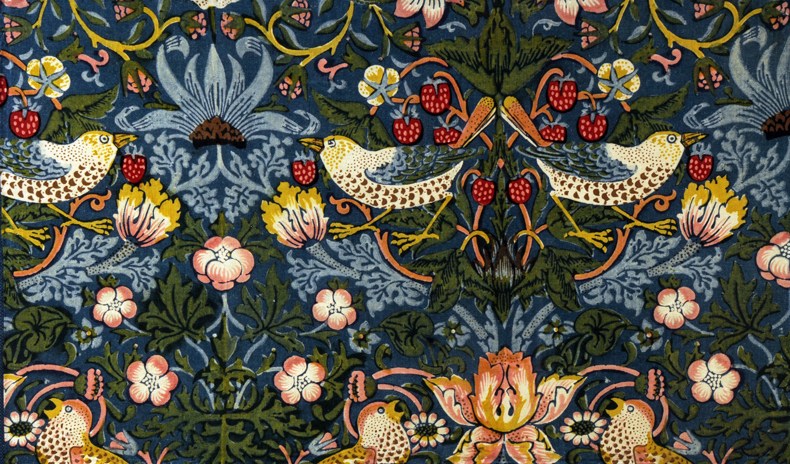
Strawberry Thief (1883), William Morris
William Morris Gallery, London
This design began at Kelmscott Manor, Morris’s country house in Oxfordshire, where thrushes raided the strawberry beds; when the gardener moved to chase them off, Morris told him to let the birds stay so that he could draw them. He argued that a pattern ought to carry the memory of a real place, and that ornament that referred to nothing was worth nothing, a position he set out in lectures throughout the 1880s. Printed at Merton Abbey, this was the first design in which he used indigo discharge to add red and yellow, each colour dyed, printed and washed in sequence over several days. Click here to find out more.
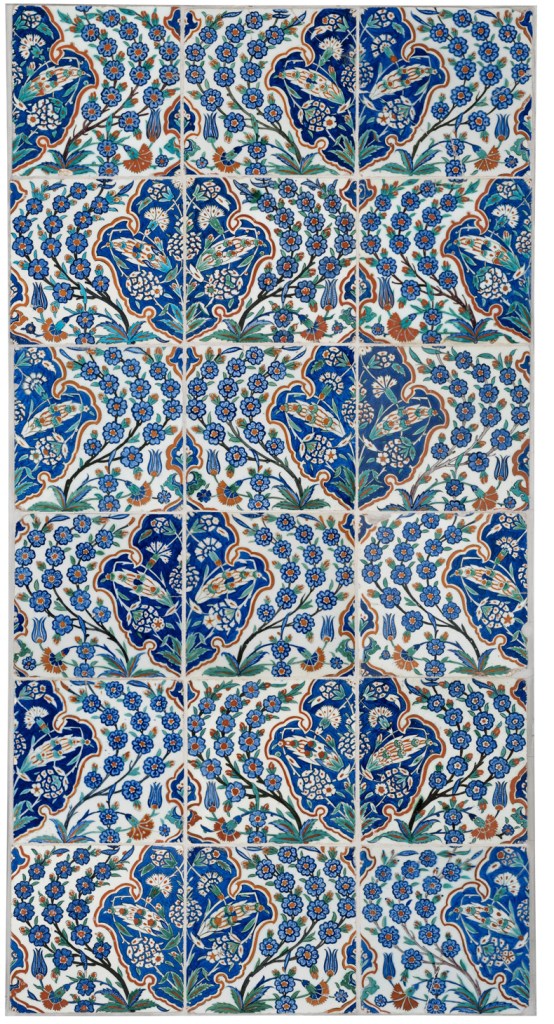
Iznik tile panel (1565)
Museum of Islamic Art, Doha
Blue blossom rises across a white ground, curling past dark cobalt cartouches that hold tulips, carnations and peonies among long serrated leaves. This panel likely adorned a mosque interior. The style began with imitation: Ottoman Sultan Mehmed II admired the Chinese blue-and-white porcelain arriving at his court, and the kilns at Iznik in western Anatolia were tasked with producing something comparable. A century later, after Suleiman the Magnificent commissioned tiles for his new mosque in Istanbul, the palette had widened to include red and green and the borrowed motifs had given way to the flowers of Ottoman gardens. Click here to read more.
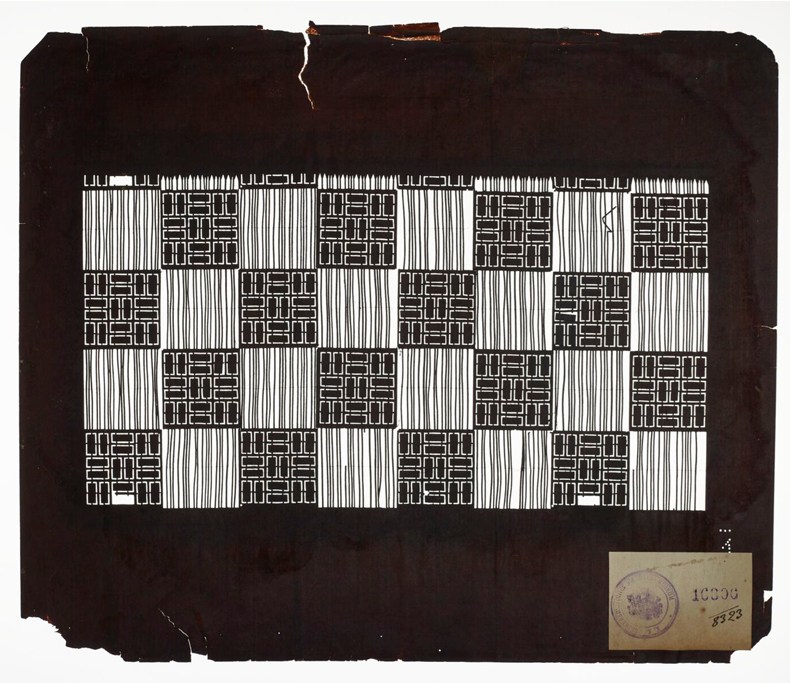
Katagami stencil (19th century)
MAK, Vienna
In this Katagami stencil, a checkerboard alternates squares of hairline stripes with squares of a glyph-like pattern similar to the character that means ‘two’ in Japanese. Such stencils were used to pattern cloth through a technique called resist dyeing. When sumptuary laws in the Edo period barred merchants and townspeople from the bold colours and large designs permitted only to ruling samurai and the elite, artisans responded by going small: patterns dense enough to read as plain cloth at a distance and reveal themselves only close up. Designs indicated a particular clan or territory, worn as a mark of allegiance. Thousands of these stencils reached Europe during the Meiji era (1868–1912), where they had a great influence on the decorative arts. Click here to learn more.
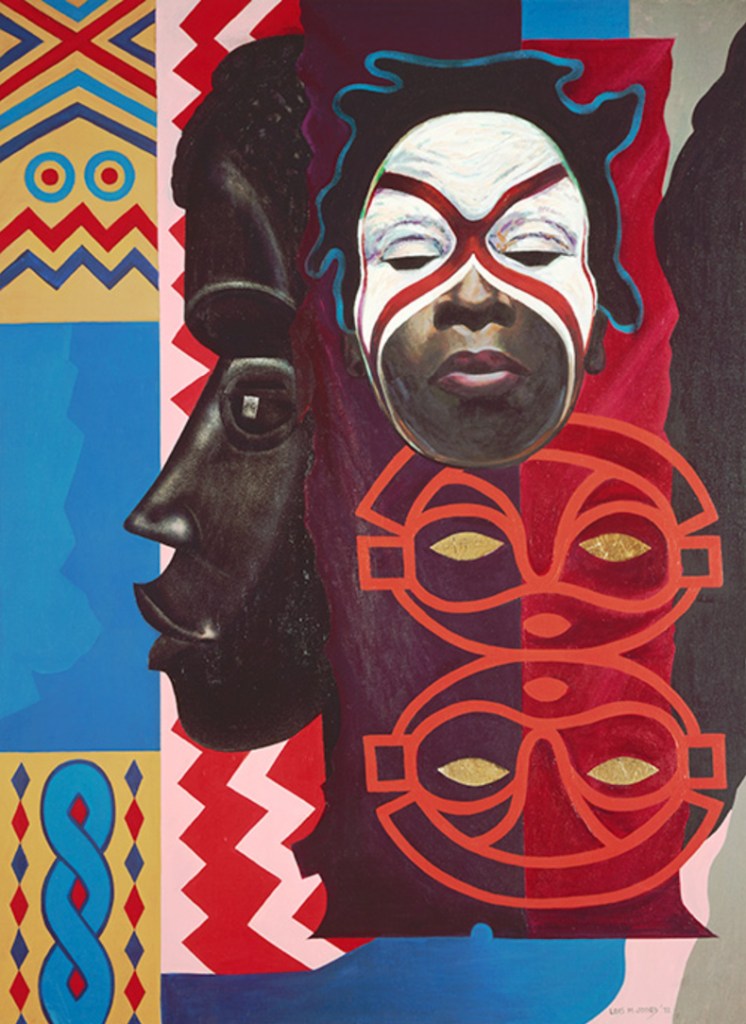
Ubi Girl from Tai Region (1972), Loïs Mailou Jones
Museum of Fine Arts, Boston
The painted face of a young woman floats at the centre of this canvas, surrounded by a mask in profile – probably Dan, from Liberia or Côte d’Ivoire – and the orange outlines of two Pende masks from the Congo. Here pattern appears painted on skin, carved into wood and woven into cloth. Nothing is arbitrary: the twisting blue and red lines at lower left are an Edo motif from the Benin Kingdom called the ‘rope of the world’, standing for the span of a life; the red, blue and yellow motifs are drawn from traditional textiles; and the white face-paint is used in ceremonies initiating girls into womanhood. Jones, who was from Boston, met her subject while visiting various African countries in 1970 – one of many African American artists of the time who searched for a visual language that owed nothing to Europe. Click here to discover more.

‘Four things to see’ is sponsored by Bloomberg Connects, a free arts and culture platform that provides access to museums, galleries and cultural spaces around the world on demand. Explore now.