When I arrive at the Towner Eastbourne, installation is well under way for ‘Maybe: Ryan Gander’. In one room, a team of local recruits is laying out hundreds of small toys and game parts in perfectly spaced straight lines for Closed systems (2024): a floor installation based on a favourite activity of the artist’s son, Baxter, who is autistic and non-verbal. Nearby, Gander is debating whether to display two pieces from his Broken Window Theory series (2019–20) – minimalist whitewashed sheets of fractured glass, behind which fortune cookies are hidden – side by side or separately. His studio manager turns on a TV monitor so I can watch Comic Cosmology (2005), a jaunty video animation of stars from the logo for the 1964/65 World’s Fair, set to an Elmer Bernstein soundtrack created for IBM’s pavilion at the fair.
The exhibition, in a quiet seaside town on England’s south-east coast, is billed as Gander’s first career survey in the country where he was born and lives. This is a little surprising, given that he has worked non-stop since the mid 2000s, building an international reputation for a practice that roves across medium, style and subject matter (his website’s meta description refers to him as a ‘contemporary artist working indiscriminately through all means’). In just the past few months he’s had a solo show at the Salzburger Kunstverein and co-ordinated the Royal Academy of Art’s 258th Summer Exhibition. He has shows coming up in commercial galleries in London and Seoul. And he has a book out: a children’s board book featuring a new series of paintings, made with his son, of educational language cards that can be used for communication.
‘This is not particularly busy. It’s been like this for about twenty years,’ Gander says, taking a break from the install to talk with me in the Towner’s bar and restaurant, a week before the show is due to open. ‘I just enjoy working and have a lot of ideas and don’t procrastinate.’ The incredible variety of his output can make for a baffling encounter: what does it all mean? But pay enough attention and a coherent set of preoccupations will emerge – which have often struck me as revolving in different ways around the same basic question of how we should live. ‘I like that,’ Gander says. ‘Although I think of it more as: what do we value?’
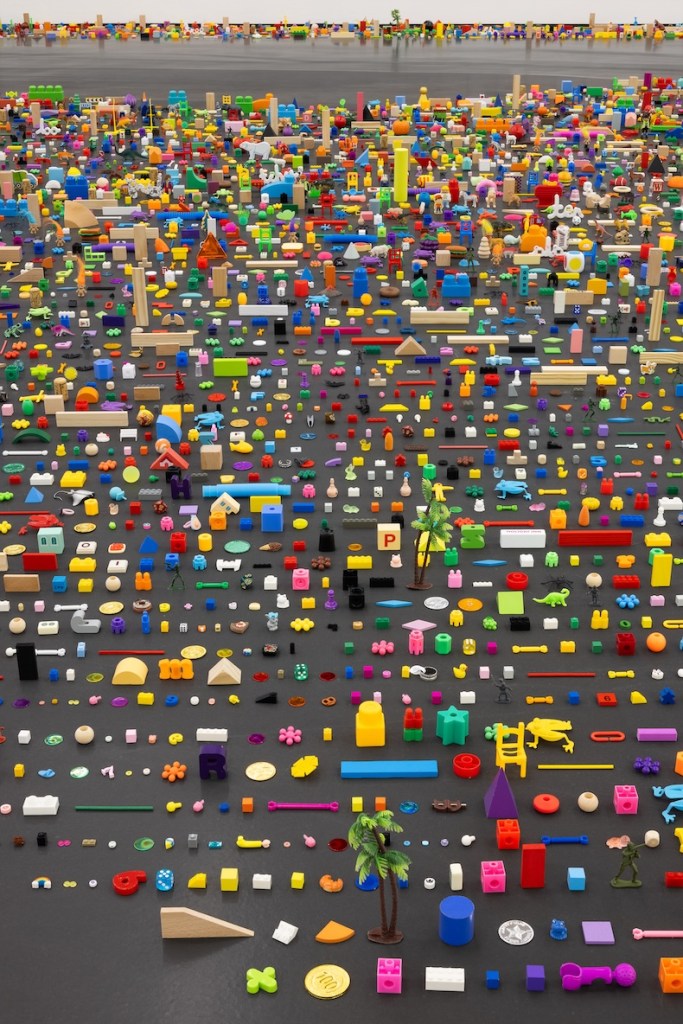
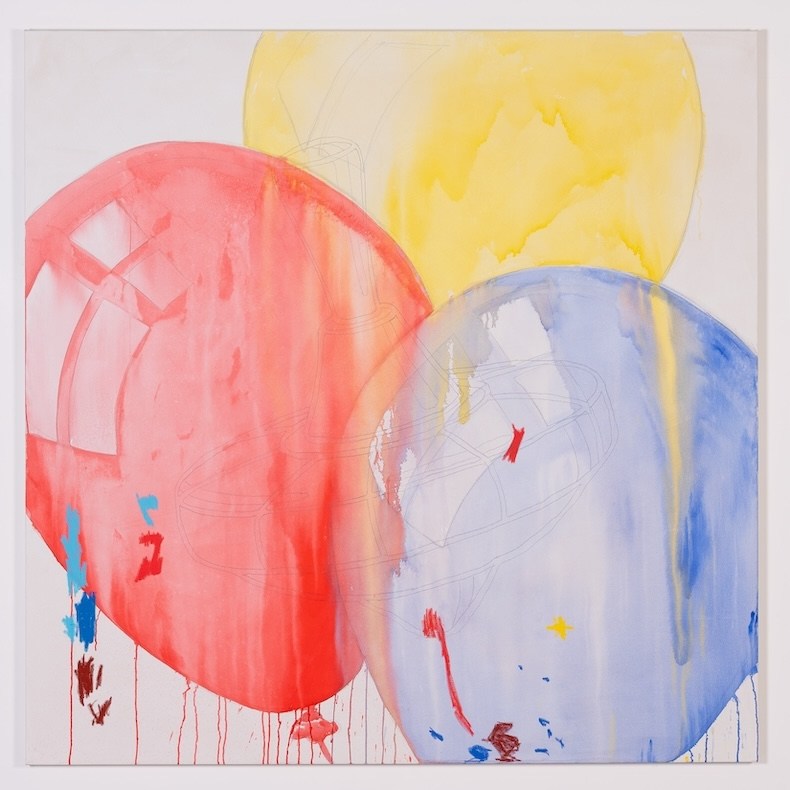
At the Towner, the works are arranged thematically. The gallery with the toys on the floor focuses on the importance of lifelong learning and maintaining a childlike curiosity about the world. ‘Prejudice comes from the fact that [as adults] we’re not close to the culture of education,’ Gander says. ‘We never re-ask ourselves questions because we think we know everything, even though the answers change constantly.’ Also on view are a selection of the paintings made with his son and a pair of bronze sculptures of Gander’s two daughters, Olive and Penelope, in fancy dress, their gazes fixed on brightly painted masks (also made from bronze) on the ground in front of them. The girls have picked out the fantastical outfits themselves, unfettered by social convention.
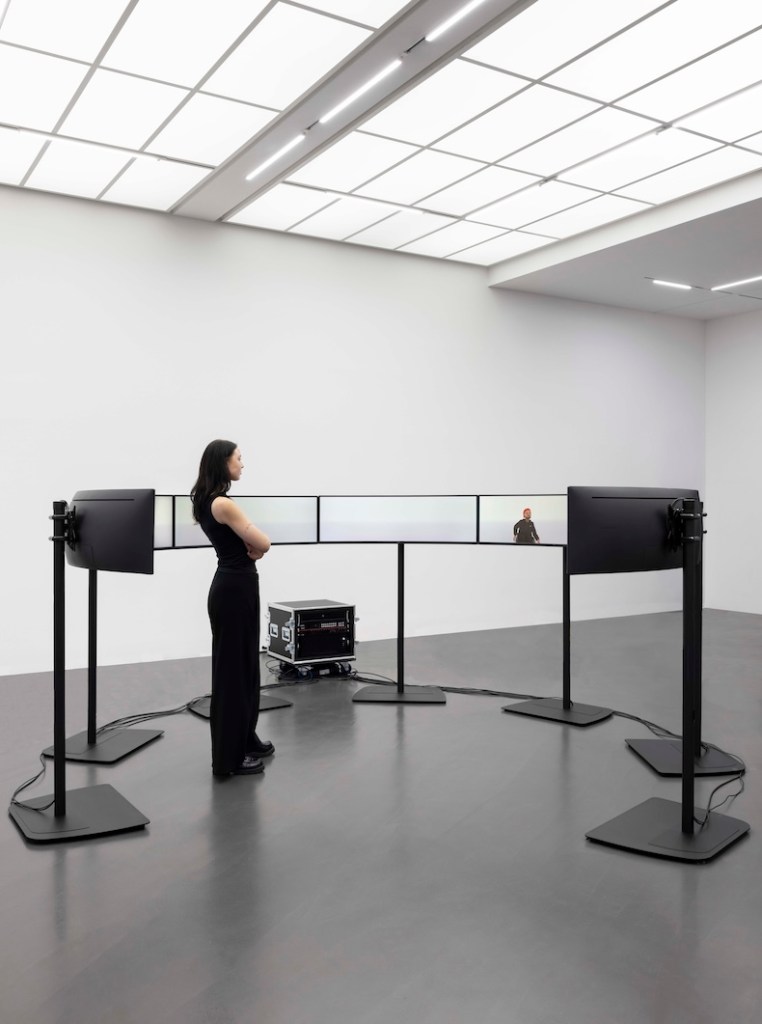
Another gallery deals with mortality and the threat of mass extinction: Gander is a firm believer that time ‘is our greatest asset’. ‘Obviously money is a great enabler, but I do think we’ve overfocused on wealth,’ he says. As well as a black carbon copy of an imagined funeral speech, there is the digital work Ryan Waiting (2024). On a halo of monitors, Gander’s avatar, created using motion-capture technology, moves around an empty white space in his wheelchair. The movements are generated by an AI algorithm which is set to run for 100 years, well past his own death. It’s intentionally dull to watch – a riposte to what he calls the ‘attention-seeking’ spectacle of much contemporary digital art. But for Gander the work is ‘harrowing and haunting’: a reminder that our time on Earth is finite.
In both conversation and writing, Gander is an articulate and convincing expounder of the ideas behind his work. You might wonder why he has opted for the primarily non-verbal discipline of art. But he loves being a contemporary artist because, in his experience, there are basically no restrictions on what you can do: you just need ‘the ability to see things that no one has seen before and the ability to will things into existence’. Here he invokes the concept of ‘reality distortion field’, first used by an Apple engineer in the 1980s to describe the quasi-magical manner in which Steve Jobs managed to convince other people that anything was possible.
Lately, Gander has begun to understand this far-from-common talent as rooted in his youth: a period which, despite his fascination with childhood, he had previously avoided thinking about. (He is about to go on the intensive therapeutic Hoffman retreat, which requires you to fill out a questionnaire about your past.) ‘I was brought up in hospital,’ he says. Gander was born with a severe brittle bone condition – which is why he now uses a wheelchair. ‘All my friends were grown-ups and there were lots of things I couldn’t do as a kid. So like, hyper-FOMO every time there was a birthday party and all the other kids would run upstairs. I didn’t experience things, so I used my imagination to experience things and my imagination got over-enlarged.’
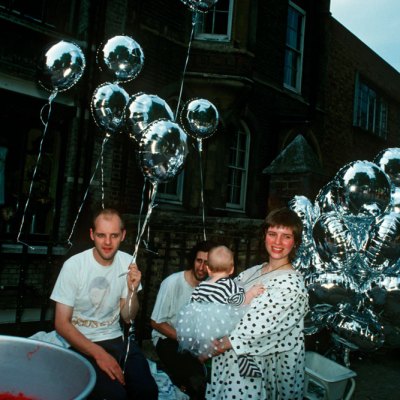
Though he is open about his story, Gander isn’t interested in making what he calls ‘disabled art’ – something he has said many times before. I’ve often wondered about this, because there’s so much personal material in his work. His children are frequent collaborators, and one of the simplest yet most powerful pieces at the Towner is a black-and-white print of the artist’s parents and brother from before his birth: My family before me (2006). ‘All work is autobiographical because it’s made by the artist,’ Gander explains. ‘But no work that I make should exclude through identity. We have so much in common, and so much art just talks about difference. I’m interested in subjects that are as universal and as accessible as possible.’
It’s true that Gander is committed to dealing with the big stuff – more so than the majority of artists working today. This sense of ambition when it comes to the content of his work is also reflected in its scale: the constant stream of new work and exhibitions and other projects. Towards the end of our conversation, Gander brings up the fact that the Towner show is his first major institutional outing in the UK, even though he’s exhibited around the world, from the Palais de Tokyo in Paris to the Guggenheim in New York. ‘It’s funny,’ he says. His theory is that his generation of artists in Britain were overshadowed by their immediate predecessors, the YBAs. But now his time has come. ‘Secretly, I’m really an artist’s artist, and love it when other artists are excited by my work,’ he says. ‘So I just hope some artists can see the show, although it’s not in London.’
‘Maybe: Ryan Gander’ is at Towner Eastbourne from 14 November–11 April 2027.