This review of Andy Holden: Weight of Imagination by Jennifer Higgie appears in the December 2026 issue of Apollo.
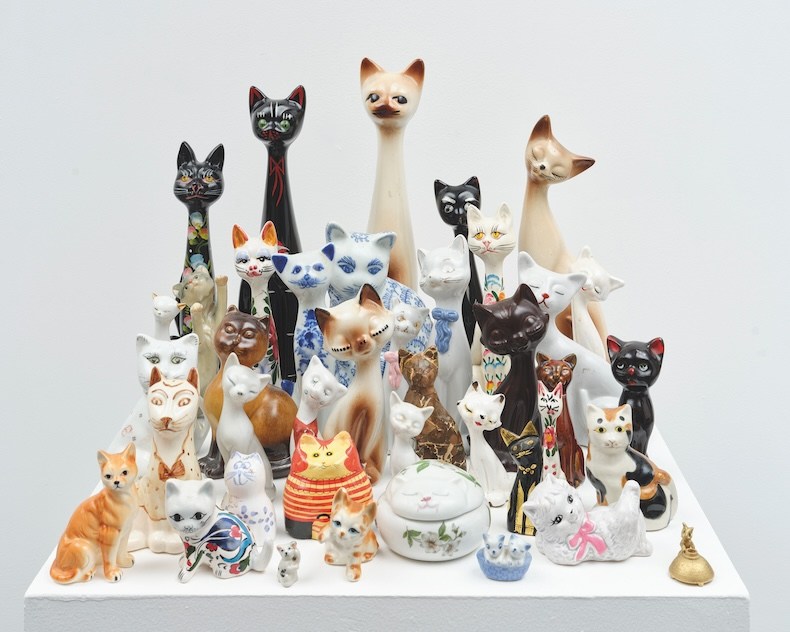
Andy Holden is an increasingly rare kind of artist. Far away from the urgent engagement, -isms and -ialities of much contemporary art, he is a local universalist. Born in Bedford, he still resides there today. He lives in his parents’ house, works in a friend’s garage and has spent the last 20 years producing a series of artworks that seem almost obsessively centred on his roots and surroundings. There is Hermione: Kingdom of the Sick (2021–23), a biographical animation based on the paintings of an artist whose work Holden bought en masse from a local charity shop, the zoological lectures of Natural Selection (2017), written with his ornithologist father, and even Cat-tharsis (2022), a performance centred on unpacking the hundreds of cat souvenirs accumulated by his dead grandmother. Yet for all this localism, as an artist he travels far further than most. As Jennifer Higgie puts it in Weight of Imagination, his art is seemingly boundless: a practice of ‘artistic and philosophical enquiry’ in which ‘the intertwining of the physical world and philosophical realms […] poses a seemingly infinite set of questions’.
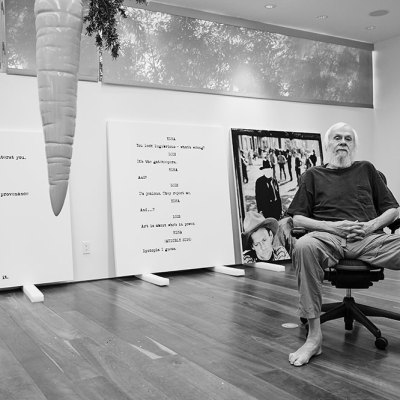
If that characterisation risks making Holden’s work seem unapproachable, it is anything but. There is philosophy here, as the theory-crammed bookshelves of The Dan Cox Library for the Unfinished Concept of Thingly Time (2011–ongoing) prove in spades, but Holden looks on it with a distinctively humorous eye. To use one of his favoured terms, Holden’s work is a place where categories tend to go ‘gooey’. This is work that delights in daftness, in puns, in the aesthetics, ethics and physics of cartoons, populated by echoes of Scooby Doo, Wile E. Coyote, Peanuts, the Beano. Even in questions of metaphysics, he is as likely to cite Looney Tunes as German idealism. The resulting ‘domestic conceptualism’ is a unique hybrid, as if the cartoonist Leo Baxendale were channelling the ghosts of Marcel Duchamp and the English naturalist Gilbert White.
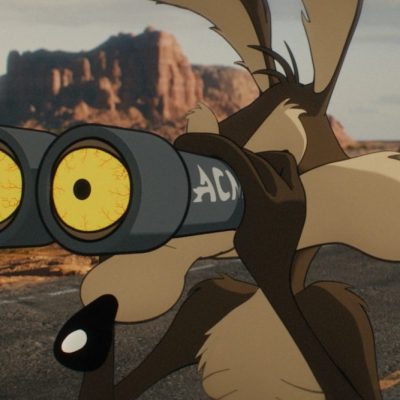
Holden’s characteristic approach is clearest in the hour-long film Laws of Motion in a Cartoon Landscape (2011–17), which sees his avatar – part scruffy indie hipster, part worn-out academic – wander pensively through clips of classic animation ruminating on the emergent physical laws of the cartoon universe. Cartoon-world, we are given to understand, is ‘a multi-morphic space where categories are no longer ontologically distinct’, but where the plausible impossible – delayed gravity, cookie-cutter holes in walls – acts according to certain rules and conventions that cannot be broken. Step back again, Holden suggests, and you might see a template for discussing the crazed velocity of contemporary politics and the breakdown of our shared reality itself.
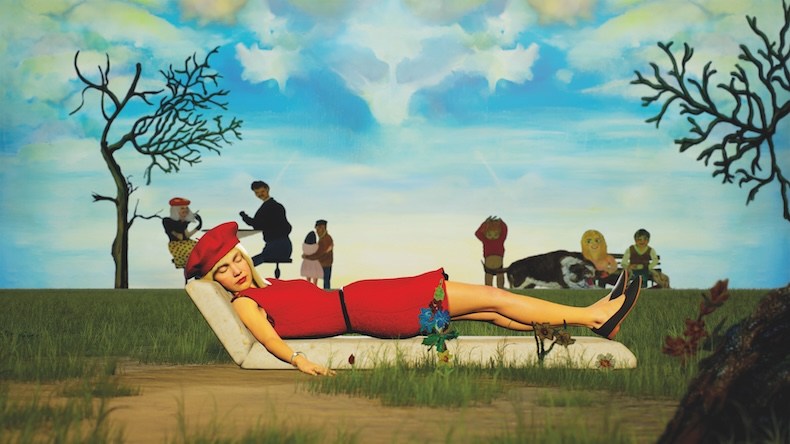
If there is a characteristic set of concerns and references, Holden otherwise is reliably unpredictable. He ranges happily through painting, sculpture, film, assemblage, performance and installation, in addition to leading his long-running band the Grubby Mitts. The objects that populate his work are similarly various. Sometimes they are marvels of craft or manufacture, like the thousands of porcelain eggs, handmade and painted in species-specific tones, that nestle in cotton wool in the improvised containers of How the Artist was Led to the Study of Nature (2017). At other times, they are palpably homemade: a stream of Blue Peter projects, like the melted and moulded records turned into painted plant-pot holders of Pessimism of the Intellect, Optimism of the Will (2011), or the cardboard exhibition architecture of Collected Domestic Conceptualism (2021). Defiance of summary seems to be a cardinal virtue.
That defiance, though, is less about restlessness than generosity, a distinction that Higgie understands well and returns in kind. The book is billed as a ‘mid-career retrospective’, but Higgie herself characterises Weight of Imagination as an invitation to join Holden on his ‘journey of discovery’, and proceeds on exactly that basis. Selecting 12 works, she approaches his practice with light-touch deftness, offering ways in without imposing herself upon them. Even for a longstanding fan there is plenty to chew on. Though there may be, she suggests, no ‘signature style’, there are signature moves: objects, themes and methods appear again and again. This is in part, a signal of the nostalgia in Holden’s work. Not the negative nostalgia of stunted longing for quasi-imaginary pasts, but a positive nostalgia that digs down into the strata of the self in search of aetiologies, artefacts and lost pleasures.
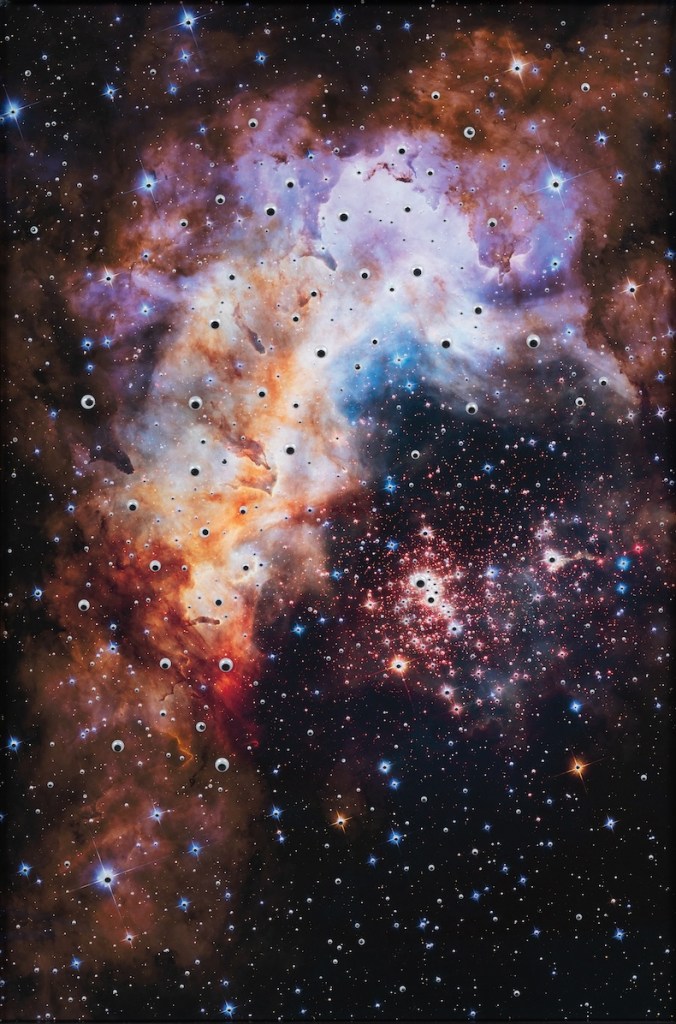
There is, too, a signature theory that goes hand in hand with the nostalgia: the ‘unfinished concept of thingly time’ that Holden’s friend and ‘theoretical advisor’ Dan Cox was in the process of elaborating before his untimely death in 2011. Thingly time appears when objects ‘make a duration visible’: four dimensions unfolding from three. Nostalgia is one function of it and so is mourning – something that Holden is no stranger to – but as that neologistic ‘thingly’ signals, neither of these are antithetical to fun.
All three are evoked in Holden’s recurring Ornamites: ornament-stalagmites, the portmanteau nature of which is as much physical as linguistic. Layers of coloured plaster dripped slowly over old found supports, they look like the years of candle wax congealed on trattoria Chianti bottles and, when bisected to make bookends, like the geological strata of deep time. Inanimate, they register, nevertheless, as organic: silent alien sentinels that stand among us, looking and absorbing. Both quick and slow to produce, they are goofy reminders of the strange time of art itself. ‘I worked for forty-five minutes drawing that horse,’ says Peanuts’ Charlie Brown in a panel painted on the side of a bookshelf in Library for the Unfinished Concept of Thingly Time. ‘A true work of art takes at least an hour!’ responds Lucy. What the library makes visible with its clutter of images, ornamites and stacked volumes is the painful truth of one seemingly unconquerable dichotomy: ars longa, vita brevis. I closed Weight of Imagination thinking that if anyone can conquer it, it will be Andy Holden.
Andy Holden: Weight of Imagination by Jennifer Higgie is published by Heni Publishing.
From the December 2026 issue of Apollo.