From the December 2026 issue of Apollo.
Going to south London to see the dinosaurs has been part of childhood in the British capital for more than a century and a half. Sculptor Benjamin Waterhouse Hawkins made his series of imaginative reconstructions of more than 30 prehistoric species in 1854, as part of Joseph Paxton’s masterplan for Crystal Palace Park. The park was laid out as a new home for Paxton’s extraordinary, high-tech Crystal Palace after it had completed its service as the venue of the Great Exhibition of 1851. Paxton intended what might be called the first theme park, partly in a spirit of Victorian enlightenment and partly as a way of burnishing his architectural wonder. It would be a journey through time, telling the whole story of the Earth, from geological formation through to the triumphant modern age represented by the Crystal Palace itself.
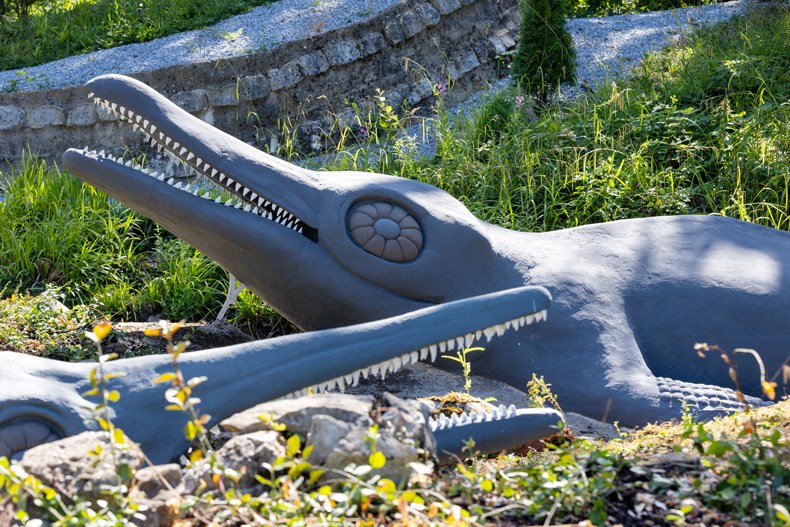
So Hawkins’s dinosaurs, arranged around an island on a lake at the far end of the park from the palace, were meant as a sort of educational warm-up act. But they have always been an attraction in their own right, all the more so now that the Crystal Palace is gone (burned down, 1936). In recent years their quaintness has been part of the appeal – their making involved a good deal of guesswork and fancy, owing to the fairly rudimentary palaeontological evidence and understanding available at the time, and several only vaguely resemble the creatures they represent. For as long as I can remember, they have been somewhat shabby, despite being Grade I listed, but now they have been restored by a team led by HTA Design as part of a wider refurbishment of the park.
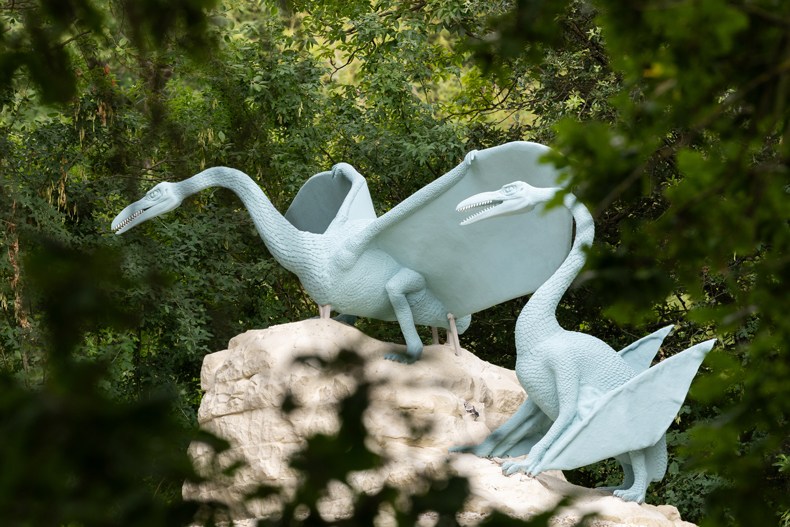
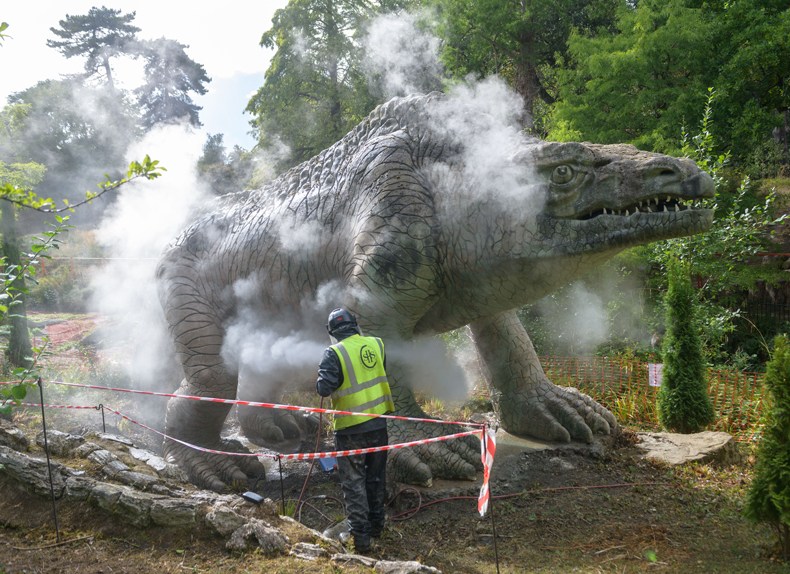
‘Since the 1850s the dinosaurs had been painted all sorts of colours, from bright reds and oranges to the more subtle greens,’ says Natalia Roussou, landscape design director at HTA Design. The restoration, which was supported by conservation architect Donald Insall Associates, stripped away this accumulation, and paint analysis established the original colours. Where no original paint traces could be found, the team studied paintings by Hawkins to make informed choices. These restored hues turn out to be on the subtle side, almost muted, though their strange paleness may help them stand out against the vegetation. In places, more significant repairs were needed. The restorers have used 3D printing, a technology that it’s easy to imagine Joseph Paxton enjoying, to recreate missing parts: the Irish Elk had its lost antlers replaced using scans taken from an example of the animal in the Natural History Museum.
The vegetation – which in some places was growing out of the sculptures – has also been stripped back and new planting follows the evolutionary story, starting with ferns in early eras and moving through conifers to flowering plants. Lakeside geological exhibits, including artificial cliffs with illustrative rock strata, and a waterfall, have also been restored, using stone and gravel appropriate to the relevant prehistoric era. ‘The setting is as important as the sculptures themselves,’ Roussou says. Decades of silt were removed from the lake, ‘which was like an archaeological process – we found some lost ammonites […] A lot was hiding in the depths of the silt.’
In short, it’s all looking as good as it has at any time since the 1850s. A new timber-faced visitor centre and a large playground complete the attraction. Rather adorably, the play area is conceived as a palaeontological dig site where children can uncover and imaginatively reassemble their own fossils. And judging from the fleets of buggies traversing the park on the last day of the autumn half term, children will continue to make up a substantial portion of the dinosaurs’ visitors. So they should. Children love dinosaurs, as they are big and disruptive and outlandish and they exist in a promising border region between imagination and reality. Hawkins’s sculptures still make some of their smaller visitors stare and utter expressions of awe; some children run around roaring and snarling and pursuing each other, shrieking in happy terror. This is only right. One wonders about the adults. Can the dinosaurs be more than a place to take the kids, or unusual, rather antiquated, set dressing for a stroll around a picturesque lake?
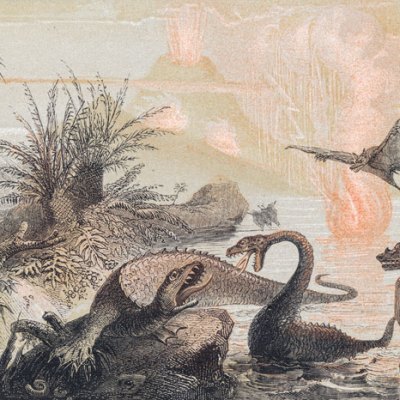
Happy terror used to be part of the experience for all ages. In 1830 Henry De la Beche painted the watercolour Duria Antiquior (‘more ancient Dorset’) based on William Buckland’s imaginative description of the copious fossil discoveries of Mary Anning and her family at Lyme Regis. In this strange and memorable image, which was widely circulated in a lithograph version by George Scharf, ichthyosaurs with lidless, staring eyes and scissor-like jaws snap at noodle-necked plesiosaurs. In 1840 the painter John Martin, better known for his biblical catastrophes, engraved more primordial combat as frontispiece for a book by Thomas Hawkins (no relation, as far as I can tell). While De la Beche’s painting has a picture-book naivety, Martin delves into nightmare: scaly monsters with eyes like headlights bite and spit on a moonlit shore, watched over by bat-like, carrion-eating pterosaurs. But this disturbing image was almost too tame for Hawkins. ‘Martin has barely attained, with all his stupendous Powers, the utter hideousness their own,’ he wrote. ‘These huge Dragons and their horrid Brood!’
It’s easy to detect a note of relish. Viewing dinosaurs was a complex pleasure for the Victorians, a pungent and challenging thrill. It was a giddy confrontation with a radically altered conception of reality, in which history, rather than starting fairly recently with a tenancy dispute in a garden, swept back in countless strange aeons. Fortunately Mr Paxton’s cast iron and glass temple was on hand to reassure them that everything turned out for the best, with them on top. Today we are more familiar with the idea of the Earth as ancient, its surface churning like porridge and humans as transitory – looking at the artificial strata built to demonstrate this to Victorian visitors, we see only our school science classes. It takes some imaginative reconstruction of our own to feel an appropriate frisson of awe at the deepness of time and the strangeness of its inhabitants.
From the December 2026 issue of Apollo.