From the November 2026 issue of Apollo.
About a decade ago I found myself in a private room at the Arts Club on Dover Street in Mayfair explaining the reasons for my selection of that year’s international exhibitions, biennnials and art fairs to a table of wealthy diners. The expensively, if discreetly, dressed group – about 20 in total – listened politely; some even produced pens and took notes. I had been invited to speak at one of the early events of an organisation called the Cultivist, described variously as ‘an art concierge service’, ‘an arts members’ club’ and a provider of ‘art-themed experiences’.
The Cultivist was set up in 2015 by two former Sotheby’s employees, Marlies Verhoeven and Daisy Peat, as a membership scheme for people interested in art and collecting. The premise was to offer the sort of invitations – to artists’ studios, museum openings, biennials and art fair previews in cities like London and New York – that established collectors love but tend to take for granted. Suddenly you could buy into this world, albeit for fairly hefty fees. Early members paid £1,900 a year in the UK, with the costs of dinners and other events on top.
Membership schemes are common in historic houses and museums, although the entry price is usually a lot lower. Indeed for some, such as the Royal Academy of Arts (RA), which is not government-funded, the money it gets from its friends and patrons are the bedrock of its income. (It is always on the lookout for more, which probably explains why Charles Saumarez Smith, then chief executive of the RA, was also speaking at the Cultivist event.) But until relatively recently they have been unusual in the commercial art world.
That appears to be changing. The London Art Fair, which takes place each January in the Business Design Centre in Islington, has been piloting a scheme called Culture Club, which it will roll out this autumn. Members pay £150, which gives unlimited access to the fair and monthly events, from curator-led tours of private and corporate collections, such as Deutsche Bank’s or Linklaters’, to shows at museums including the Tate. The test group has been small, about 30 people, but the aim, according to Sally Bent, the fair’s director, is to grow that significantly over the next few years.
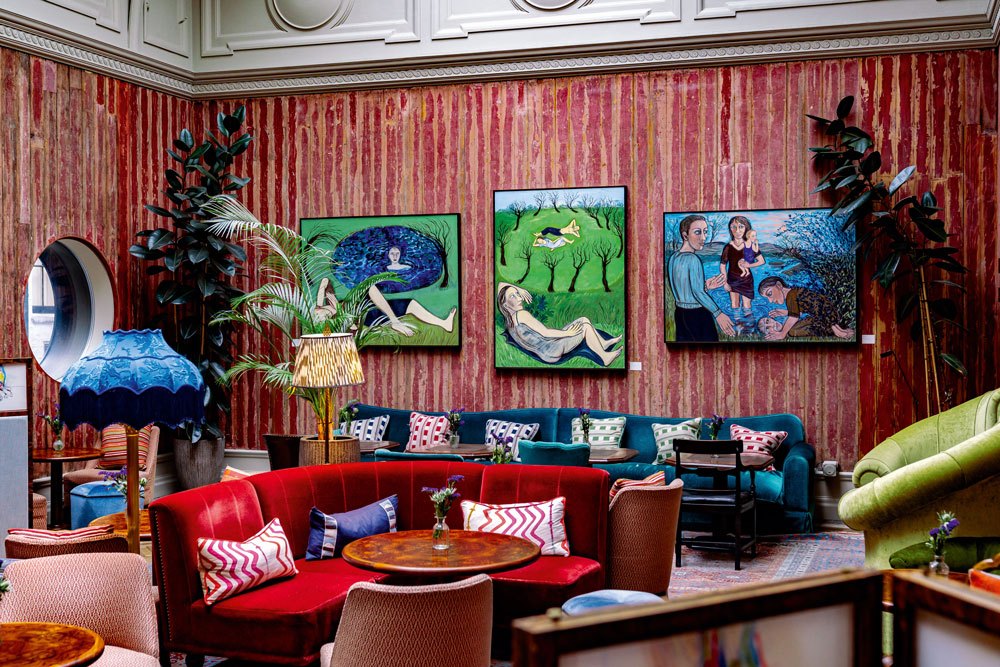
Bent says that the fair team has been ‘talking a lot about how to deepen the relationship with our audience, because we have a fantastic five days [of the fair] and then we disappear’. But, she says, the scheme has also been conceived as a way of bridging the gap between the fair’s 24,000 paying visitors and collectors on the 4,000-strong VIP list, who account for the majority of higher-value purchases. (The average price of a work of at the fair is around £15,000, although galleries specialising in modern British art, such as Osborne Samuel, bring works vastly more expensive than that.)
‘The Culture Club is aimed at people who are culturally curious, and perhaps at the start of their collecting journey,’ Bent says. ‘It is a way to deepen their relationship with the fair, help them feel more plugged in to the art scene and give them more confidence in collecting.’
The design of the membership scheme was inspired by the Tate’s and the National Trust’s, Bent says. But looking for new ways to expand the fair’s business makes sense, she says, in the context of its ownership. In 2019 it was bought by Immediate Live, the events arm of a multimillion-pound contract publisher that produces the BBC’s Gardeners’ World and Good Food magazines and owns several associated live consumer shows.
More exclusive patrons’ schemes – at more inclusive prices – were the inspiration for Saatchi Yates gallery’s membership. Or so says Edie Jones, the gallery’s director of marketing and communications and daughter of former GQ and Evening Standard editor Dylan Jones. ‘Our reference point was patron groups like the Serpentine’s Future Contemporaries, which offer amazing studio visits, first access to shows and champagne receptions to meet the curators,’ she says. But at a suggested payment of £1,000 a year, and no option to pay monthly, Future Contemporaries is a pricey option for the under-40s it is aimed at, she says.
Saatchi Yates is owned by Phoebe Saatchi, daughter of the collector and advertising mogul Charles Saatchi, and her husband Arthur Yates. It mostly shows emerging artists but peppers its programme with exhibitions of much more established artists, such as the veteran American painter Peter Saul. In the background, its private sales department is focused on the high-end secondary market.
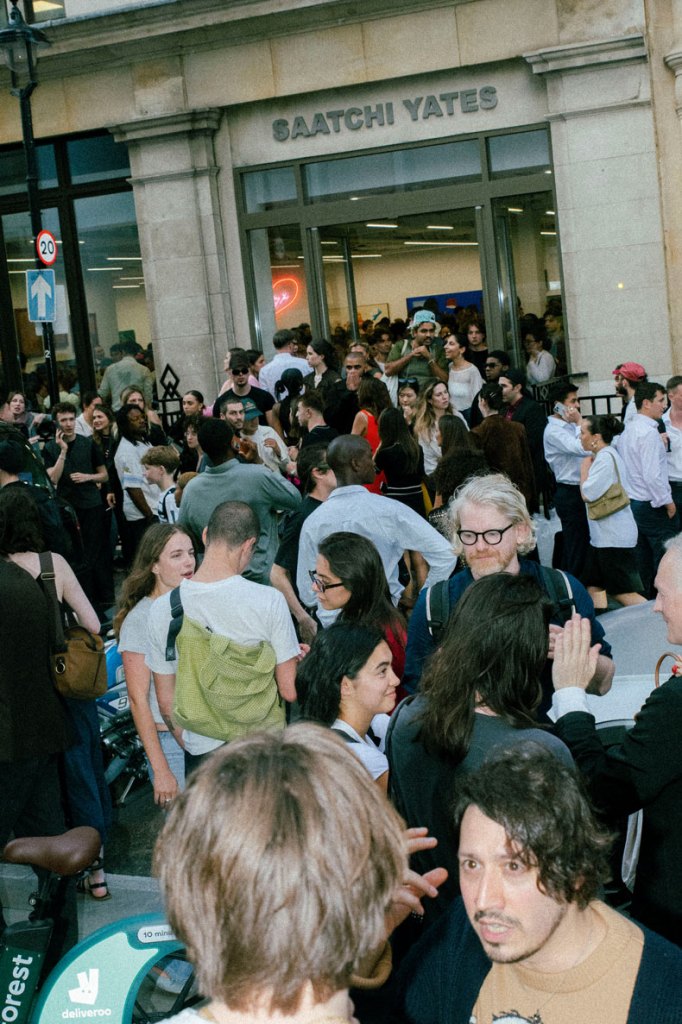
Since it opened in 2020 the gallery has proved adept at generating a fashion and social media buzz around its space. The membership launch coincided with ‘Once Upon a Time in London’, an exhibition that brought together work by Lucian Freud and Francis Bacon, YBAs such as Tracey Emin and emerging artists such as Joanna van Son and Jadé Fadojutimi. Queues built outside on the preview evening, with crowds eager to see the work and meet attendees such as the designer, painter and graffitist Olaolu Slawn.
‘We wanted to find a way to bring bigger audiences to the gallery and build a community,’ Jones says. ‘We all know that commercial galleries are traditionally seen as closed spaces and we wanted to find a way to give the public entertaining and exciting ways to engage with art.’
Saatchi Yates membership has three tiers: Friends, Family, and the Big Kahuna. Friends level is free to join but members pay for the events they attend, Family members pay £80 a month and have access to everything, while the Big Kahuna is bespoke and aimed at partner businesses and brands. All get invitations to shows in the gallery’s large, glamorous space in St James’s, but where the team has scored is by creating events that go beyond what Jones calls ‘the traditional PV from 6pm to 8pm with lukewarm white wine’.
There is a book club, hosted by the literary agent and author Clare Conville, and an art history club. There have been visits to Paula Rego’s studio, left untouched since the artist’s death in 2022, and sessions teaching members to take traditional photographs and develop their own film. For Frieze week last year the gallery hosted a séance over supper. ‘Having a medium put a fun spin on what could have been a typical boring art dinner,’ Jones says. It seems the members, who are mostly aged between 20 and 40, agree: there are now around 700 on the free tier and 300 regular paying members.
The Frieze group of art fairs has been at it slightly longer. In spring 2021 it announced its membership scheme, Frieze 91, a reference to the year Frieze magazine (where it all started) was first published. It has recently been rebranded as Frieze Connect, ‘connecting [members] to the people and ideas shaping contemporary culture’, as the official information puts it. It currently operates in London, New York, Los Angeles and Seoul – where Frieze has fairs – and a ‘soft’ launch will accompany the first Frieze Abu Dhabi (19–22 November). Prices at Frieze start at around £10,000 but the majority of reported sales are in the hundreds of thousands or higher.
‘There are a large number of people who are genuinely interested in art and might collect a bit in different places, or collect design, but who aren’t part of our VIP programmes,’ says Aryana Khan, head of Frieze Connect. ‘The whole industry is talking about the fact that we need to bring in newer people, so we were looking for ways to bring those people into the fold.’ Others, she says, may not know the art market well. ‘The art world is famously difficult to navigate, so we wanted to create a programme that makes that process a little easier.’
The scheme now has three tiers: Offsite, Select Access, and All Access, priced at £750, £990 and £1,430 a year respectively for UK members. The top membership offers in effect VIP access to all Frieze-owned fairs, a monthly programme of events in London, New York, Los Angeles and Seoul, Frieze magazine’s print and digital publishing and a private members’ Instagram account. During Frieze London in October, events included a breakfast at the Mayfair restaurant Sketch with artist Jonathan Baldock, a talk with Hayward curator Tarini Malik at Annabel’s nightclub, a visit to painter Sholto Blissett’s studio and a party at the Shoreditch Arts Club.
Art fairs are generally reluctant to give information about numbers, especially of VIPs, but Frieze says that about 85,000 people visit Frieze London and Frieze Masters. Most visitors pay, with the lowest price for general admission to both fairs a punchy £92. Unsurprisingly, Frieze Connect membership is much smaller, with Khan saying numbers have reached ‘the high hundreds’, fairly evenly spread across all four main cities. The Cultivist, meanwhile, reports that its main Club level, now priced at $2,850 a year, has ‘over 1,000’ members, ‘with many more at its [$440] Enthusiast level’.
These are tiny numbers compared with, say, memberships of the UK’s national art museums. The Tate group of galleries has one of the most successful schemes, reporting 155,000 members in 2025/26 who pay between £84 and £180 a year, depending on the number of guests they want to bring. Membership generates £15.8m in net income, according to its most recent annual report. The National Gallery reported 67,000 members in the year ending March 2025: it wrote that ‘income related primarily to corporate and individual membership schemes and sponsorship was £8.2 million’.
Museums have many advantages over commercial galleries and fairs. Apart from the benefits they can offer, such as free access to paying exhibitions, shop discounts and increasingly luxurious members-only cafes, they are charities with educational missions. Most also set up their membership schemes decades ago. The Friends of the Tate Gallery was set up in 1957. The National Gallery set up a membership scheme only in 2014, which may explain its lower numbers.
But as museum memberships have become larger, more impersonal, more efficient and more focused on earning money to fill growing funding gaps, some worry that the social and philanthropic reasons that used to drive people to join museums – rather than perks – are becoming obscured. Earlier this year, Guy Turton, a director at research agency MHM (formerly Maurice Hargreaves McIntyre), wrote that ‘[museum] memberships seem increasingly segregated between the members who have been around forever, supporting out of a sense of altruism, versus new members hyper-analytical of the value they receive’.
Then there are newer collectors who prefer to explore the art world on their own. Nouri Verghese is in his thirties and works for an asset management firm in London. He is slowly building a collection of work by mainly women artists working with mostly natural materials. ‘It’s not systematic and it’s not rigid criteria,’ he says.
Verghese bought his first piece at the London Art Fair – the pages of a book encased in Perspex by the Scottish artist Georgia Russell, who is now represented by Karsten Greve in Cologne. That was about a decade ago: now he buys from degree shows, fairs, East End galleries, what he calls ‘disruptor or itinerant’ spaces and the occasional high-end gallery such as the London-, New York- and South Africa-based Goodman Gallery.
He is ‘wary’ of the conformity of collectors’ circles. ‘I’m sure they are useful for extending your vision to artists, galleries and practices you might not otherwise encounter,’ he says, but ‘I prefer the chance encounter, word of mouth, the fun of reaching out to someone you don’t already know.’ As for social events like group studio visits – ‘That sounds rather ghastly.’
Many may agree, especially those who learned about art in traditional ways: childhood visits to museums, art history lessons at school, learning drawing and making skills, reading exhibition catalogues, developing the interest and confidence to walk into museums, commercial galleries and fairs even as students. But these are not experiences everyone shares. If clubs like the Cultivist, Frieze Connect or the London Art Fair’s Culture Club succeed in bringing new art lovers, collectors and arts patrons in, then they are surely to be applauded.
From the November 2026 issue of Apollo.