From the October 2026 issue of Apollo.
I’ve noticed recently that the art I love best I can barely talk about. Which makes me almost regret my choice here: lord knows, there are any number of paintings I can stand next to, boring the pants off my kids while I explain their merits. But a few artists insist on my silence and no one shuts me up quite like Brice Marden. I could almost begin and end with Marden’s own test of a good painting: ‘You look at it and it makes you better.’
I rarely have any interest in an artist’s process, but in Marden’s case it’s so close to writing that I can’t help but be intrigued by it. Many of his ‘loop’ paintings began with a loose grid of freely improvised cell-like characters, imitative of the Chinese calligraphy he’d become obsessed with in the 1980s and which much of his work then closely resembled. He would then connect and overpaint them with swooping, curving, overlapping lines, a technique initially inspired by the nonlinear way in which Chinese classical poetry is read. These would then be sanded down and painted over, though more to unify than obliterate them. What he liked in the faintly persisting lines, he could revive or adapt; what was too wayward or complex had served its purpose. At some point, line and colour and shape would find their unified form. (They remind me that I often miscategorise my own early drafts as ‘missteps’. Of course they aren’t; I’m only discovering what I mean.) And yet Study for the Muses – Marden began this version in 1991, reworked it over the next decade and finished it in his studio in Eagles Mere, Pennsylvania – never seems fixed. Its coloured lines move as you follow them, sometimes pulling on one another, sometimes converging at some invisible point of attraction, sometimes guided in their path by the ghost-lines below.
A romantic might say that there was something germinal, even genius, in Marden’s initial marks that guarantee the harmony of the result. We have this magical idea in writing and music too: that there’s something in the DNA of the given line or melodic phrase from which one merely intuits the whole. But half the genius is in making such a bold start. And there’s noise and error, too, in any human work. Better to welcome it in on your own terms than pretend you can eliminate it. Marden made these paintings with a stick four or five feet long. Theoretically, one could paint perfectly with this thing, just as one can allegedly play the trombone perfectly in tune. What’s magnified between the hand-end and paint-end is less error than the body’s limitations, which creates the space for a little fuzz or serendipity. It all amounts to a painting that looks, somehow, both opportunistic and inevitable. Marden chose freely and each time chose what he must.
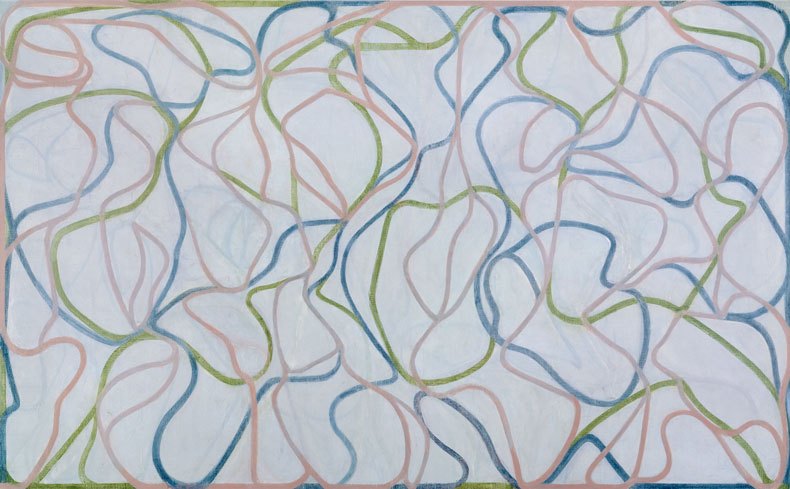
Study for the Muses is the record of how the painting rose to its own final plane. The earlier lines persist as buried subsystems of veins or nerves under the milky, lime-wash-y background. My eye will confuse them with the shining afterimages and auras left by the darker lines. The result is an astonishing, shifting depth. From a distance, the painting looks beautiful and classical. All the subcutaneous networks blur and texture the background. Closer, the background starts to look beautiful and natural, with some of the translucency of marble. Up close, it looks like skin, and alive.
Marden always had a gift for colours. I can never put a name to any of them. In his earlier Color Field work they looked like colours you half-knew, only seen through mist or smoke or grey cellophane. In the loop paintings, they seem calibrated to contrast with both the ground and one another, so the eye can easily lift out the shapes they make. In Study for the Muses, I find many beautiful natural forms, bodies and family groups. It’s a sort of paradisal reply to de Kooning’s Attic and Excavation period of the late ’40s and early ’50s (I’m certain Marden admired those paintings): where de Kooning’s figures are interlocked, claustrophobic, constricted, Marden’s are free, airy, even voluptuous, their superimposed and interwoven forms filling the canvas over and over without ever crowding it. I sense we’re always above it all, or beyond it all, or on the other side of it all, in the serene, dimensionless space of the universal mind-at-large.
Or at least I am. I got carried away there. The truth is I think of absolutely nothing when I look at Study for the Muses. I look at it; I disappear; I’m better. If I have a thought at all, it’s, ‘I wish I could write like that’ – before I remember that I’m not reading.
From the October 2026 issue of Apollo.