From the July/August 2026 issue of Apollo.
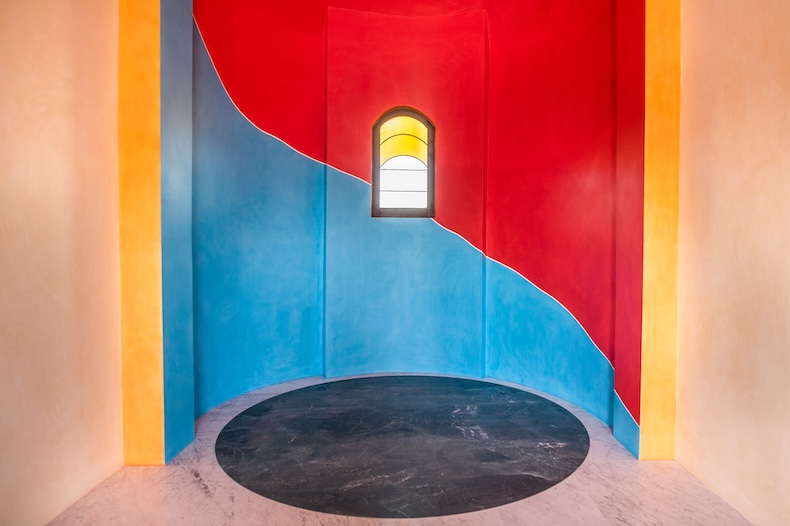
Exhibiting contemporary art on wine estates is a very recent phenomenon in many countries, but in Italy the practice has a longer history. One such attraction is the Cappella del Barolo on the Ceretto winery in Piedmont, a chapel built in 1914 that was restored and redecorated in rainbow colours by Sol LeWitt and David Tremlett in 1999. The building sits amid the rolling hills of the Langhe, which was listed as a UNESCO World Heritage Site in 2014. The Nebbiolo grape has grown there since at least the 13th century. The first recorded mention of the wine was in 1266, when the Conte Umberto de Balma referred to a ‘delightful’ wine called Nibiol in his accounts of the Castellania di Rivoli.
The Barolo zone was officially recognised in 1896 and promoted to DOCG (Denominazione di Origine Controllata e Garantita, Italy’s highest tier) in 1980. Barolo wine can only be produced following a strict set of rules and procedures, most notably that it must be composed entirely of Nebbiolo that is grown on hillsides of the region and that it must spend a minimum of 18 months in oak or chestnut barrels.
The Ceretto winery, founded in 1937 by Riccardo Ceretto, a négociant in Alba, is one of the most respected Barolo producers. His sons Bruno and Marcello took the helm in the 1960s and bought premium vineland in Barbaresco and Barolo. Eventually they acquired Brunate, one of Barolo’s most celebrated vineyards.
The third generation took the reins in the 1990s and changed the wine style to favour shorter skin contact – the length of time the grapes spend macerating with their skins – and smaller ageing vessels to allow for greater control. ‘We as a family come from this land and our occupation is linked to it,’ Roberta Ceretto says. Her father, Bruno, wanted to mark and honour the land by commissioning an artist to celebrate their success in winemaking. ‘Few of us could have imagined how a little chapel in the heart of the vineyards of Barolo would change our lives and the local approach to the area,’ she says. This region was already world famous for what came out of the ground. Art was a way to enrich the culture of the winery.
The Ceretto family first met the British-Swiss artist David Tremlett when they sponsored an exhibition at Barolo Castle in 1996. Bruno asked the artist to look at a shed on the estate that was used by farmhands for storage and shelter. It had been built as a chapel but was never consecrated. Tremlett explains that it was ‘just a shell of a building with a tractor parked inside’. He spoke to his friend Sol LeWitt, who had settled in Spoleto with a friend of his, the Italian gallerist Marilena Bonomo. Tremlett remembers that they agreed to take on the commission as a ‘casual project we did in exchange for a few bottles of wine’.
LeWitt’s use of bold colours with geometric and curvilinear forms on the chapel’s exterior stands out amid the earthy tones of the surrounding landscape. The softer interior, designed by Tremlett, is made up of inlaid stone floors, pastel walls and ceilings, and stained-glass windows. Tremlett applied the paint with the palms of his hands to mimic a viticulturalist working with soil. For him, the commission became a significant public-facing work in a country where he is better known for private projects. Ceretto says that when she first saw the completed chapel in September 1999, ‘it was like love at first sight – a rainbow of colour on the hills of Barolo’.
Transforming the chapel from an abandoned storage building to a cultural landmark is ‘part of a sort of circular economy’, says Tremlett. ‘You are not having to destroy things. You are not having to let things completely fall apart […] you reinvigorate them; you turn them into small places of contemplation.’ Temporary exhibitions are one thing; to build something permanent is to change the landscape for good.
From the July/August 2026 issue of Apollo.