From the July/August 2026 issue of Apollo.
On 7 February 1994, a Concorde carrying President François Mitterrand landed in an airport in the West African bush. France’s ‘Sphinx’ had arrived in Yamoussoukro to honour the late Sage of Africa, President Félix Houphouët-Boigny, who had ruled Côte d’Ivoire since its independence in 1960. As tam-tam drums proclaimed the ‘Fall of the Baobab’, Mitterrand, along with representatives of 147 nations, gathered in Notre-Dame de la Paix, a basilica taller than St Peter’s in Rome (and with a dome more than twice as wide) under a stained-glass window depicting Boigny at the feet of Christ. Nearby, in front of the Presidential Palace, a man reportedly threw himself into the ornamental lake and shouted ‘Houphouët is dead, why should I live?’ as he was devoured by Papa Houphouët’s crocodiles.
Yamoussoukro – named after Houphouët-Boigny’s great-aunt Yamousso, a Baoulé queen – had been developed by the president from the mid 1960s on the site of his ancestral village. The heart of Côte d’Ivoire’s commodity-based economy – which was to fuel the economic boom of the 1970s and early ’80s known as the ‘Ivorian Miracle’ – lies inland. As such, the development of Yamoussoukro as a substantial urban centre away from coastal Abidjan (with its colonial associations) was economically and symbolically driven as much as it was personal. In 1983 Houphouët-Boigny designated Yamoussoukro as the capital of Côte d’Ivoire.
Houphouët-Boigny’s plans for the city were always ambitious. Its footprint, around 2,000 sq km, puts it on a par with Tokyo and is around 25 per cent larger than London’s. As with all serious new cities, early priorities included a presidential compound, a grand hotel, official guest houses (including the ‘Giscardium’, nicknamed after its first visitor, President Valéry Giscard d’Estaing, and to which the ousted Burkina Faso president Blaise Compaoré would later flee) and an airport whose runway could accommodate Concorde (a sine qua non for that era: in the DRC, Gbadolite – President Mobutu Sese Seko’s ‘Versailles of the Jungle’ – was similarly equipped).
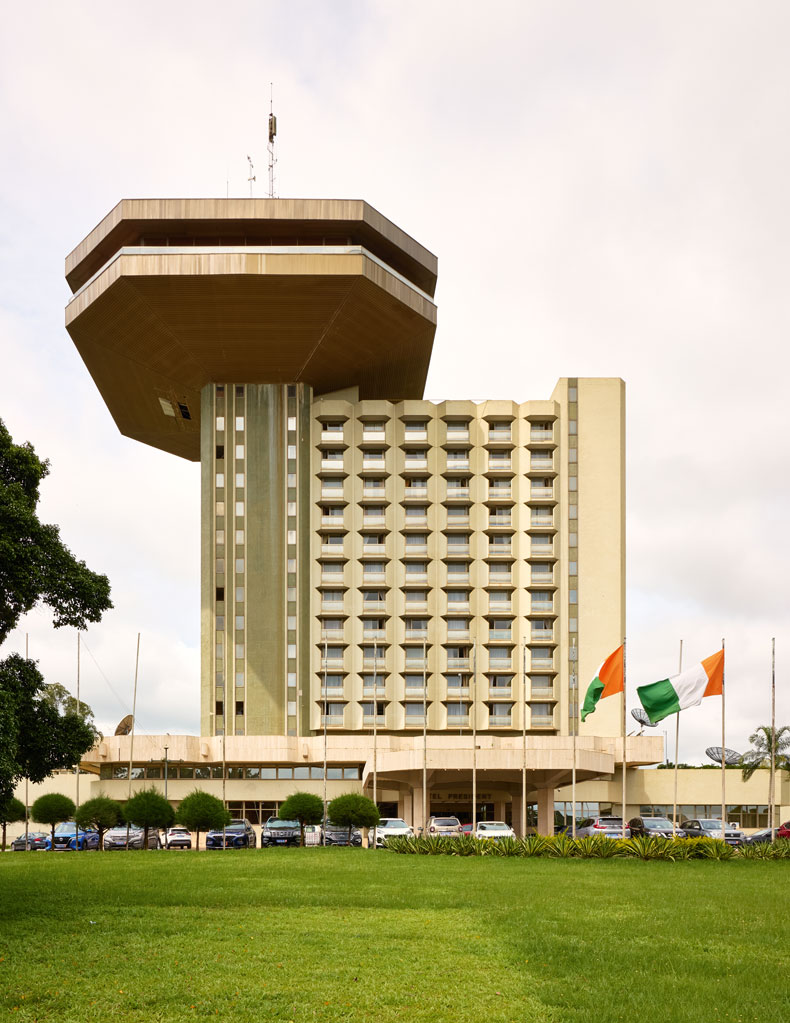
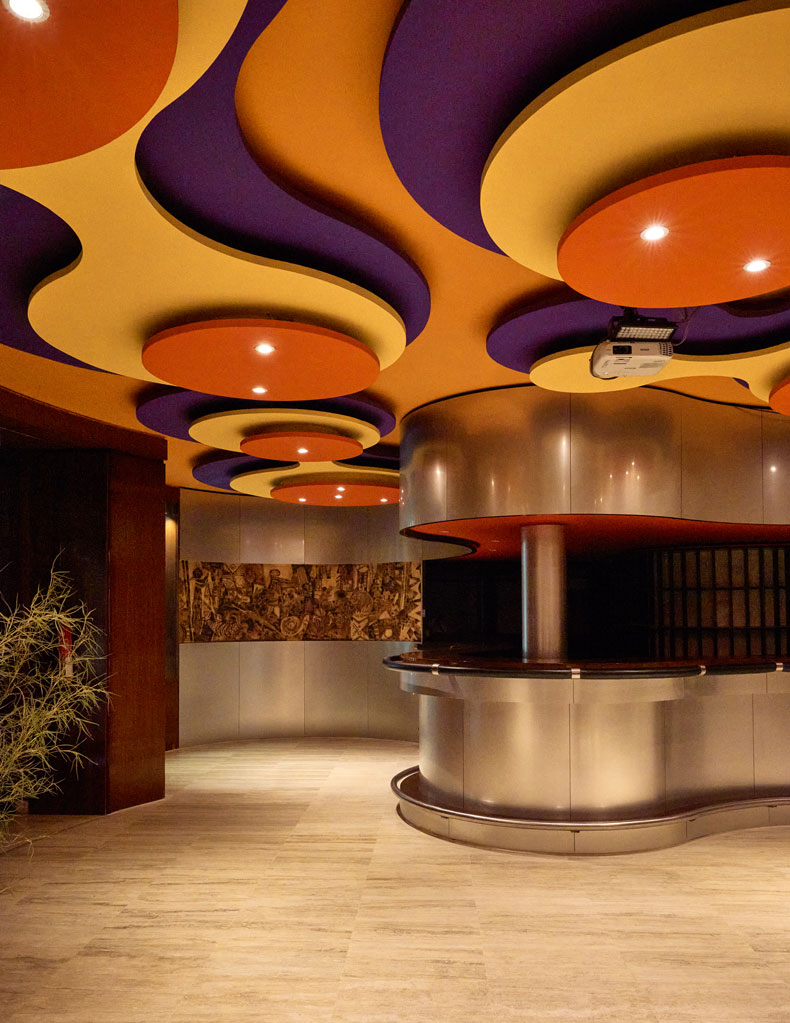
The first building of note after the three-hour drive from Abidjan is the Hotel Président, designed by the Tunisian architect Olivier Cacoub (completed 1973; extended 1980). After miles of soft and verdant bush, you are confronted with a concrete castle, a brutalist Neuschwanstein set in well-tended gardens. Like so much of Yamoussoukro, the hotel is oversized – 285 rooms, several rognon-shaped swimming pools, a nightclub exuberantly bedecked in polychrome and stainless-steel swirls, a (now defunct) rooftop restaurant, a karaoke bar and a cinema, with only a handful of guests (and rather more staff) treading its immaculate pink-and-butterscotch marble hallways.
Cacoub knew a thing or two about dictator chic. Introduced to Houphouët-Boigny by the Tunisian president Habib Bourguiba, the architect had built several palaces for Bourguiba (and helped redevelop his birthplace, Monastir) as well as working for Mobutu on his palace in Gbadolite and on the extraordinary folly that is the Limete Tower in Kinshasa. He would go on to Cameroon to build the vast brutalist-baroque Etoudi Palace for President Ahmadou Ahidjo. Cacoub and Houphouët-Boigny worked closely on Yamoussoukro, designing the Presidential Palace, the Félix Houphouët-Boigny Foundation for Peace Research, the Giscardium and other official structures.
Next to the Hotel Président lies the elegant, low-slung double concrete shell of the Président Golf Club (1980). For this building, Houphouët-Boigny engaged the French architect Roger Taillibert, whose practice had received international acclaim for its soaring ‘Big O’ stadium at the 1976 Montreal Summer Olympics. The club is a well-maintained facility, but here again visitors are outnumbered by staff (and taxidermy).
Yamoussoukro feels like a large suit with a rather small body inside (which happens also to be missing a few vital organs), a vision of a future that never happened. Aside from the occasional large structure, the dominant impression is of a grid of eight-to-ten-lane highways lined with dozens of streetlights framing vacant and overgrown parcels of land. Every now and then a motorbike or bicycle passes. Despite it being the capital of the country, no ministry or embassy has made the move from Abidjan (which remains one of the most cosmopolitan and sophisticated cities on the continent).
While formal development in recent decades may not have materialised, informal activity has brought life to the centre of the town: highways and empty lots have become reassuringly cluttered with cattle markets, vegetable gardens, tyre repair shops, stalls selling diesel in old plastic bottles and typical shanty structures. On a visit to the city in 1984, V.S. Naipaul described this side of Yamoussoukro as ‘Something like a real town […] attaching itself to the Presidential creation.’
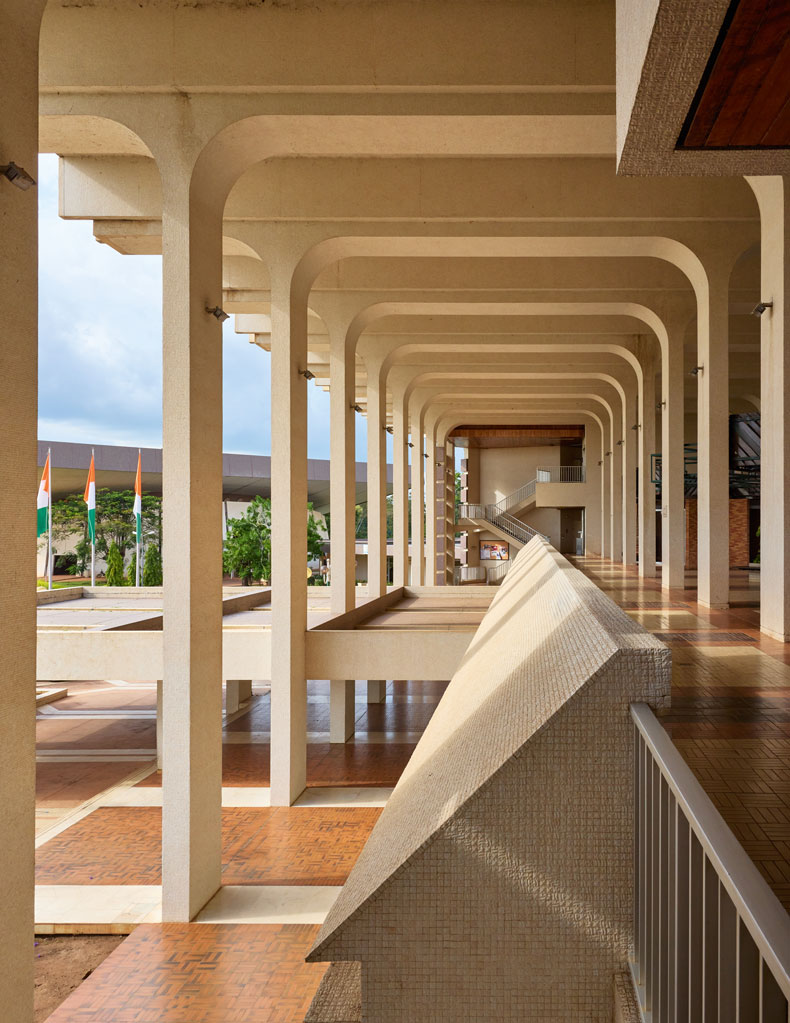
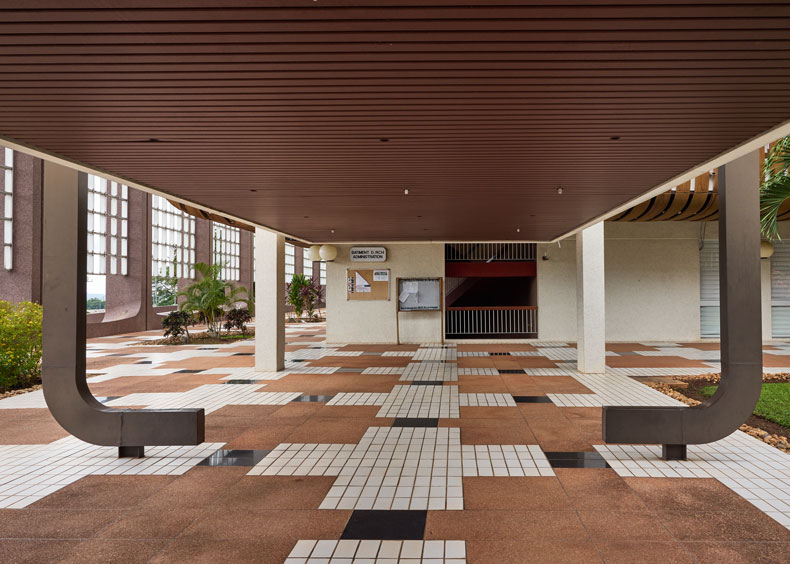
An exception to the emptiness of much of the presidential creation is a cluster of secondary and tertiary educational institutes in a dedicated quarter. Here, on sculptural 1970s campuses, the inherent optimism of the city is kept alive by the happy chatter of youth. Technical, agricultural, scientific and engineering schools, with feeder Lycées, attract students from around the country. The École Nationale Supérieure des Travaux Publics (1979) by the French architect Henry Pottier is a particularly rewarding complex. You approach it through a magnificent screen of 25 monumental arches. Suspended bridges link the different buildings, spanning geometric ponds. Poittier also designed the Institut National Supérieur de l’Enseignement Technique (1983), where soaring colonnades coexist with a semi-submerged library decorated with extravagant mosaic murals.
In contrast to those of many other purpose-built 20th-century capital cities, from Abuja and Lilongwe to Brasília, Yamoussoukro’s masterplan does not appear to have a clear focal point. The plan has been likened to a Roman villa neighbourhood, a cluster of suburbs rather than a conventional urban framework – in this case, it seems, the personal and somewhat whimsical vision of Houphouët-Boigny rather than of a more orthodox urbanist.
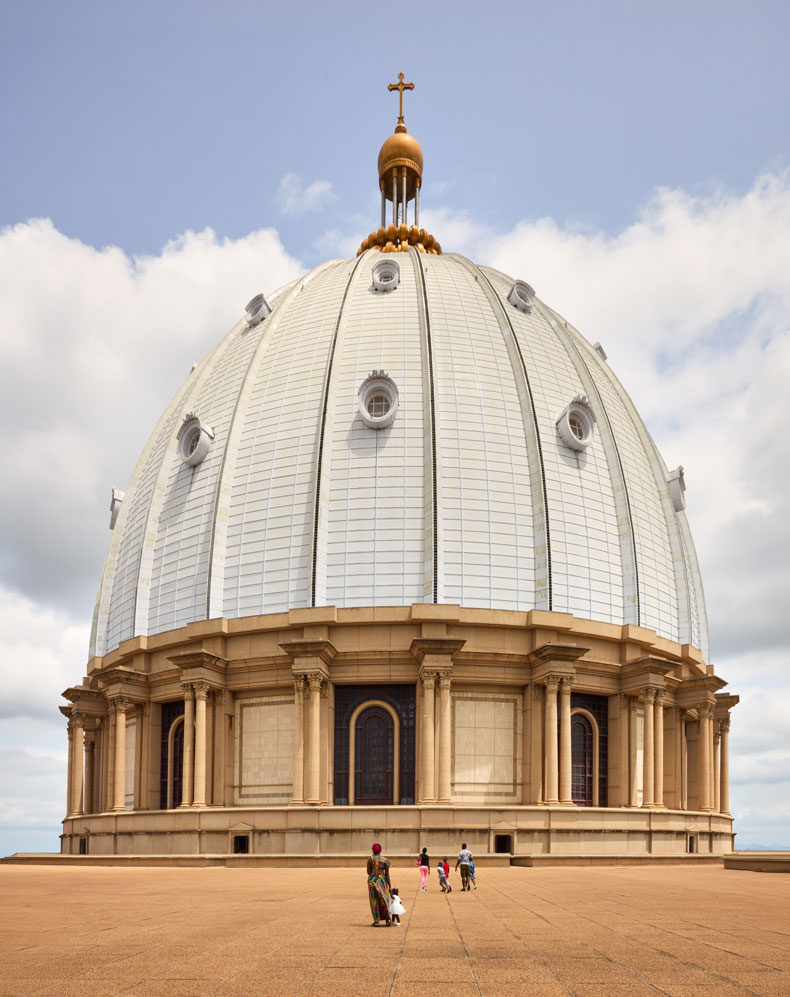
Even if the plan lacks a formal centre, Yamoussoukro’s de facto focal point is undoubtedly the Basilica of Notre-Dame de la Paix, consecrated in 1990. Similar to how St Paul’s Cathedral once dominated views within London, the colossal dome of the basilica is a constant as you move around Yamoussoukro. Its presence is a function both of its scale and of its architecture: while most of the city is built in an international modern/brutalist idiom, the basilica is unrepentantly Roman. Often dismissed as a copy of St Peter’s in Rome, it has a number of superficial similarities – most notably the dome and the colonnaded parvis and esplanade – but also some significant differences such as the open shrine (which is closer to the Pantheon in concept). Classical language is used throughout, particularly in the columns, but elements such as the pediments are much simplified, making the overall appearance of the basilica (and its surrounding buildings) more postmodern than strictly neoclassical. In an interview in 2024, Pierre Fakhoury, the basilica’s (otherwise modernist) Lebanese-Ivorian architect, described how he had originally proposed a modern design. Houphouët-Boigny had responded that he wanted something Roman, to which Fakhoury had, perhaps rashly, said that Roman architecture was ‘all over’. Interviewed by the architect Pier Paolo Tamburelli in 2024 for the magazine ARCH+, Fakhoury recalls:
[The president] then showed me Ricardo Bofill’s columns in Marne-la-Vallée […]. ‘You can make columns like Bofill’s,’ he said. At that moment, I realized there was no point in arguing. That’s also when I realized that for […] all the great architects of our time, it was all over. And so we made the columns like Bofill’s, and we made them huge!
And huge the 368 columns are, especially when seen towering over the motley clergy, nuns, pilgrims and tourists. This is a church that can hold 18,000 inside and a further 180,000 outside.
The basilica was built in less than four years under the eye of an increasingly fragile, but impatient, Houphouët-Boigny. In addition to the representation of the president at the feet of Christ in the stained-glass windows, the basilica’s naming and iconography work to reinforce the glorification of its patron. Houphouët-Boigny saw himself as a global peacemaker, and his circle promoted him with names such as ‘Le Père de la Paix’, a title easily conflated with the basilica’s Notre Dame de la Paix. An official publication of the basilica likens its canopy to ‘the royal Baoulé throne which becomes the throne of the King of Kings, Jesus Christ’. (Less benign symbols of Houphouët-Boigny’s power are the crocodiles he imported for his presidential lake and which have thrived in the city’s waterways and other artificial lakes. Although the crocodiles have claimed many lives over the years, local people are said to be reluctant to kill them because they are believed to have mystical powers.)
Critical discourse sometimes expresses disapproval of the ‘neo-colonial’ style used for the basilica. Perhaps more justified is the criticism of the extravagance and funding of the project, valued at around $300m in 1989 (though some put the figure much higher) and coming as it did after commodity prices had collapsed, bringing to an end the Ivorian Miracle. While Houphouët-Boigny maintained that he had paid for the basilica out of his own funds, commentators have pointed out that his style of governance (and likely a portion of his personal wealth) was based on concepts of ‘neo-patrimonialism’, a modern adaptation of traditional Akan/Baoulé rule in which the line between public and private property is blurred and public institutions are treated as the property of the ruler. The influential newsletter Africa Confidential, while recognising that the 130-hectare site of the basilica was once a part of the president’s coconut farm, has suggested that the ‘most likely source of the [construction] money is two private accounts held by the president in the Public Treasury’, through which large sums in addition to those officially allocated to the presidency passed every year.
Houphouët-Boigny offered the basilica as a gift to Pope John Paul II, who, despite strong opposition from the Ivorian Catholic church, accepted it on the condition that a hospital for the poor be built next to it (the hospital only opened in 2012). In 1992, the Ivorian Catholic church consecrated a more modest cathedral a couple of miles away. More sober in style, it has the appearance of a pared-down Greek temple, a postmodern riposte to the postmodern basilica.
In some ways there is nothing unusual – or African – about an ageing and increasingly senile authoritarian ruler with a passion for golf, a longing for the Nobel Peace Prize (for which Houphouët-Boigny was nominated by National Front leader Jean-Marie Le Pen) and a complicated relationship with the Vatican hurrying to secure his legacy by building a huge neoclassical monument with opaque funding. What is remarkable about Yamoussoukro is the scale, ambition and relative success of Houphouët-Boigny’s endeavour.
Following Houphouët-Boigny’s death in 1993, the presidency was wrested by the rather less competent and more divisive Henri Konan Bédié. Bédié set about making improvements to his home town Daoukro and his nearby village birthplace of Pepressou, building a presidential palace, large roads and bridges, an oversized conference centre, the luxurious Hôtel de la Paix, a discotheque, a new mosque and a private heliport. On Christmas Eve 1999 Bédié was overthrown and, taking the inaugural flight from the recently completed heliport, flown into exile in Togo. His presidential compound, never completed, is now largely overgrown and the conference centre abandoned. Some vanity projects are more vain than others.
From the July/August 2026 issue of Apollo.