When I was a child, I became fascinated by a painting. It wasn’t something I’d seen in a museum or a gallery, but a postcard reproduction affixed to a family friend’s fridge with a magnet. The composition depicted two figures, a man and a woman, positioned either side of a floor-to-ceiling window, its shutters open so as to flood the central section of the image with summer light, revealing a balustrade and a view on to the stucco facades beyond. It prompted a lot of questions: why was the female figure standing, while her companion was slouched in a chair? Why did he have bare feet? And what, precisely, was capturing the attention of the white cat on his lap?
I had no idea who the painting’s subjects were, let alone who its author might be; but I was in no doubt that the setting was just a ten-minute bus ride away, in Notting Hill. I also knew that I really, really liked it. And so, three weeks ago, I did something I’d been meaning to do for a very, very long time: I walked into Tate Britain’s gift shop and bought my own postcard repro of David Hockney’s Mr and Mrs Clark and Percy (1970–71).
It’s a picture of the 1960s bohemian ascendancy, underpinned, compromised and thus made all the more interesting by the corruption of that tendency’s ideals in the decade that followed. As for the details: Hockney had begun working on the picture in 1969, taking photographs and – as he remembered in Hockney on Hockney (Thames & Hudson, 1976) – making ‘little drawings’ of fashion designers Ossie Clark and Celia Birtwell until he’d worked out a coherent composition.
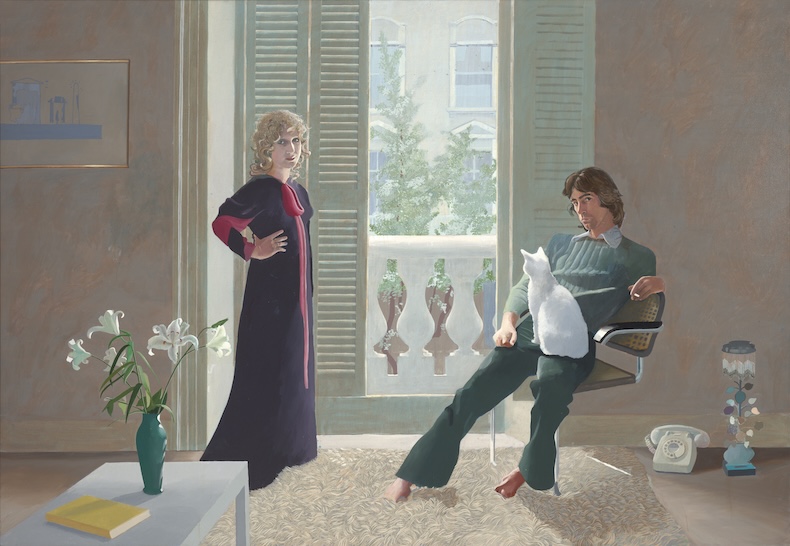
The painting itself took a year to complete, eventually surfacing in an exhibition at the National Portrait Gallery in 1971. It is heavily indebted to Piero della Francesca, a painter who became a touchstone to British artists after the publication of Kenneth Clark’s monograph in 1951.
But it’s also packed with delicious period detail: there’s the shagpile carpet; the artfully distressed paintwork on the walls; the minimal furnishings, with the couple’s white telephone sitting on the floor beside Clark’s tubular steel chair. Yet as I know all too well, you don’t need to know any of this to love Mr and Mrs Clark and Percy, a work which loses little of its power in reproduction. It’s something you can say of many of Hockney’s best-known pieces, and this, I think, is one of the qualities that distinguished him as a truly modern artist.
For all his deep knowledge of Old Master techniques (and more-or-less credible theories as to the working methods of the greats), he displayed a lightness of touch – a ‘populistic’ tendency, if you like – that saw him design everything from theatre sets to a one-off redesign of The Sun’s logo in 2017. And while nobody could have felt short-changed for Hockney exhibitions in the artist’s final decades, one could also have been forgiven a degree of fatigue on account of their regularity: for a while, shows of his iPad drawings, serial, quick-fire portraits and full-scale, garlanded retrospectives seemed inescapable.
In the last year, however, a number of scholarly if characteristically idiosyncratic displays cut through any sense of groundhog-day overfamiliarity. There was his gargantuan (if partial) career summary at the Fondation Louis Vuitton in Paris; a show of new work at Annely Juda; and a superb presentation of his early work at Hazlitt Holland-Hibbert, featuring many paintings and drawings the artist hadn’t seen since executing them. Just last week, I spoke to Louis Kasmin, the curator of the last of these, who told me that, even in old age, Hockney’s recall was total. And yet he refused to ascribe meaning to compositional elements – for instance, apparently phallic symbols – that might, to an objective eye, require no explanation. He was always looking to the next project.