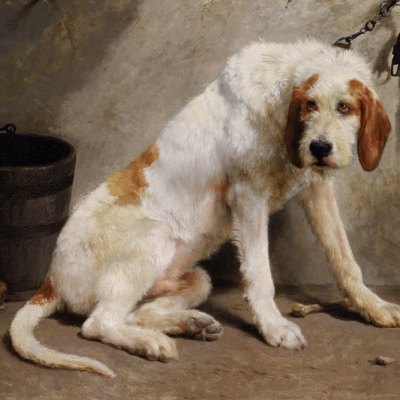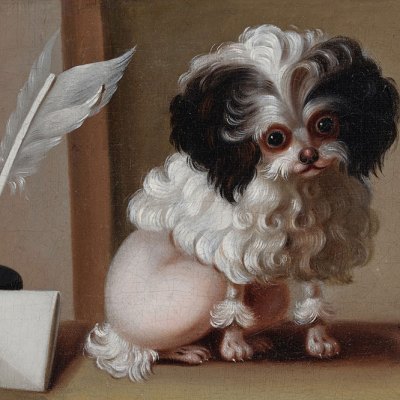

The 16th-century physician John Caius didn’t have much time for spaniels. In De Canibus Britannicis – a milestone survey of Tudor-era dog breeds, republished after his death as Of Englishe Dogges – he damned them with faint praise as ‘delicate, neate and pretty’. You can sense him getting more wound-up as he writes: spaniels ‘satisfie the delicateness of dainty dames, and wanton women’s wiles, instruments of folly for them to playe and dally withall, to tryfle away the treasure of time, to withdraw their mindes from more commendable exercises, and to content their corrupted concupiscences with vaine disport’.
It’s a lot to place on a spaniel’s slender shoulders. So, when paying a visit this week to the Royal Kennel Club in Mayfair – home to a first edition of De Canibus Britannicis – your roving correspondent was gladdened to find the spaniel given pride of place on a ceramic vessel decorated with designs by the artist Allison Ksiazkiewicz. One of 12 vessels of different shapes, all crafted by the Athenian studio Attic Black to resemble ancient pottery, this barrel-shaped jug features two spaniels crouching just beneath the handle as part of a canine family tree. No playthings of the idle, these: they look ready to pounce.
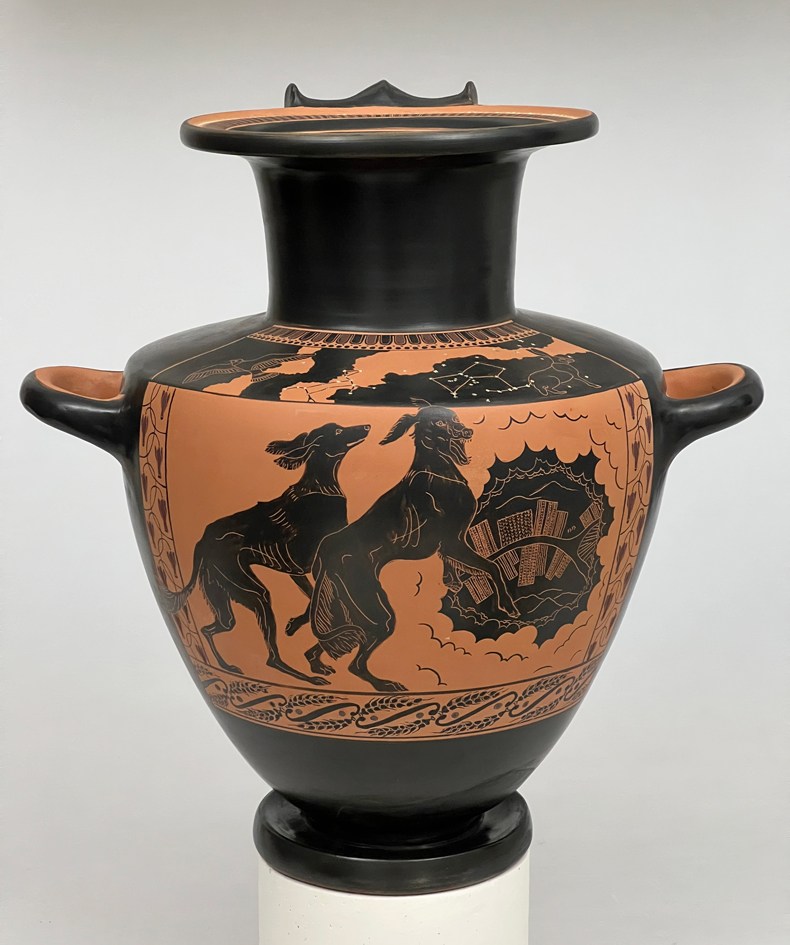
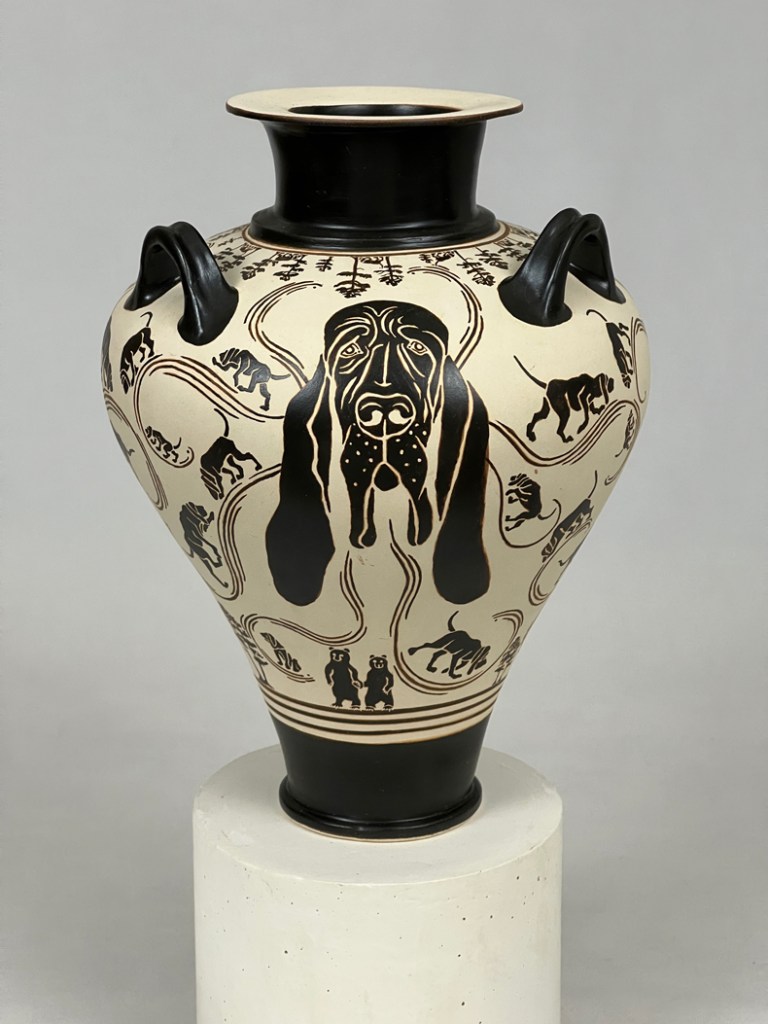
As we recently learned from Thomas Laqueur’s book The Dog’s Gaze, dogs in art go way back. Loyalty and servitude are frequently represented attributes, but ancient art grants them intelligence and curiosity too: on one Greek red-figure amphora from the fifth century BC, in the collection of the Allard Pierson Museum in Amsterdam, a man and his dog look with equal interest at another man’s erection. Ksiazkiewicz does justice to the variety of canine dispositions. On one amphora here, which relates the French medieval tale of Guillaume de Palerne, bloodhounds go hunting for the lovers William and Melior, who are disguised as bears; sets of wavy lines double as directions of travel and wafts of scent. In another vitrine, an epinetron bears a finial in the form of a Salish Wool dog’s face, all excitable innocence, while all along the side of the vessel the same dog – now sadly extinct – is being shorn.
To emphasise the variety of doggy moods, Ksiazkiewicz adopts styles other than Attic: her Raitsits Krater, in which trim Hungarian sheepdogs stand alert in the shadow of horses, resembles art from ancient Egypt, with man and beast flattened in profile, while an eye cup depicting a Pekingese and a grey wolf back-to-back features on its underside nautical imagery that brings to mind Minoan and Mycenaean pottery. (Rakewell was reminded that the first Pekingese, according to Chinese legend, was the result of a lion and a marmoset falling in love.)
According to the fifth-century treatise the Hieroglyphica by the Egyptian scribe Horapollo – rediscovered in the 15th century and later published with illustrations by Dürer – when the ancient Egyptians wanted to depict a scholar, they would draw a dog. After all, ‘he who wishes to become an accomplished scribe must study many things and must bark continually and be fierce.’ The description could just as well apply to artists, who must also apply themselves and promote themselves to make their mark. Ksiazkiewicz has earned a place at the Royal Kennel Club following in the footsteps of the likes of Edwin Landseer, and for that she deserves a round of a-paws.
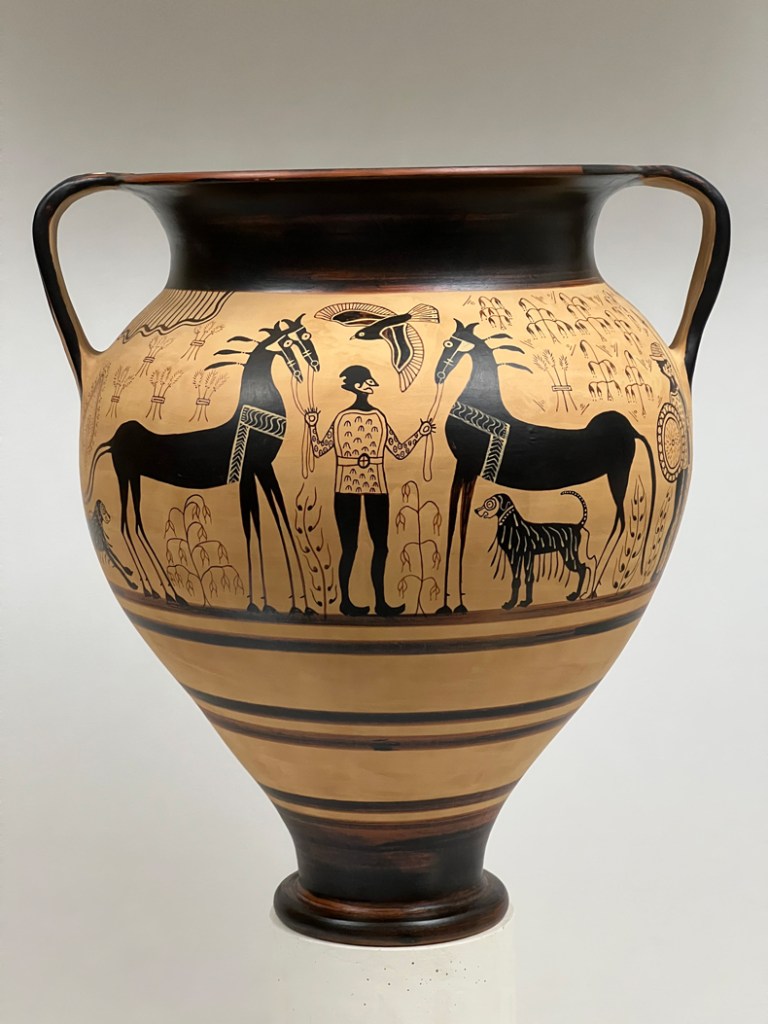
‘Cultured Canines’ is at the Royal Kennel Club, London, until 31 March 2027.