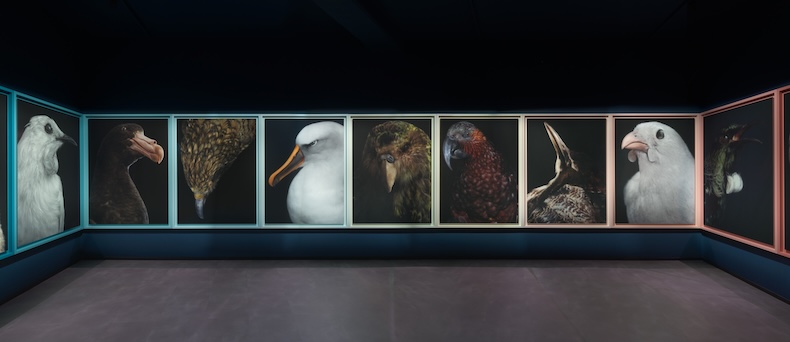
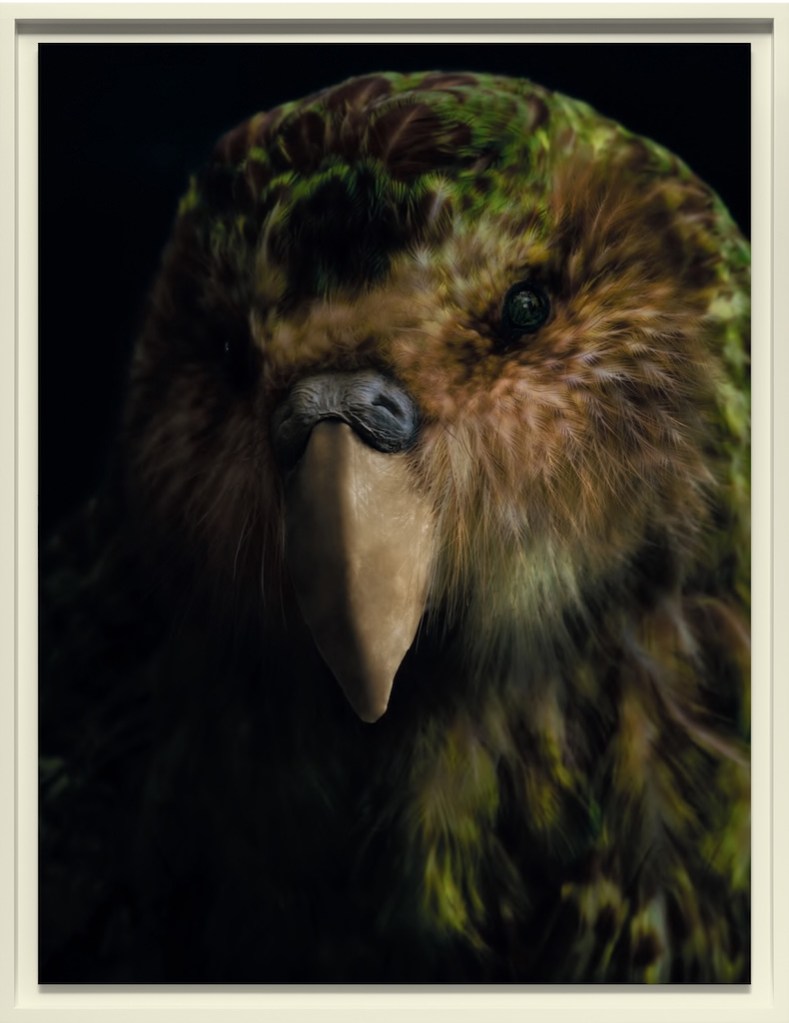
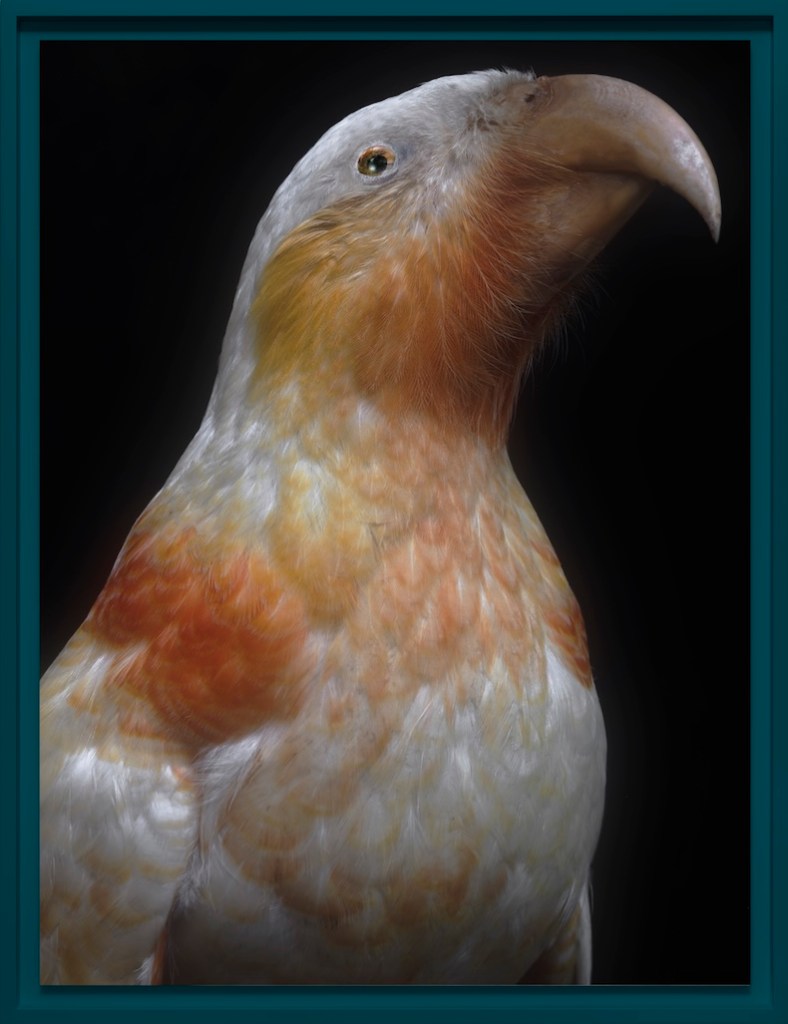
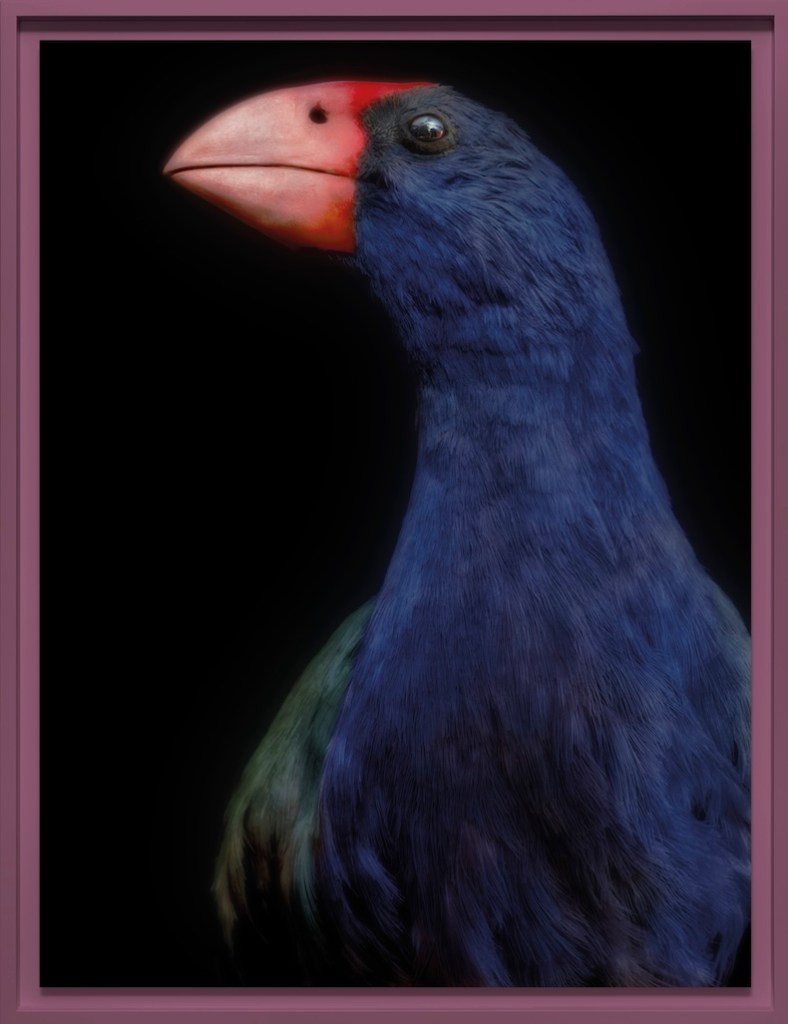
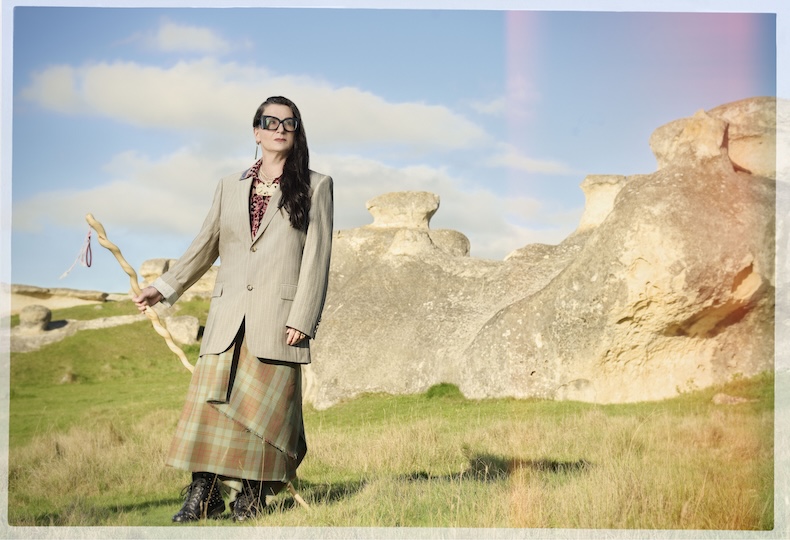
Fiona Pardington is one of New Zealand’s most acclaimed contemporary photographers. As well as exhibiting her work at institutions and biennials around the world, in 2010 she broke the auction record for a photograph by a New Zealand artist, selling Ake Ake Huia for NZ $30,385 (£14,466). An artist of Māori and Scottish descent, Pardington has spent the past two decades documenting taonga (Māori ancestral treasures) held in museum collections. This culminated in her 2024 exhibition ‘Te taha o te rangi / The edge of the heavens’, which comprised portrait-style photographs of taxidermied native birds, from the ground-dwelling kākāpō to the long-extinct whēkau (laughing owl). Representing New Zealand at the Venice Biennale, Pardington has built on this project in a series of 17 large portraits of critically endangered or extinct birds set against black backdrops in ‘Taharaki Skyside’, on view at the country’s pavilion at the Istituto Provinciale per I’Infanzia Santa Maria della Pietà until 22 November.
Where is your studio?
I’ve never had a studio, so I’m planning to build one when I get home. I’m 64 now, and I prepared for this show in my spare room on a little fold-down table with the curtains drawn. And I just thought, ‘Fiona, what are you doing to yourself? This is ridiculous.’ I’m going to build a sprawling, luxurious space with a darkroom. It will be separate from the house, but not too far, as I’m not one to leave the property if I don’t have to – I’d rather just roll out of bed, off the chaise longue, with my camera eternally set up so I can just keep working.
And where is home?
Home is in the South Island of New Zealand, in a place called Motupipi, which is the seaward side of Golden Bay. It’s a beautiful microclimate – very lush, with lots of fruit growing. My property is on an acre of native bush with a farmhouse, and there’s enough room without cutting any trees down to stick a decent studio there.
Do you work alone?
Yes. I have the most ridiculously simple process. I started photography in the 1980s and I learned from people that were working with large-format film. I really liked Type 55 black-and-white Polaroid film because I could see what my negative looked like straight away – it was like digital before it existed. I loved printing, but when they stopped making Type 55 I didn’t want to use other sheet film, so I just rage-quit. I was hoping they would bring it back but they never did. That’s why I’m planning to build a dark room, so I can get back into doing my own printing.
What happened when you stopped doing your own printing?
I had to learn to think in colour, which was like learning a new language. I came to understand colour by looking at wallpaper – I used to have a massive collection of The World of Interiors magazines, and looking at those spaces, which were very different from the places I was living in, raising kids, inspired me.
Do you have a specific routine or process when you’re working?
There’s not an off switch for me, so every part of my life from the minute I wake up – even my dreams – is grist for the mill. Still-life photography involves a never-ending process of collection: finding things on the beach, people giving me something, finding something on the street or in an opportunity shop.
When photographing manu [birds], you have to be careful – they are our ancestors. We are related by whakapapa [genealogy, lineage] to everything; nothing is outside of nature. I have karakia [ritual chants] written for me, addressing their spirits. For Māori people, all of the dead, everything that’s happened, is accessible. In Aotearoa New Zealand, we identify ourselves through our bloodlines and our relationship with the whenua [the land], the mountains, the animals. They must be respected, because they are us. I always address the spirit of the manu, and it’s not hard to find that individual spirit. There are some birds that are terribly taxidermied – there used to be an entirely different attitude, where people thought these birds should be killed and saved and stuck in a museum – but I still find a way to connect with them.
Do you spend a lot of time looking at different models of the same species of bird until you find one that you want to work with?
Yes, to a certain extent, but there aren’t a lot of them, especially the ones that are extinct. There are some museums overseas that have our extinct manu – bones and specimens that were traded – which I believe should be returned. A lot of the people that I travelled to Venice with are really involved in the repatriation of bones and other very important taonga, and in teaching people about how to relate to these objects.
What tool could you least do without when you are working?
A bottle of water, to wash my hands when going in and out of the space where the taxidermied birds are kept, as they’re all covered in toxic chemicals to stop them from falling apart.
Do you refer to any books while working?
That’s a difficult question, because I read in a very diverse manner, across early New Zealand ethnographers and cultural historians. I also read a lot of historical documents by our people; oral histories, the writings of important chiefs. I also regularly look at books on ornithology.
Do you listen to music as you work?
No, because I’ve got bad tinnitus. My hearing is fine, but it makes everything so loud. It’s like when you go into the shops and people are playing terrible music – it can make it hard to concentrate.
Do you have many visitors and, if so, who is the most interesting visitor you’ve had?
I don’t have visitors, really. I’m very private, and I live so remotely that that nobody comes. The place I’ve just moved to is less remote than the one that I lived in previously, which was up in the mountains, off grid. I do love people but I’m just so immersed in my work. I’ve got animals as friends.
Do you live with animals at home?
Yes, I do – a French bulldog and a cat – but I will be getting more. I can now get chickens on my property, so I’m really looking forward to that. Animals are good to have around. I really enjoy people, but only in small amounts!
As told to Edward Behrens.
‘Taharaki Skyside’ is at the Aotearoa New Zealand pavilion in the Istituto Provinciale per I’Infanzia Santa Maria della Pietà, Venice, until 22 November.