From the July/August 2026 issue of Apollo.
Joseph Holtzman, the artist and editor of the design magazine Nest: A Quarterly of Interiors, once described the American flag as one of the greatest pieces of design achieved by the country. As anyone who has been stirred by blockbusters such as Independence Day (1996) can tell you, the Stars and Stripes make for a particularly effective banner: visible from afar, pure in line and with the implication that people who follow it are commensurately pure in heart.
While the semiquincentennial of the declaration of American independence has given us plenty of opportunities to appreciate the US flag, the World Cup allows us to get to grips with the flags of 47 other nations. This year, we’ve been able to enjoy the flag-waving of not one but three host countries. One of them, Mexico, has one of the most enjoyable flags around – a coat of arms set atop a tricolour shows a golden eagle standing on a cactus while eating a snake. The iconography refers to the legend that the Aztecs knew where to found their capital, Tenochtitlan (in what is now Mexico City), on seeing just such a spectacle.
Like all the best flags, it draws on the past to bolster the political mission of the present, in this case an affirmation of independence by a country once smothered by a European empire. Yet more contemporary concerns have crept in throughout the years, as they always do. The first Mexican Empire, founded in 1821, had a more frontal eagle bearing a crown on its coat of arms. By the time a federal republic was established, the crown was gone and the snake had been added. The current version of the flag, with a livelier illustration for its coat of arms, was adopted in 1968 to project a new image of Mexico to the world in the year it hosted the Olympics.
Having such a detailed coat of arms embroidered on a flag comes with certain technical challenges. Flags, of course, have two sides – and they are meant to be the same on each, rather than a mirror image. But it is impossible to have an eagle standing on its left leg on both sides and for the design to map directly on to itself. In 1995, Mexican law was changed so that the eagle is allowed to stand on his right rather than left leg on the reverse of the flag.
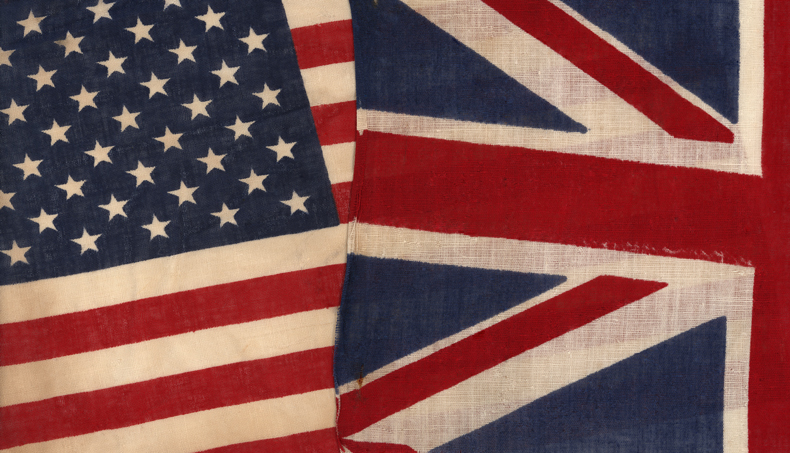
The Union Flag of the United Kingdom is an amalgamation of flags that came about with the unification of Scotland and England under James VI and I in 1603. Initially, various flags that juxtaposed the St George’s Cross and the Saltire were proposed in a fashion that was more traditionally heraldic. But this was seen as unsuitable, given the feelings of separateness that already existed between the people of both lands. To avoid ‘contentions’, the heralds recommended the more united emblem that – subject to a few variations over the next 200 years – the British currently enjoy. Like the US flag, it has the force of being blue, white and red, colours available to heralds in the guise of azure, argent and rouge. The Union Flag might proclaim unity, but it also declares tradition.
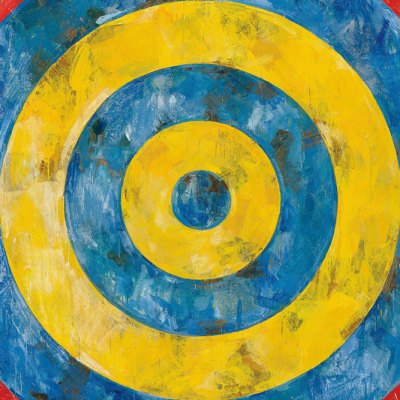
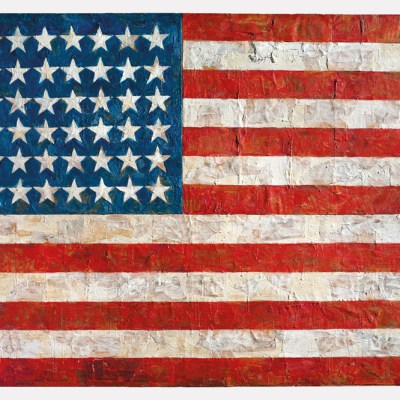
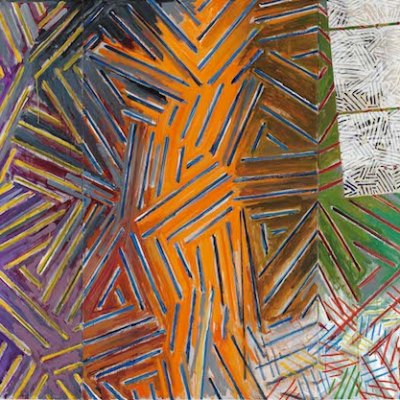
One of the artists most associated with flags is Jasper Johns (b. 1930), who painted the US flag both exactly as it is and in versions with different colours or with newspaper showing through. What Johns was doing with this is the subject of much debate. ‘Two meanings have been ascribed to these American Flag paintings of mine,’ Johns has said. ‘One position is: “He’s painted a flag so you don’t have to think about it as a flag but only as a painting.” The other is: “You are enabled by the way he has painted to see it as a flag and not as a painting.”’ As ever, one of America’s most acute artists is able to refer both to art and life with an enviable perspicacity. Flags, which are so much a part of the fabric of our everyday life, are rich aesthetic objects that come freighted with all manner of histories. But their most enduring lesson might be in teaching us to look carefully and to not take symbols for granted.
From the July/August 2026 issue of Apollo.