From the July/August 2026 issue of Apollo.
The Grand Trianon, Louis XIV’s palatial refuge in the park of Versailles, is an appropriate setting for an exhibition largely focused on French landscape gardens from 1750 to 1800. Its galleries are the forerunner of and directly adjacent to the Petit Trianon and Marie Antoinette’s jardin anglais, one of the best exemplars of the period’s taste for extravagant architecture, man-made geological features, serpentine lakes, winding paths and scattered groves.
By around 1750, when this exhibition takes up its story, in Britain the design practices of Lancelot ‘Capability’ Brown, who distilled landscapes down to a minimal palette of open rolling lawns, vast lakes and clumps and shelterbelts of trees, had achieved a remarkable dominance. This was not so in Europe, where such understated naturalism found few takers. Here, the man of the hour was Brown’s rival, the architect William Chambers. This Swedish-born, French-trained, sometime merchant seaman derided the ‘monotony’ of Brown’s ‘fields’, and instead offered a fantasy vision of Chinese gardens based loosely on his voyages. His work at Kew for the dowager Princess of Wales, as well as his writings and engravings of China, offered an alternative model of garden-making that was embraced from Paris to Saint Petersburg in the 1770s and ’80s. French theorists coined a new term for this English-inflected, Chinese-inspired and French-perfected idiom: the jardin anglo-chinois.
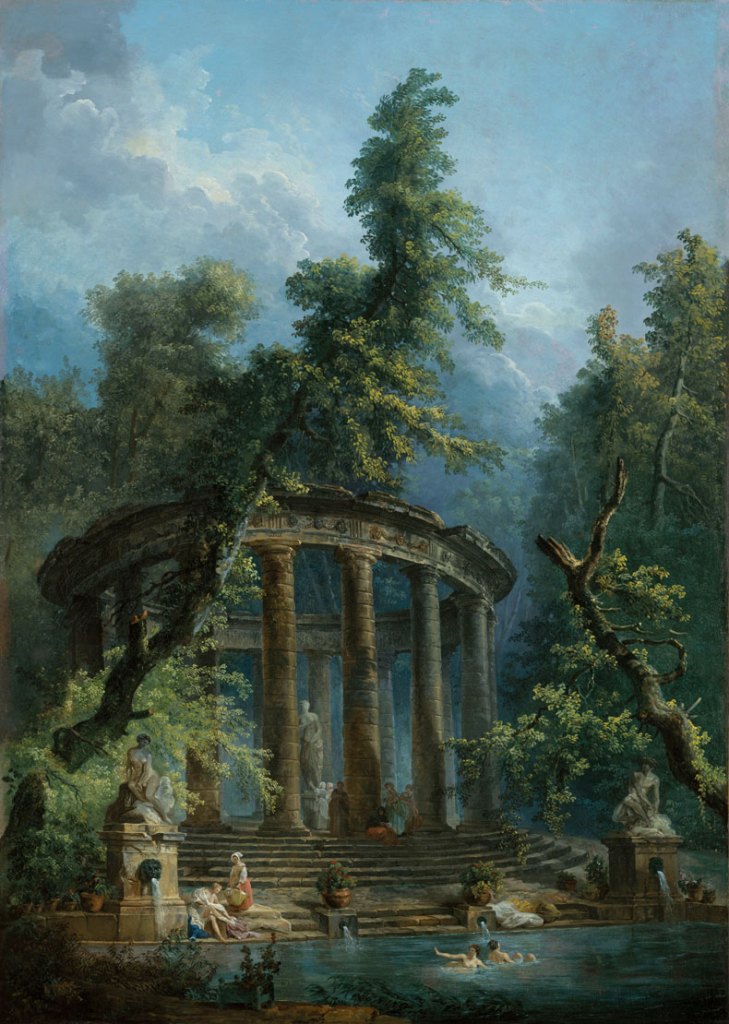
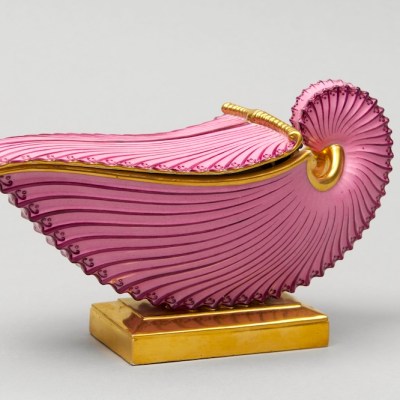
‘Gardens of the Enlightenment’ unites some 160 artefacts to offer an overview of the anglo-chinois phenomenon. Many loans are truly exceptional: rarely seen drawings by artists such as Fredrick Magnus Piper (Nationalmuseum, Stockholm); Hubert Robert’s ruinscapes for Bagatelle (returning for the first time in a century from the Met in New York); or Fragonard’s garden scenes for the hôtel de Saincy, reunited from the Banque de France and the National Gallery of Art in Washington, D.C. The exhibition adopts a thematic approach, examining the influence of classical antiquity, China and philosophy, as well as fashion, furniture, and theatre in the garden. These complex topics are explored through an intriguing and diverse array of artworks. For instance, the fad in the 1780s for garden-owners to show off their estates with drawings mounted on oversized waistcoat buttons is represented here with Carmontelle’s views of Le Raincy. The fashion for temple-like dairies is evoked with the exquisite ‘neo-Etruscan’ Sèvres porcelain and chairs imagined by the painter Hubert Robert for the royal park of Rambouillet. The elegant Chinese-style mahogany table made for the duc de Choiseul’s pagoda at Chanteloup exemplifies the elegant design and valuable materials lavished on garden ‘follies’.
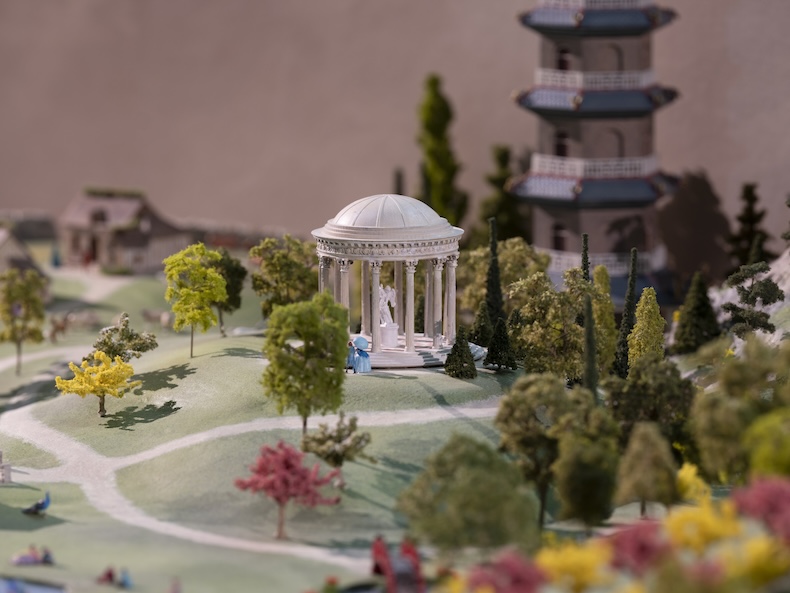
A rather questionable choice has been made to open the exhibition with a large modern resin model depicting many of the principal structures of European gardens within one ‘ideal landscape’. Its presence adds little and distracts from the authentic historical material at hand. It is part and parcel of the somewhat generalising approach to garden history offered here. For instance, while landscapes such as Monceau, Retz, Chanteloup, Méréville and Rambouillet make repeated appearances, we learn little about their individual histories or overall form. While the exhibition emphasises the strange and delightful architecture of garden follies, it loses sight of other essential ingredients such as plantings, water features and topographical forms. This is especially regrettable because grottoes, cascades, and ersatz rochers are among the most expressive and costly elements in anglo-chinois landscape compositions. Some objects that have no relation to the garden – chairs created for the interiors of Garrick’s Villa or the Duke of Beaufort’s Badminton, for example – are included here simply because of their eccentric design.
Over the past 50 years, the discipline of garden history in France has benefited from a run of remarkable exhibitions: Monique Mosser and Jurgis Baltrušaitis’ pioneering ‘Jardins en France: 1760–1820, pays d’illusion, terre d’expériences’ (Centre des monuments nationaux, 1978); Catherine de Bourgoing’s ‘Jardins romantiques français, 1770–1840’ (Musée de la Vie Romantique, 2011); Versailles’ own ‘André Le Nôtre en Perspectives’ (2013) and Laurent Le Bon’s encyclopaedic ‘Jardins’ (Grand Palais, 2017). These shows did much to raise awareness of France’s garden heritage, spur research and inspire conservation projects at, for example, the Petit Trianon, Retz and Méréville. This exhibition aims to be more broadly accessible than its predecessors and draws little on recent research. The introductory texts and individual object labels provide sparse analysis or context. Important themes such as political, ideological and freemasonic symbolism are touched on in passing, but never developed. More nuanced questions of usage are left unexamined. For example, the widespread dissemination of guidebooks, popularly priced prints and even song-sheets celebrating gardens, shows that these were never exclusively aristocratic retreats, but also addressed a wider public. Even Marie Antoinette, the exhibition’s protagonist, was criticised for fraternising with the public she hosted at dances at Trianon.
While the anglo-chinois gardens were certainly the last gasp of Ancien Régime extravagance, it is reductive to consider them solely as playthings. The elite embrace of England and Englishness was a rejection of the absolutist status quo. Louis XVI confided in Joseph II that he considered the rise of such fashions and mindsets to be the greatest threat to order in his kingdom.
Gardens are playgrounds, but they can also be places of experimentation, settings where ideas of rank and hierarchy can be set aside. It would have been interesting if the exhibition had delved further into these aspects. After all, only a few years later, as the Bourbon regime ran adrift, the garden-makers discussed here – Marie Antoinette, the duc d’Orléans and the comtes of Provence and Artois – all became deeply enmeshed in factional politics. In this light, as Monique Mosser has suggested, the anglo-chinois gardens can also be seen as an instance of Gramsci’s ‘morbid symptoms’: signs that one order was dying, but that the new had not yet taken form.
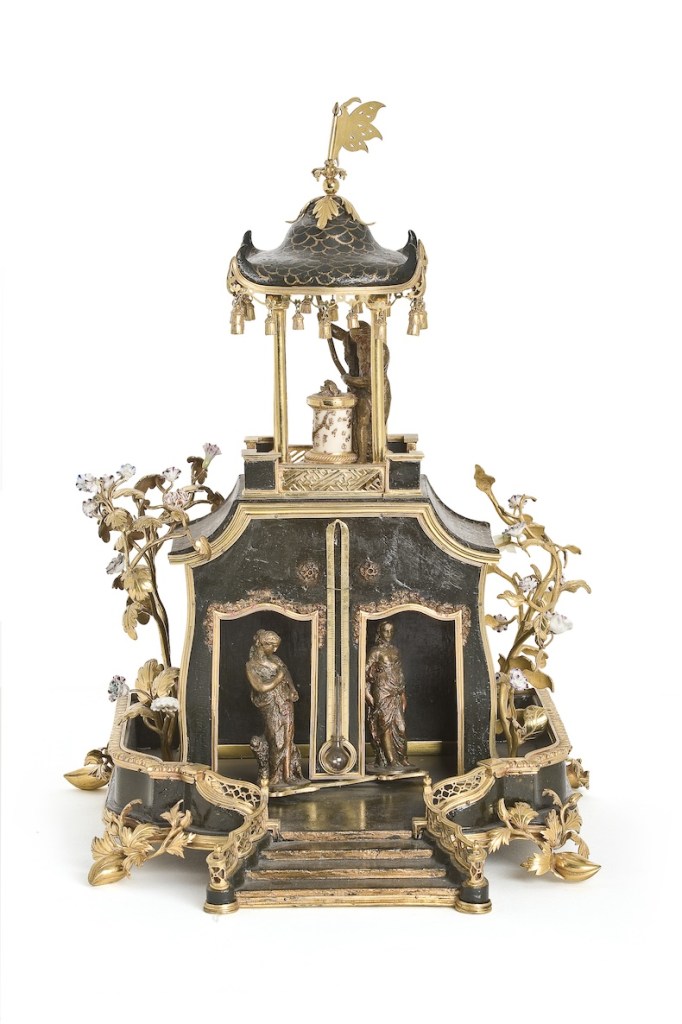
‘Gardens of the Enlightenment: 1750–1800’ is at the Grand Trianon, Versailles, until 27 September.
From the July/August 2026 issue of Apollo.