From the November 2026 issue of Apollo.
There is something gloriously Parisian about the fact that the Institut de France – the home of the five académies – and the Monnaie de Paris, or mint, should be next to one another, on the Left Bank overlooking the Seine. By happy accident, the two neo-classical fortresses built to protect what France values most are neighbours. Since May this year something more than mere proximity has connected them. Guy Savoy, whose restaurant is located in the Monnaie, was elected to the Académie des Beaux-Arts; he is the first chef to be part of the academy dedicated to the arts and artists. Long before Julia Child, ‘the art of French cooking’ was a self-evident truism, but no one in the art world proper took seriously the idea that a chef was an artist. Savoy’s admittance to the hallowed halls of the Académie suggest that perhaps such an idea should be countenanced.
As with the best art, eating a meal at Restaurant Guy Savoy requires a commitment from both chef (artist) and visitor (viewer): the prices are huge (€150 for a single course, or so it appears at first) and it takes a long time – three hours for lunch. Yet the rewards far exceed the costs. First contact with the restaurant comes before you cross the threshold of the Monnaie. On the street, caught between scaffolding and the building, a young man dressed in a uniform that resembles the stereotypical dress of a hotel bellboy, but in khaki rather than red, greets you and shows you where to go. Having ascended the grand Emperor staircase, you must turn to the right. It seems as though there is nowhere to go and then, magically, what appears to be a wall opens up to admit you.
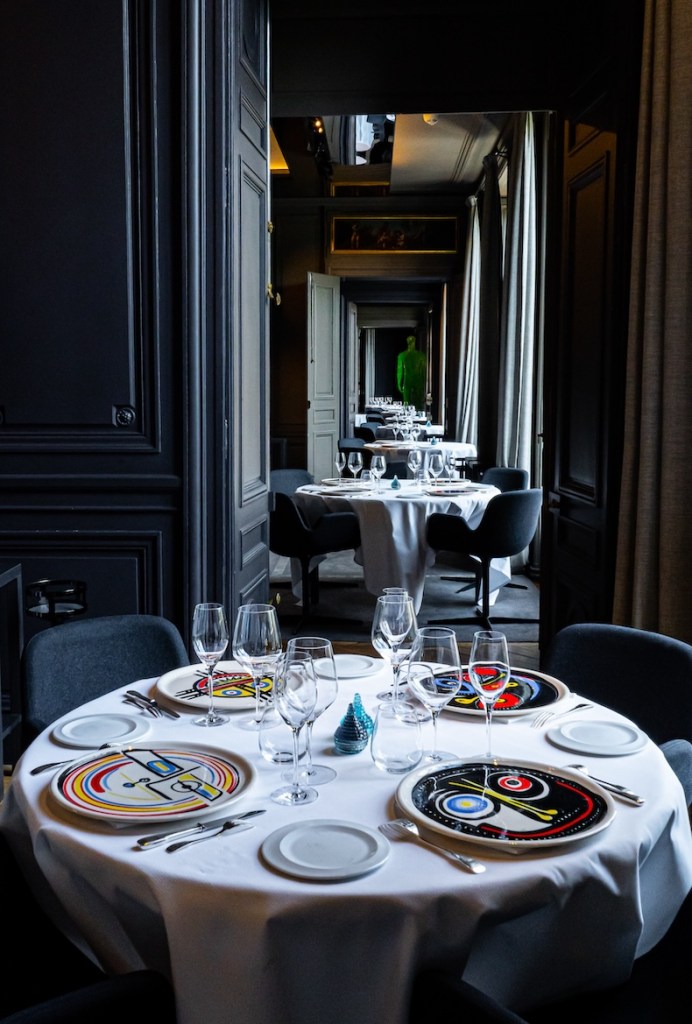
A large antechamber winds down the corridor to the front of the building. There you encounter a series of five enfilade rooms painted in a shade of grey that can only be described as very French. The walls of the restaurant work hard to burnish the place as a cultural experience: art, some on loan from the Pinault Collection, is everywhere. The plates that are set on the tables each carry a unique design by artist Virginia Mo. They are known as the Smiling Plates. Savoy likes smiles; he greets every single diner in the restaurant.
At lunch, you have a choice between the à la carte or ‘Keep It Simple’ menu. The latter is not a translation – even in French it’s called ‘keep it simple’ – and while the seven courses listed, laden with truffles and foie gras and lobster, might seem anything but simple, that’s not all you are presented with. The trolleys of champagne, the three amuse-bouches, the inter-course treats and the palate cleansers create an illusion of endless generosity.
Perhaps the most delicious thing I ate there was the second dish I was given. I was told it was called the ‘rooftops of Paris’. It was a watercress soup to drink through a straw, a tiny tartlet of potato dice in watercress pesto – dice makes them sound large, they were not, pixies would not have struggled to lift these miniscule cubes – and a transparent crisp made of watercress water. The technique was as intricate as anything you might find in any kitchen. And, as became true of everything that I ate, all these processes went into making things taste more of themselves, more intense, more delightful. Oysters may never taste the same to me again after the oyster tartare and poached oysters that I ate, from their shell, teasing me with the idea that perhaps the chef had done nothing to them – only for me to discover that the preparation had involved seven separate processes (poaching, puréeing, gelifying, and so on).
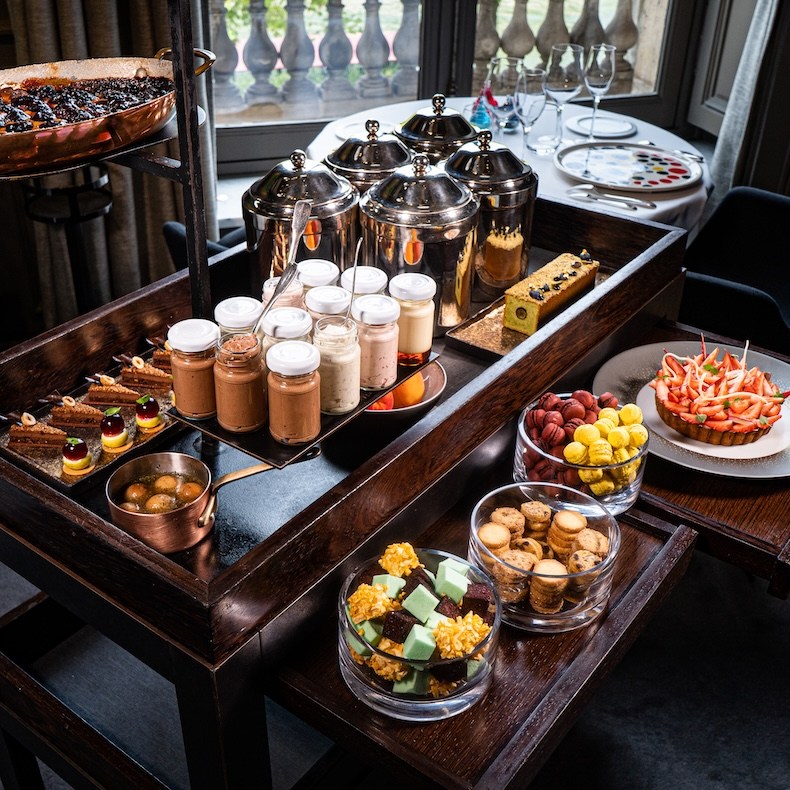
In the smallish room there were eight diners. Of course the main attention was on the plate, and yet during the meal one of the most delightful things was the amazing ballet performed by the waiters and sommeliers: the wheeling in, the wheeling out, the carrying, the bearing away, the lifting of lids, the surprises, the winks, the endless movement so that diners could stay perfectly still. It was some of the most impressive choreography I have ever seen. In the antechamber there is a work of art in red neon that reads, ‘Cooking is the art of instantly transforming products steeped in history into joy’. Everything on the plate was a transformation of the highest order. I am not sure it goes beyond that to reach metaphysical levels, so perhaps it is no more than exceptional skill. But I also realised that sitting there was possibly the happiest I have ever been. And it is an experience that I would give anything to repeat.
From the November 2026 issue of Apollo.