From the July/August 2026 issue of Apollo.
Two humans in intimate contiguity – lovers, dear friends, siblings, or some queerer connection with no name. Their bodies sunk into themselves, one another, the couch. Lap cradling legs. Eyes closed, or almost. The vulnerable specificity of bare feet; the weight of an arm on belly. The hand of the person on the left is raised to their face (taking a drag), half covering it; their other arm, more implied than visible, may be under their companion’s hips. The longer I look, the more I believe that their left hands are clasped. And the things: sofa as sanctuary – and frame, its pillows pressed against the edges of the canvas. In the foreground, the interrupted present tense of an open book. To its right, the pop of a brown paper bag rendered in limey greens. Above all, the feeling of profound ease together. Not on view, though if the people represented here aren’t performing for our gaze, the painting itself is a feat: melding Jennifer Packer’s signature abstracted and recognisable forms, strong lines and swathes of colour, presenting a privacy to which the painter makes us privy.
Nate, Chey was the first to meet the visitor, sited opposite the desk at Sikkema Malloy Jenkins in New York at Packer’s exhibition ‘Dead Letter’, where I saw it late this past fall. In her artist’s statement, she wrote about trying ‘to map the tremendous, transformative quality’ of her loss of her partner, the poet April Freely, who died at the age of 39 in 2021; her attempt since ‘to desperately rebuild my practice – the force and future of which was and remains inextricably indebted to her love, her life, and her work’. I kept coming back to this painting, its demand to stop, breathe deeply, and reckon with the vital disorientations of loss, even in presence. Such paradox is fundamental to Packer’s art and sensibility. Another piece in the show, in which a seated figure reads over one who is asleep or no longer alive – it’s not clear – was titled Activity, The Pause.
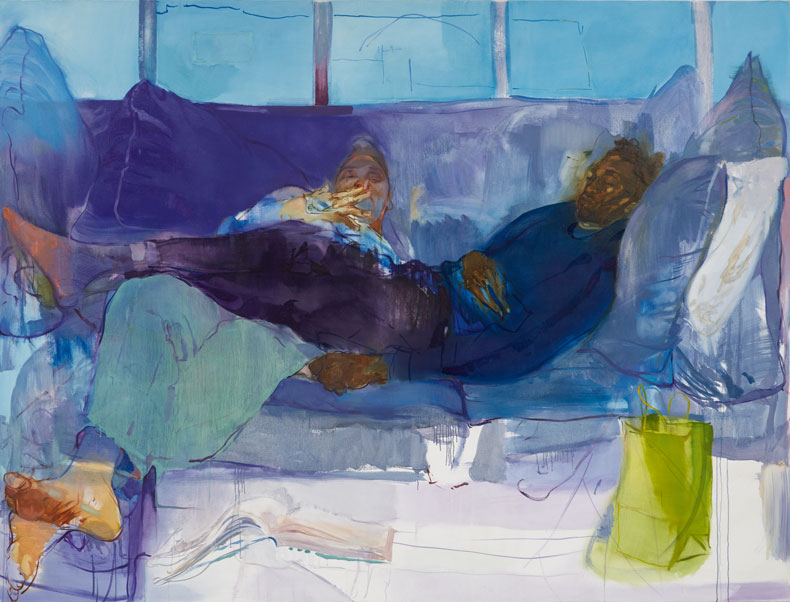
Home in the sense of true safety, not a given for too many, is also her subject and métier. The tangible but fleeting texture of life together; of being held in silence as well as speech; of separate togetherness (the comma of her title matters; it is not Nate and Chey); a pose that is not a pose. All these are familiar, repeated often with the visual artist I have loved for more than three decades. Still my sense of home has been hard-won, shaped by loss, and is indebted to friends. For years I have been writing a book about living in felt immediacy with vulnerable friends who lived with AIDS and died too young of HIV-related illnesses; our bodies of desire, fear, creation and sensation; all the ways we surrounded one another; our connections matters of life and death. Of course, there are intimacies without physical proximity – closeness from years of conversation, shared reading, looking, questioning. I write these paragraphs grieving the recent death of a friend whose physical reserve was as austere as her generosity was vivid. Hers was a long life well lived, but any dear friend dies too soon, making the world poorer, oneself lonelier. And we live with more distant proximities: The daily pain of the loss of people we’ve never met killed by state violence, in numbers both vast and particular. Packer’s Blessed Are Those Who Mourn (Breonna! Breonna!) (2020) is one such reckoning.
Freely’s desire for ‘a poem to […] build a landscape in an environment of feeling – a land of perception’, aptly limns Packer’s approach to portraiture. This is an artist, as others have observed, who does not render loss literally; she materialises forms of mourning that are difficult to express. Painting a grammar of relation, she makes me think about the power of prepositions: on, with, by, near, beneath, beside. Her melding of bodies with furniture, fabric, the very air, and the way she keeps the eye at once grounded and uncertain summon Vuillard’s interiors of people merged with furniture, doorways, textiles. Nate and Chey seem to be breathing blue. Their exhaustion, which holds the possibility of playful gesture, calls to mind the founder of the Nap Ministry, Tricia Hersey, the author of Rest is Resistance: A Manifesto (2022), who imagines ‘liberation through refusal and trickster rebellion in the face of capitalism and white supremacy’. Death inhabits life and interrupts it always too soon. The comfort of going on together makes that fact more bearable.
From the July/August 2026 issue of Apollo.