From the October 2026 issue of Apollo.
There is a red-figure ceramic vessel, dug up in southern Italy and dating to the fifth century BC, that bears the painted image of a robot. He has collapsed into the arms of the twin brothers Castor and Pollux while Jason the Argonaut unpicks a metal bolt from his ankle. The robot is Talos, the bronze automaton who, according to Greek myth, was forged by Hephaestus and made – programmed, we might say – to patrol the coast of Crete three times a day, hurling boulders at enemy ships. The bolt was devised to keep his lifeblood, ichor, from leaking from his artificial veins.
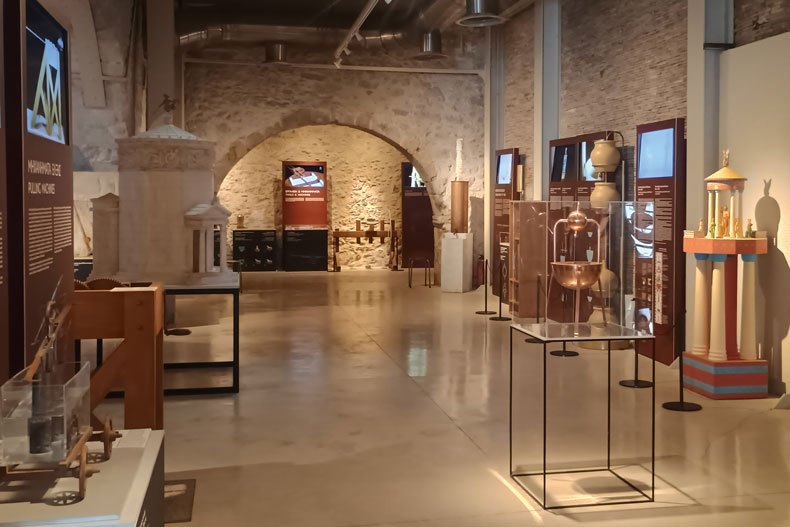
Talos was made, not born – a form of biotechne, or ‘life through craft’ – which places this story in the realm of early science fiction. Like all sci-fi, it was informed by what was at the time deemed theoretically possible; Talos may not have seemed too far-fetched to the ancient Greeks. In the Cretan capital of Heraklion, less than five minutes’ walk from the sea – well within Talos’s mythological stomping grounds – is the Kotsanas Museum of Ancient Greek Technology. It’s one of four such museums spread across Greece and founded by Kostas Kotsanas, an engineer who has spent years building and displaying replicas of antiquity’s niftiest tech. The Cretan outpost – housed in a former palazzo commissioned by the Venetians in the 15th century, when they were occupying the island – contains only a few dozen of the museum group’s collection of 500 reconstructed innovations, but it manages to be that rare thing: a museum in which adults and children are thrilled by the same exhibits.
I was sold by the very first invention on display: a coin-operated vending machine designed in the first century AD. Placed outside temples, these unassuming pithoi dispensed holy water: through a cavity at the top you’d drop a coin, which would land on a small scale connected to a stopper plugging up a chamber of water inside the pithos. Scale goes down, stopper goes up, and water escapes through a spigot near the bottom of the vessel. Every so often a temple official would smash the bottom of the pithos and collect the coins and the ceramic would be remade.
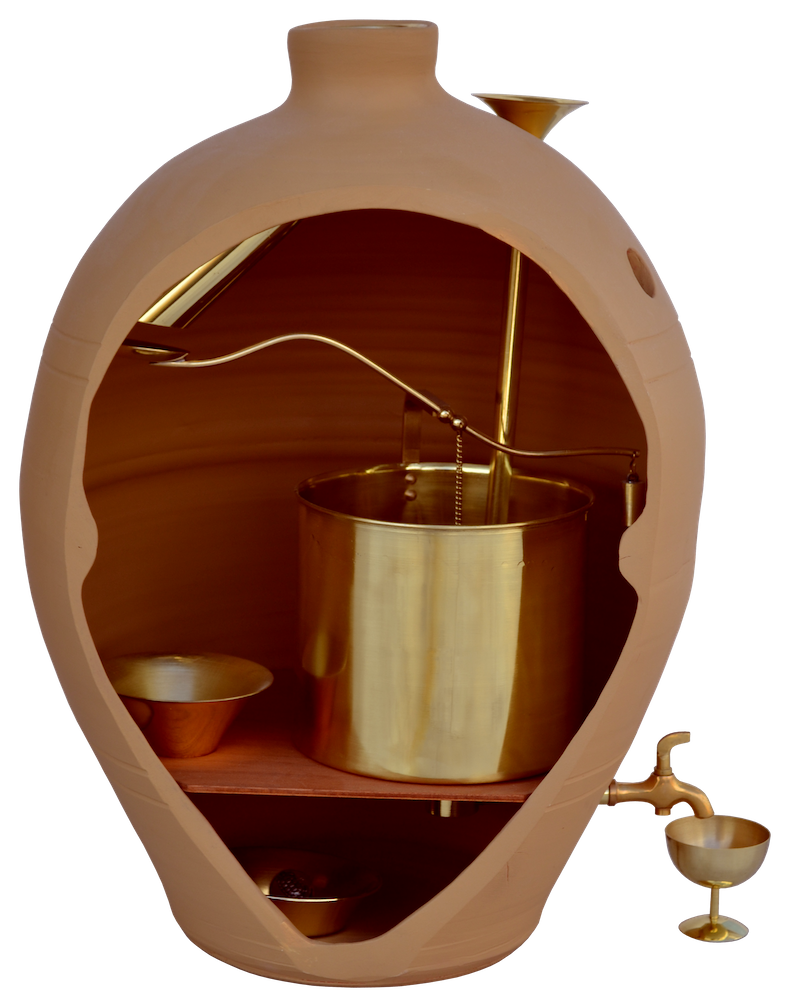
The museum helpfully presents the pithos as a cross-section, so visitors can see how it works, though one suspects that users of the original contraption would have had a stronger grasp of the workings of their vending machines than we have of ours. Other inventions, however, might have seemed like divine intervention. Take a wine cup that Pythagoras is said to have designed in the sixth century BC to prank the greedy: if the drinker filled it beyond a certain level, all the wine – not just the excess – would be siphoned through a hole in the bottom of the cup. This is technology as moral instruction.
The physics of the cup was explained to us by one of the helpful staffers, who every so often take visitors around the ground floor and give demonstrations of select exhibits. Here a first-century fountain that, after a small amount of water is added to a small basin beneath the spout, spurts the liquid forcefully into the air without the use of pumps; here a miniature version of a handpump-operated fire truck designed by a barber named Ctesibius in the third century BC (take care with this one if you don’t want a face full of water); here an impressively compact tripod crane (sixth century BC) with a pulley system so cleverly calibrated it lets you lift a 30kg stone with one finger.
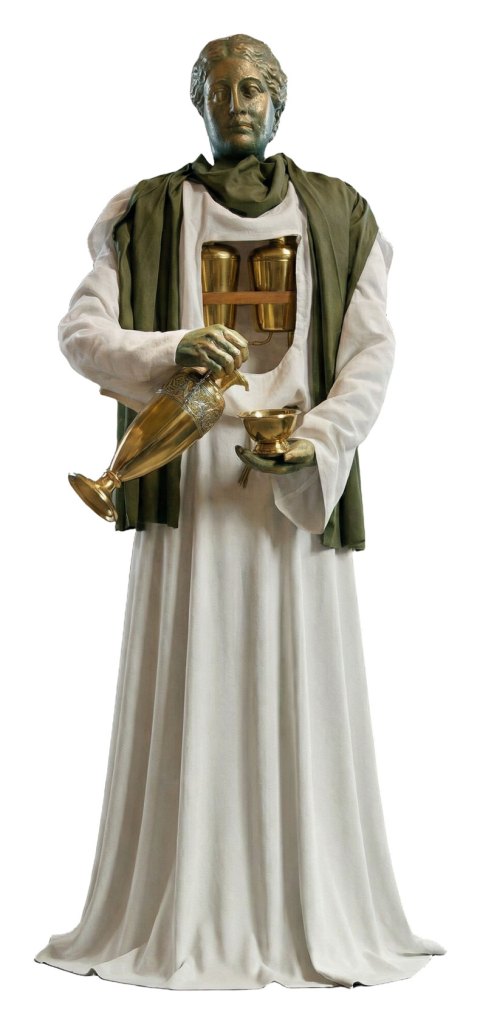
The most eye-catching recreation, of an invention from the third century BC by Philon of Byzantium, is too forbidding to be touched by visitors: a nearly six-foot automaton – picture the robot from Fritz Lang’s Metropolis but with the visage of an ancient Greek royal and a verdigris veneer. This robot, however, was confined to the pleasure quarters. Her right hand carries a jug; her left is extended in servility. Drinkers would place a cup in her empty palm, and the resulting depression would open – through a lever that ran invisibly up her arm to behind her clavicle – a couple of valves that would push wine hydraulically from a tank in her midriff up her body, through the jug and into the cup. Pythagorean moderation was at play here too: after a certain amount of wine had been poured, the valve controlling a separate tank of water would open and water would be pushed through an adjacent tube into the cup to dilute the drink.
Occasionally the strain of presenting ancient innovations in modern terms shows through – the world’s first laptop! the world’s first telecoms network! – and the wall texts don’t let on which inventions never left the textbook. Chief among these is the magic trick, designed in the first century AD by the extraordinarily prolific Heron of Alexandria, in which a fiery animal sacrifice on coals outside a temple would heat air inside an underground chamber, forcing a lever that opened the temple doors seemingly without human hands – a sign from the divine that might have terrified congregants into submission, though it was likely never put into practice.
Although a couple of exhibits cover military use – including a formidable catapult designed by Alexander the Great’s chief engineer, Diades of Pella – more diabolical Greek designs go unmentioned. Take the bronze bull mentioned by Cicero, Lucretius and others: the idea was that victims would be locked inside the beast’s stomach cavity and a fire lit underneath them, and as they were baked alive their screams would be transmitted through the bull’s mouth as a strangely musical lowing. As the ancient historian Diodorus Siculus tells it, the tyrant king Phalaris was so horrified by the invention that he asked Perilaus, the bull’s supposed designer, to climb inside to demonstrate how it worked, whereupon the bull claimed Perilaus as its first victim.
Apocryphal this may be, but let’s not forget Jimi Heselden, owner of the Segway scooter company, who in 2010 accidentally plunged to his death riding one of his company’s inventions off a cliff – a cautionary tale that, for all its West Yorkshire setting, has the ring of Greek myth. In the stories of the ancients, when the gods bestow technology on mortals, accidentally or otherwise, things rarely end well for the humans. History has not recorded ancient anxieties about cutting-edge technology threatening human livelihoods, or lives. But as deferential as Philon’s wine servant seems, she is part of a millennia-long history of automation that could end in us inventing ourselves out of existence.
From the October 2026 issue of Apollo.