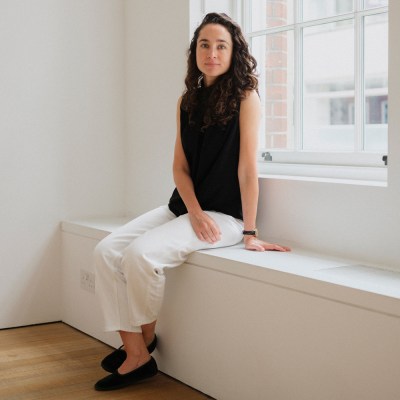
Kristell Chadé, executive director of Frieze Fairs, has worked at Frieze for just under 15 years. During that time the fairs have expanded, with editions in New York, Los Angeles, Seoul and now Abu Dhabi, as well as in London. For Chadé, Frieze is more than a fair and ‘an important part of a gallery’s business’; it is also a platform that provides opportunities for new relationships, professional development for curators and new art commissions. It is a milestone in the London art calendar as well as one of the organisations that has most shaped the idea of the contemporary art fair.
How do you feel about the market at the moment?
We are aware that the market is going through a correction. Buying patterns are shifting, priorities are changing and that makes the industry more volatile; we are very much at the centre of that. At the same time, costs have gone up across the board – shipping, travel, staffing, production. So we’re conscious that galleries are under a lot of pressure. It’s essential that we adapt to those shifting requirements, and that we make sure that coming to Frieze is still worth it.
There are many examples of how we do that, but to name just a few, we try to keep increases in gallery pricing to an absolute minimum. A couple of years ago we introduced a sliding-scale pricing structure which makes the transition between the young gallery section and the main section of the fair a lot more manageable, as well as our curated sections, which mostly have lower entry levels. That means that there are different ways for a gallery to participate in the fair, not just in the main section.
We’ve reviewed our eligibility criteria to reflect how galleries work and the shifting models in the industry, so galleries without permanent physical spaces can exhibit at the fair.
How does Frieze ensure that there are new people coming into this marketplace?
Galleries participate at Frieze to meet audiences that will add value for the artists, so it is our top priority to get the right people in the room for them. We work closely with galleries to identify who’s active, and then we really start building those personal relationships. In order to do that, we’ve built a team of regional leads and consultants that are based in the market that they serve: Canada, California, Brazil, Africa, the Middle East, Japan – and that’s not an exhaustive list. To reach new collectors who may not yet be known on the international circuit, having those boots on the ground allows us to have more specific conversations and a better understanding of who’s becoming active.
We also partner with institutions that are doing some of that work. We host intimate gatherings where we encourage collectors at the beginning of their journey to learn from artists, curators and more established patrons. And we work with art advisors because they’re an important gateway for new collectors entering the market.
Once at the fair, we really deepen those relationships. We do personal invitations and introductions, the idea being that we want to build a community that’s engaged, that feels part of the art world, and that as a result will feel committed to supporting galleries and artists in the long term.
How have you seen the business of art fairs change over the past 15 years?
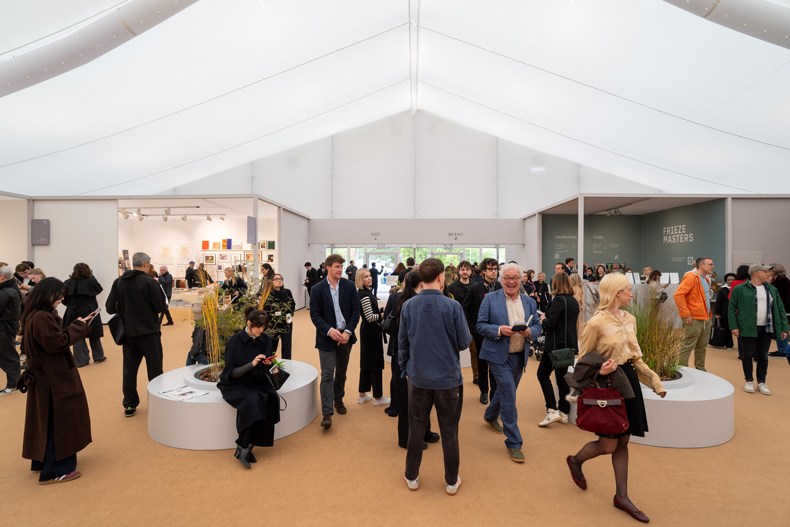
The market’s changed a huge amount and, as a result, so have fairs. What’s been important for us through that change is to remain relevant and additive. Everything we do is in constant dialogue with galleries, collectors, curators, advisors. We’ve expanded a lot over the last 15 years. We now have a presence in multiple regions and markets. But it’s important to note that as we’ve become more international we’ve also become a lot more connected, and that expanded network is a real strength for us because it creates opportunities for collectors, artists and galleries to move between markets. It also encourages exchanges and cross-pollination between our different fairs and the different markets in which we operate – for instance, hosting a section of Korean galleries in Chicago, or bringing Frieze Masters to Abu Dhabi.
What about the people who are visiting the fairs? Did you see more Korean collectors in Los Angeles or London after Frieze Seoul?
Definitely. It’s a real indicator of success for us. The breadth of geographies, in terms of not just galleries and artists but also audiences who visit our fair, is something we pay close attention to. And one inevitably shapes the other.
When you look at all the Friezes, are there any countries that are performing much better than others? If so, why do you think that might be?
We’re seeing a growing momentum, as is everyone else internationally, in a number of art scenes. Some of the most exciting developments are coming from places that haven’t always had the same visibility on the global stage, and the map of whose work is being shown, collected and discussed is constantly widening. We’ve seen the rising visibility of galleries and artists from Brazil, India and [elsewhere] across the global South, as well as the attention [paid to] markets such as Korea or the Gulf, but these things didn’t arrive overnight. They have been well represented at our fairs for some time, so what changes is not the scenes themselves but the infrastructure that has been maturing around them to give them international visibility.
Abu Dhabi is our first fair in the region, and we’ll have a Frieze Masters section that explores centuries of trade and exchange between the Gulf, South Asia and East Africa. That really reminds us that many of the places that we now describe as new markets were historically at the centre of cultural life and commerce.
Which upcoming projects are you excited about?
I’m excited about all of them, but I think London continues to be very special. We’ve known which works galleries are bringing for months but there will be some surprises, be it the scale of a sculpture, the patina on a painting or just walking around the fair and falling in love with a work. That’s the magic of Frieze in general.
I’m particularly excited about the curated sections; they’re always a highlight. Frieze was founded with a curatorial intention, and that still shows in everything that we do. This year we’re working with Carol Yinghua Lu on a section called ‘The Code Universe’, which will explore how different generations of artists respond to mass culture, consumer goods and the exchange of digital information.
On a human level I think we’re very lucky to work in an industry that is all about exchange and relationship-building. I can walk the fair every day and meet a new person or discover a new work.
What do you think needs to change to improve market conditions?
Probably knowledge-sharing. At Frieze we serve very different parts of the industry. We serve an incredibly wide range of galleries at many different stages of development. There isn’t a one-size-fits-all approach; we’re all different organisations, with different stakeholders, different goals, different infrastructures and structures, but ultimately we’re all navigating similar challenges. Being able to have that dialogue is essential. One of the good things that came out of Covid was a lot more information-sharing. People are a lot more comfortable around collaborations and the exchange of information, and understand how coming together in those moments will get us through.
If you have any advice about what it takes to be successful in the market right now, what would you say?
I think we all agree that we’re going through a bit of an existential moment for the industry, and everyone is evaluating how we navigate that. But for me, long-term success relies on staying in line with your value system, as well as thinking on your feet. It’s a fine balance between consistency and adaptability – you can’t have one or the other. Some galleries have had to make very difficult decisions to close recently, but many others have remained incredibly resilient and nimble. And some have been able to continue to grow and invest, exploring innovative and collaborative models.
As an art fair, I think the best we can do is to consolidate and make sure that each fair is the best version of themselves. And having a considerate approach to growth seems key. Each decision should be based on a careful consideration of what issue it addresses or resolves, and what it adds to the current proposition.
Frieze London and Frieze Masters take place at Regent’s Park, London, from 14–18 October.