From the November 2026 issue of Apollo.
In 1921, Kurt Schwitters wrote a poem called Cigarren (Cigars). It consisted of one word, that of its title. This, Schwitters subjected to a kind of orthographic torture, breaking Cigarren’s eight letters down into individual phonemes and letter names which he then variously reassembled: Ci / Garr / Ren / Ce / i / ge / a / err / err / e / en / Ce / Cei and so on, each forming one of 34 vertically stacked lines. At the end of these, he added another: Der letzte Vers wird gesungen (‘the last verse to be sung’).
The most obvious way of seeing Cigarren is as a Dadaist prank, although Schwitters – so often enlisted under the flag of Dada – was never really a Dadaist. In the catalogue to a new show of his work at the Musée Picasso in Paris, Cigarren appears anthropomorphic, a thin man with a pot belly en profile. It is concrete verse, how it looks being as important as how it sounds. Out of one eight-letter word, Schwitters has conjured a poem, a picture and a song.
A self-portrait, then, of its author not as potbellied but polymathic, a quality that ‘Kurt Schwitters: Le chaos-monde 1918–1948’ reinforces in spades. Not long before Cigarren, he had included in a collage a scrap of paper bearing the word merz, torn from an ad for the Kommerz und Privatbank of his home town of Hanover. Merz, with its scatalogical echo of merde, would be his very own Dada, the fragmentary name for a total work of art or, as he put it, a ‘collective world form, a general style’.
This totality took in Schwitters himself: ‘At present, I’m calling myself Merz,’ he wrote cheerily to a friend in 1927. A key principle of the project was that it could include anything, and did. After the great blowing apart of the First World War, Merz was all-embracing, restorative. The first half of Cigarren was devoted to breaking its titular word into fragments, the second to putting them back together again.
Schwitters was not alone in Gesamtkunstwerk thinking – it underlay Walter Gropius’s Bauhaus – but he was unique in turning it into a brand. And what a brand! In the Musée Picasso show are many Merzes, multiple Schwitters.
Along with the poet, graphicist and songster is Schwitters the PR man, creator of an agency called Merz Werbezentrale that counted among its clients the Pelikan pen company. Then again, there is Schwitters the designer of typefaces, most memorably Architype Schwitters (1927) with its own Systemschrift of vowel characters. In a vitrine at the entrance to the show is an album of the artist reciting his most famous poem, ‘An Anna Blume’: Schwitters the recording star.
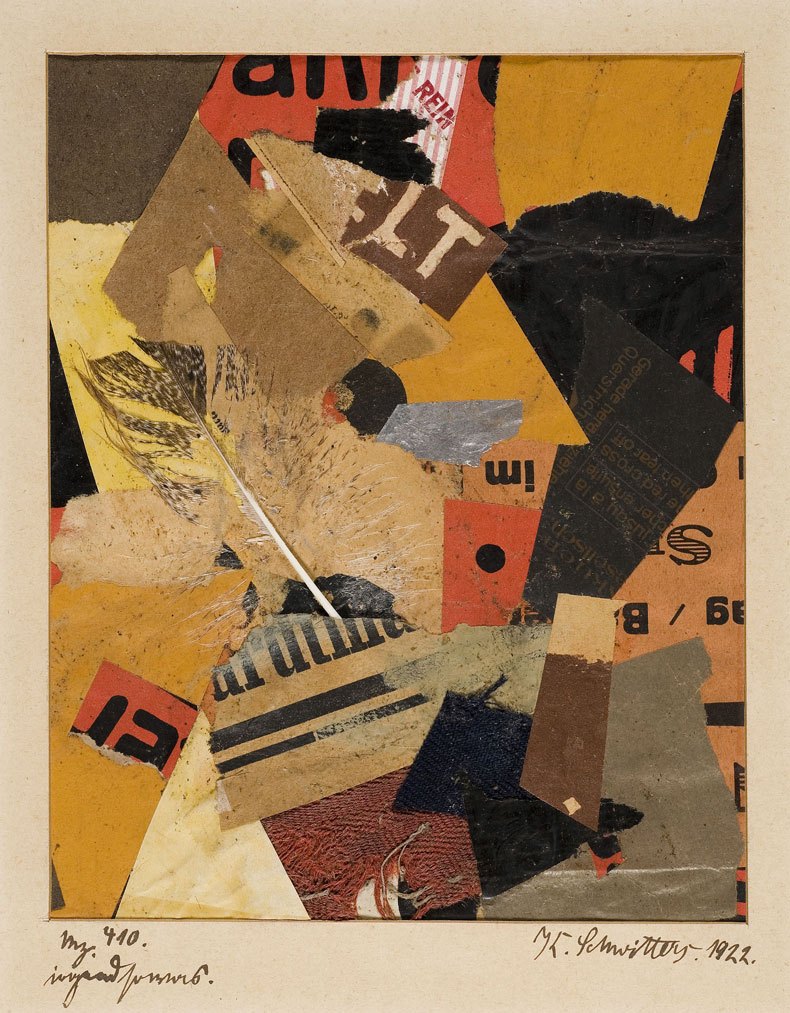
It is as a maker of collages or Merzzeichnungen (‘Merz drawings’, shortened to Mz) that he is best remembered, although the whole of Merz was really a collage of which the stuck-paper works were merely a part. ‘An archaeologist of the present’ is how Schwitters described himself, chivvying rationing vouchers, tram tickets and scraps torn from shopping lists into works such as Merzz 19 (1920). These beg both to be read and to be seen as abstract, the words on the scraps – Eintrittskarte (‘entrance pass’), Geldig voor een rit (‘good for one trip’) – inviting viewers in even as the flatness the picture plane forbids it.
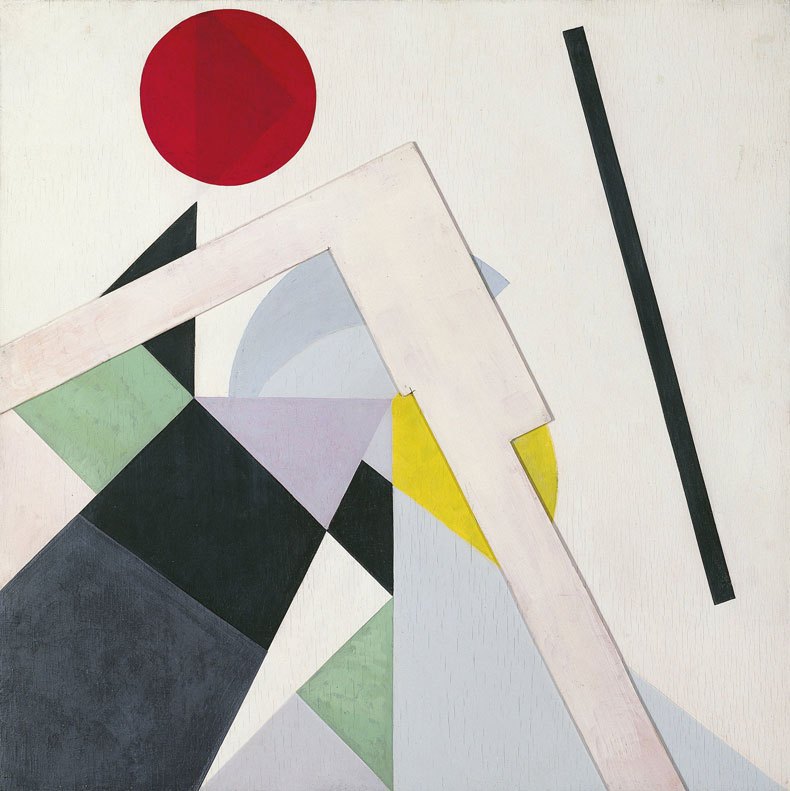
This tension worked in three dimensions as well. Missing from the Paris show, inevitably, are the Merzbauten, seen as the world’s first pieces of installation art. The original Merzbau, a three-dimensional collage of wood and plaster, has been reconstructed in an antechamber to the Musée Picasso show. Begun in Schwitters’ parents’ house in Hanover in 1923, it survived the mockery of the Nazis’ Entartete Kunst exhibition only to be destroyed by Allied bombing in 1943.
After 14 years, Schwitters had been forced to abandon the work when he went into exile in Norway in 1937. Two Norwegian Merzbauten followed, and then a final one, the Merz Barn, near Kendal in Cumbria, where the 60-year-old artist, in his last exile, died of pneumonia in 1948.
All of which raises a question. In 1994, Schwitters was given another retrospective in Paris, at the Centre Pompidou. It was his first major show in the city, and, up to now, his last. In its catalogue, chief curator Serge Lemoine wrote, ‘We know nothing of Kurt Schwitters. At least not in France.’ Since then, Schwitters has had a retrospective at the Menil Collection in Houston in 2010 and another, ‘Schwitters in Britain’, at Tate Britain in 2013. For an artist of his standing, it is not an impressive record.
Why? In part because of the difficulty of pinning him down. ‘All my life, I’ve worked on my own,’ he wrote to a friend in 1946. Curators do not like outliers. As the Dadaist Tristan Tzara wrote after Schwitters’ death, ‘It is difficult, when speaking of [him] to separate into neat parts his literary from his pictorial output, his work as a sculptor from that of an agitator. A personality as complete as Schwitters’ can not be forced into a mould.’
The labyrinthine galleries of the Musée Picasso suggest the problem. In one room, Schwitters is a Constructivist of genius, in the next a fervent abstractionist declaring abstract art ‘the highest development in painting in a thousand years’. In yet others he is the greatest collagist of the 20th century, an installation artist, a designer, a poet. But which, in the end, is Kurt Schwitters?
‘Kurt Schwitters: Le chaos-monde 1918–1948’ is at the Musée Picasso, Paris, until 7 February 2027.
From the November 2026 issue of Apollo.