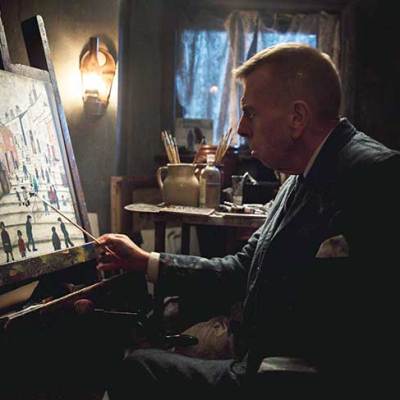
‘The Theatre of Life’, the largest Lowry exhibition since Tate Britain’s show of 2013, opens at MK Gallery just as Milton Keynes finds itself shortlisted for UK City of Culture 2029. In some ways it’s an unlikely setting. While Lowry’s vision of early and mid 20th-century England is mostly filled with Victorian hangovers – flat caps and whippets by factory gates, smoggy streets and dirt-caked smokestacks – outside the gallery the visitor walks into the civic optimism of architect Derek Walker’s vision for the new city, all clean lines, green spaces, motor cars and geometric shapes. The contrast produces some useful friction. It’s as if two very different possibilities for English modernism are in conversation with each other, inviting the visitor to reflect on the charms and demerits of each.
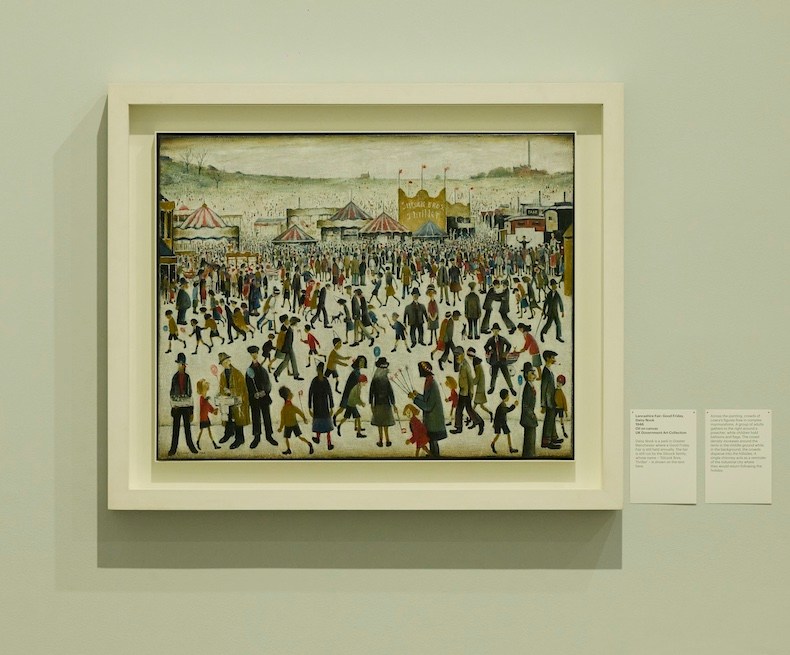
Lancashire Fair: Good Friday, Daisy Nook (1946), a painting on loan from 10 Downing Street, shows the fonder side of Lowry’s vision of traditional English culture. Thousands of figures, out for the funfair, are squeezed into a moderately sized canvas. At the back they fade into a dot for a head, one or two tiny flecks of paint for a body. In the foreground, some have distinguishable facial features, even individual fingers. The movement between these scales is extraordinary: it would take repeated visits to take them all in. Yet, as in most of Lowry’s pictures, the people only really emerge en masse. Certain figures and gestures recur, making clear that these are also compositional units, available for replication. Even those picked out for differentiation by carrying sparklers or balloons or performing some jaunty action retain a fungible quality, like ants in a busy colony. Lowry can identify the masses without necessarily identifying with them.
John Berger wrote in About Looking (1980) that Lowry’s figures ‘recognise each other’ in their shared ideology of ironic stoicism; they are ‘fellow-travellers through a life which is impervious to most of their choices’. But Berger’s view seems to have some wishful thinking about it. How much recognition can we actually see? To me, Lowry’s weirdly elongated and etiolated figures look more like the ‘pea-brained homunculi’ described by the critic Edwin Mullins in his introduction to the catalogue for a Lowry exhibition at the Tate in 1966. They stand around or walk, lemming-like, with their arms at their sides or disappeared into their coats – figures who can move through the world in limited ways but mostly lack the hands with which to shape it.
For much of his life Lowry worked as a rent collector; Mark E. Smith from The Fall, who grew up in Salford, once quipped that Lowry would call on local residents with the threat, ‘Come out or I’ll paint you’. In The Removal (1928) this biographical fact becomes a salient part of the picture. Behind a row of terraced houses, factories are dimly visible. A family’s furniture and possessions have been turfed out onto the ground outside their home. Neighbours and bystanders gather, perhaps half-sympathising with and half-enjoying their plight. Some children have paused their game of hula hoop to stare. The exhibition catalogue points out that Lowry underlined the following entry in his copy of La Rochefoucauld’s maxims: ‘The ruin of a neighbour pleases friends and enemies.’
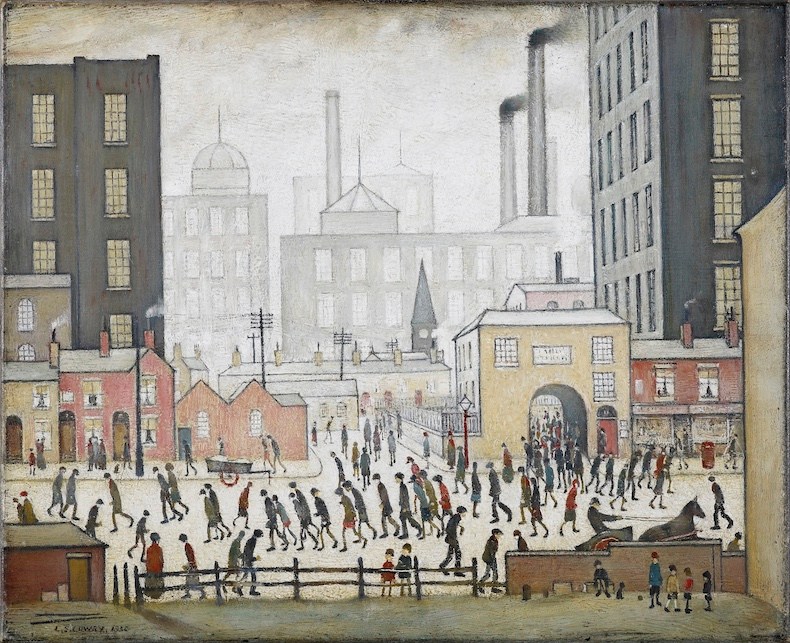
Dispossession becomes a neighbourhood spectacle. There is sympathy here and some kind of analysis of the workings of property and loss is implied. But the point of view is not that of the tenant, but more that of the petit bourgeois or the rentier capitalist. In Lowry’s famous factory scenes, too, the workers flock along well-worn tracks while the people who established those tracks for them, set the timetables and told them where to go, remain offstage. The vision of the picture gives us a managerial gaze upon people whose movements are already prescribed.
Lowry shares with T.S. Eliot the distinction of having served as a fire watcher during the Second World War. For Eliot in Kensington, the experience fed into the Dantean vision of Blitz-time London – ‘the uncertain hour before the morning’ that emerges in ‘Little Gidding’ (1942). For Lowry, spending his nights on the rooftops of Manchester department stores and watching the skies for aircraft and streets for fires seems to have shifted his characteristic ways of seeing a little. After having observed scenes mostly from street-level or the height of a small hill, the perspective in his canvases got higher. He had always been interested in crowd scenes; now he had the perfect vantage from which to see a lot of people but never get close enough to discover what any of them were thinking, saying or feeling.
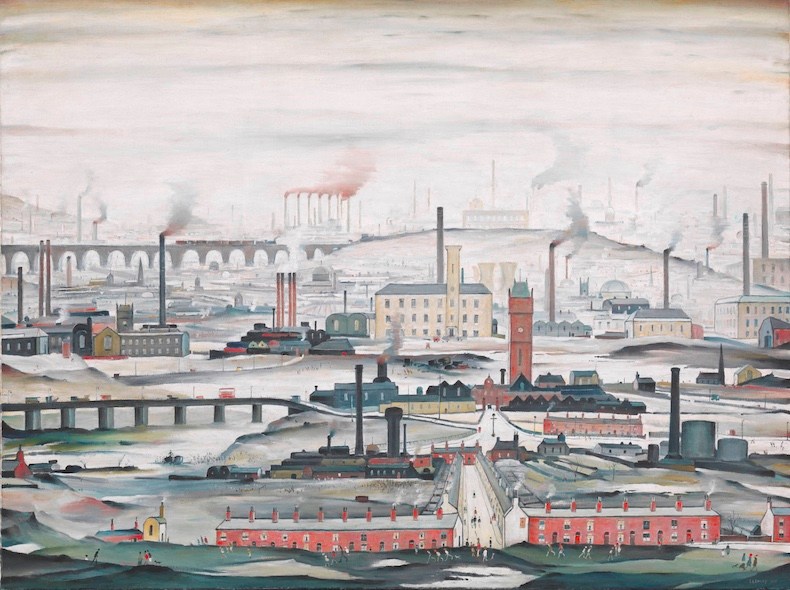
By the 1950s, the viewpoint had risen further still. This exhibition features four large-scale canvases that were commissioned from Lowry, a sign of his growing fame. In these industrial landscapes of post-war England, Lowry surveys entire settlements. Factories, roads and waterways extend towards a distant horizon that must be ten miles away. In Industrial Landscape (1955), a football match in the middle distance dwindles into tiny flecks of paint. As the view expands, the people shrink. This is the gaze of the civic planner, taking in the structure and fabric of collective life. Yet in the era of the welfare state and post-war reconstruction, Lowry’s world remains stubbornly older: smokestacks, few motor cars and little sign of the modernity being imagined elsewhere.
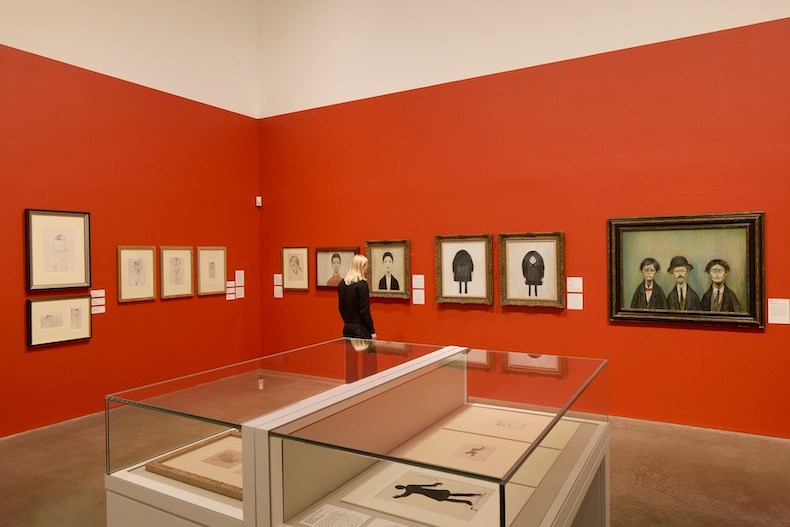
In the final room of this excellent show, the distance abruptly collapses. Three portraits of the elusive ‘Ann’, whose identity has never been established, show a beautiful young woman in relaxed mid-century garb, her hair in a fashionable updo, gazing candidly back at the viewer. She seems to belong to a different world from the stolid, dogged figures of the townscapes. Here, finally, is a face that insists upon being looked at. And yet the scrutiny is unsettling. After rooms in which people seem too distant to be known, the concentrated attention now feels uncomfortably possessive.
In a series of drawings of women forced into fetish-like mannequin shapes in the same room, it’s as if the muffled, baffled, deflected desire of the main paintings, their great distance from human beings, starts to be released, but in weird and off-putting forms. Paula Rego, Lowry’s student at the Slade, described these drawings as ‘bottled girls that have been siphoned into a bottle and screwed tight in there and had bows put on their hair and their tits pushed up so they could almost bite themselves’, adding that the pictures are ‘more sadistic than they are sexy’. Having longed for a closer-up view of the figure for most of the exhibition, I reached the last room and realised that it wasn’t what I wanted at all. But perhaps this is where the ultimate value of this exhibition resides – in managing to defamiliarise Lowry the national treasure, the painter reproduced on calendars and tea-towels, as a much weirder and darker artist than he’s generally thought to be.
‘L. S. Lowry: The Theatre of Life’ is at MK Gallery, Milton Keynes, until 28 February 2027.