
Rakewell is always impressed by the completion of physically demanding tasks: the hours of back-breaking crouching that are required to create mosaic floors in palaces, or the wrapping of a Parisian bridge in fabric, stir something in the heart. But moving a 360-tonne castle seems quite a tall order even to your roving correspondent. Last weekend 1,800 volunteers (volunteers!) moved the keep of Hirosaki Castle in northern Japan two metres closer to its original position with nothing more than rope, rollers and muscle power. The keep was first moved in 2015, by 70 metres, so that a wall damaged by an earthquake in 1983 could be repaired. Now that the repairs are done the keep must be returned. Placing a building on rollers and moving it means that the building avoids being taken apart and rebuilt. Clearly there are conservational advantages to this technique, even if it’s less relaxing for the movers.
One community of Americans might well agree with this. Following the fires in Los Angeles in 2025, many people chose to rebuild their destroyed homes but, as the New Yorker revealed this week, there is a small group of people who are literally moving homes rather than rebuilding. They are picking up historic wooden houses and moving them to the site of their destroyed home. This was a common practice in the late 19th and early 20th century, especially in LA, where land was rapidly increasing in value because of rezoning. While using a forklift truck to lift up an entire building is less physically draining than dragging a castle on rollers, there is something rather magical about the skeleton of a house floating through the air on a crane and being placed in its new home.
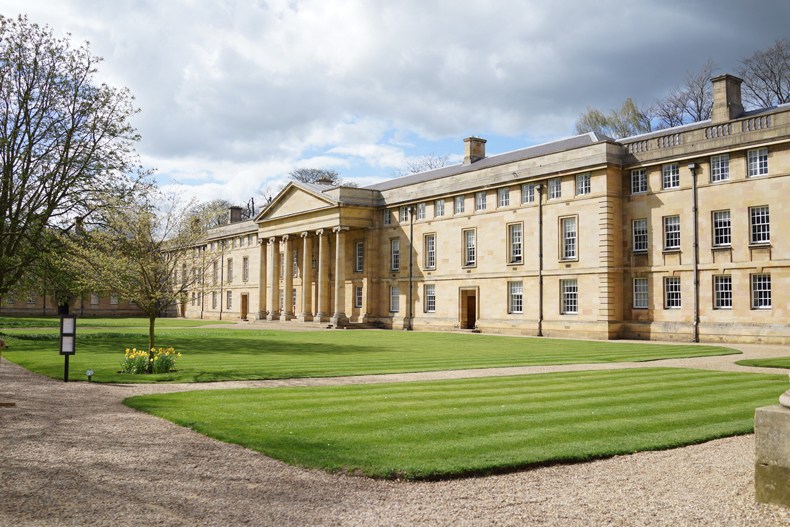
While these two very different examples of our relationships to buildings seem to come from benign intentions, Rakewell cannot help but be reminded of an English example that was perhaps driven more by greed. Downing College, Cambridge, was famously the subject of many a legal dispute before it could be founded. Sir George Downing’s will decreed that if his heirs should die ‘without issue’ then the Downing estates should be used to found a college in his own name. His last named heir, his cousin Jacob Downing, was having none of this. He left everything to his wife in direct contradiction of Sir George’s will. He even went to the lengths of putting many of the barns and buildings that he renovated on rollers so that they were not attached to the estate and so that his wife, Margaret Price, could use them elsewhere or sell them. Lady Margaret fought the foundation of Downing College with everything she had, entangling the estate in litigation when she left it to her heirs. Her behaviour clearly upset the historian of the college Stanley French, who writes of Sir Jacob, ‘from the point of view of the College, he had made one grievous mistake – the mistake of marrying Margaret Price.’
In his Booker Prize-winning novel Oscar and Lucinda Peter Carey created the image of a glass church sailing down a river in New South Wales. But as the Downing debacle makes clear, moving buildings is no guarantee of good repute.