From the December 2026 issue of Apollo.
From his house on the Breestraat, Rembrandt van Rijn could reach Amsterdam’s harbour in a matter of minutes. A short walk in the opposite direction brought him to the Sint Antoniespoort, one of the city gates leading out to the flat surrounding countryside. These places are the focus of ‘Rembrandt’s Lions: Art and Exile in the Dutch Republic’, a splendid exhibition at the Morgan that explores how the arrival of migrants, refugees and exiles to the newly formed Dutch Republic affected Rembrandt’s art. In his practice as a draughtsman and printmaker, Rembrandt was continually drawn to itinerant figures and to stories of displacement. During the artist’s lifetime, roughly 40 per cent of Amsterdam’s population was born outside the Netherlands. The show invites us to see Rembrandt’s images as reflections of a city coming to terms with its own diversity.
The Morgan holds the most extensive and finest collection of Rembrandt etchings in the Americas, the result of impassioned, competitive campaigns of Gilded Age collecting. Etchings form the core of the exhibition, supplemented by drawings, paintings and other materials that evoke the visual culture of 17th-century Amsterdam. As the title suggests, leonine imagery runs throughout the exhibition, from a map of the Netherlands in the shape of the animal to a Dutch silver dollar emblazoned with a rampant lion. Loosely organised by genre, the show does an excellent job of conjuring Rembrandt’s roving eye and bustling workshop.
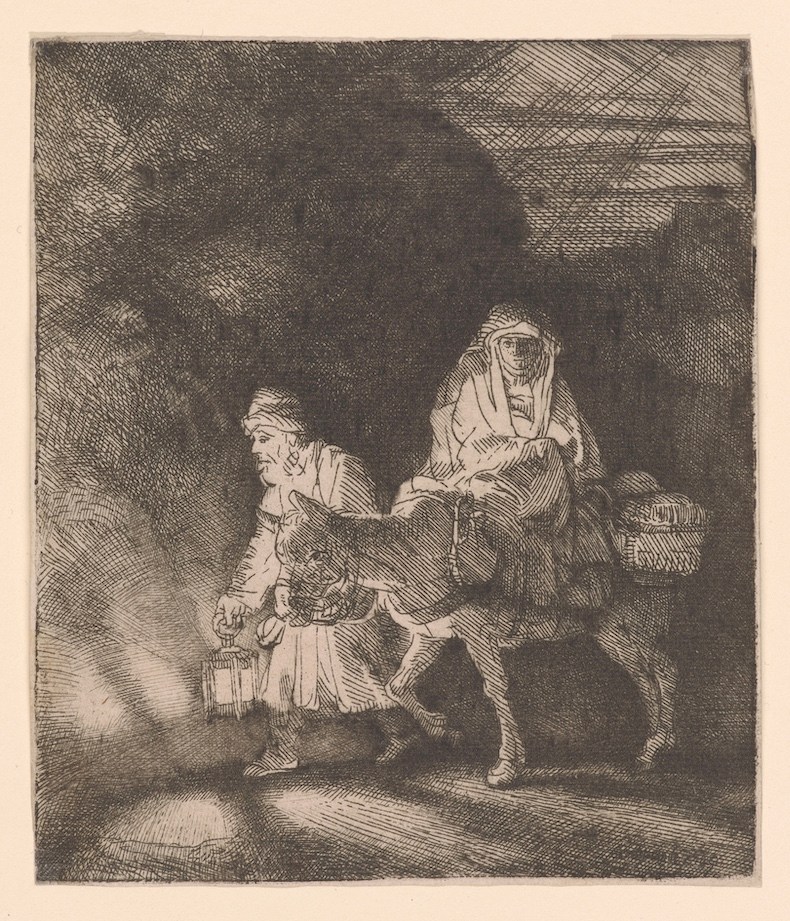
The exhibition begins with a group of six etchings depicting figures from everyday urban life: street sellers and musicians, labourers and idlers. Set in profile against the blank reserves of paper or huddled before a half-open Dutch door, these subjects are treated with specificity and care, an attitude that fed directly into Rembrandt’s handling of biblical subjects. In The Flight into Egypt: A Night Piece (c. 1651), Mary sits atop a weary donkey guided by Joseph and his lantern. Three impressions of the print show Rembrandt gradually darkening the scene until the figures nearly disappear. His etchings have long been celebrated for their dense, inky shadows, and exactly how he achieved these dark tones remains part of their enduring appeal.
Many artists of his day specialised in genre scenes, landscapes or still lifes; Rembrandt’s oeuvre is astonishingly eclectic. He was fascinated by the curiosities and goods arriving in Amsterdam – from Mughal miniatures to Japanese paper – as well as by the people who traded them. In The Shell (1650), two versions of which are exhibited here, Rembrandt trains his eye on the speckled, spiralling form of the Conus marmoreus, an exotic specimen imported from the Indian Ocean. Embedded in the thick shadow of a collector’s shelf, the object starts to look a little lonely.
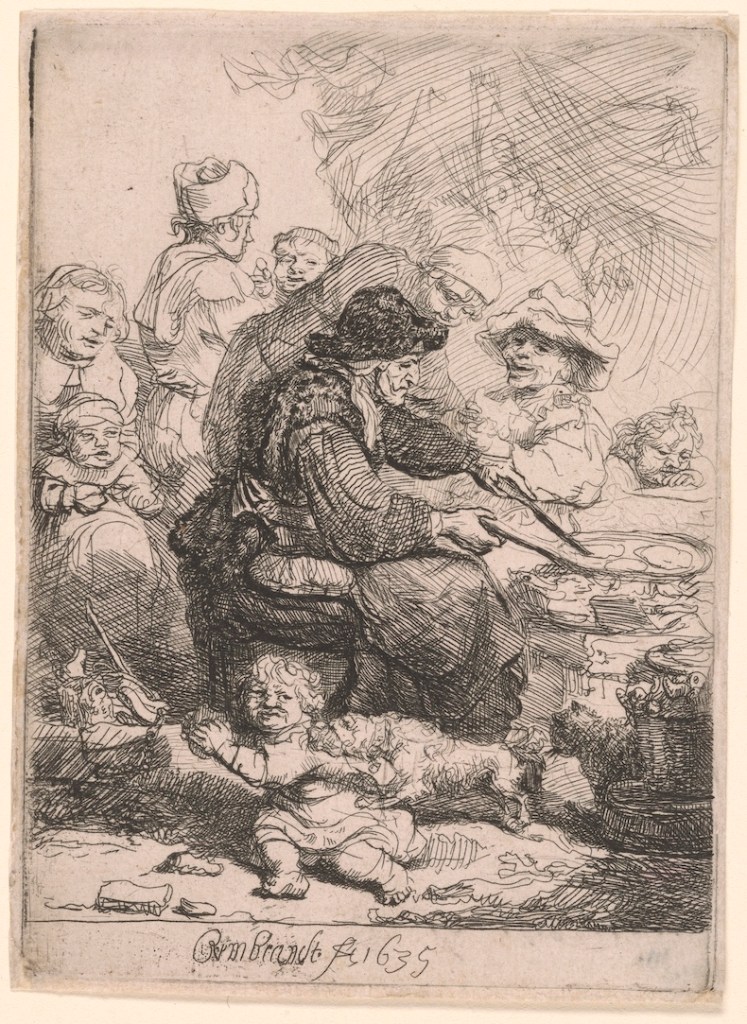
A similar sense of estrangement and isolation pervades some of the landscapes displayed in the next section. The leaning, wizened tree sheltering Saint Jerome, for example, resembles the many stooped, bearded figures seen in Rembrandt’s genre subjects and portraits. One of the exhibition’s unexpected achievements, therefore, is to bring together these disparate subjects – weary people, ascetic saints, scruffy trees, solitary windmills – and demonstrate their visual connections and thematic parallels. This is not to say that the exhibition resorts to the Romantic image of Rembrandt, the painter beset by personal tragedies and financial difficulties, taking pity on the poor. The visitor is reminded that Rembrandt was a working artist in a cosmopolitan city, whose experiments in etching were oriented outwards, towards a thriving art market.
Rembrandt produced numerous images of lions throughout his career, just as he repeatedly recorded his own likeness or dressed up his wife Saskia in the guise of different allegorical personas and biblical heroines. As a symbol, the animal has a variety of meanings. In hunting scenes, it is a heraldic emblem of the Dutch Republic’s courage and independence; elsewhere, it is the companion of Saint Jerome, protecting the scholar who sought refuge in the wilderness. But it also represents the real exotic animals and goods arriving in 17th-century Europe, at once a source of pride and a reminder of the troubling consequences of the Dutch Republic’s expanding global presence. The lion is a slippery image, one that matches the diversity of the exhibition and Rembrandt’s restless creativity. In the case of his etchings, he worked through the same subjects and figures on multiple occasions, sometimes on the same copperplate. Most of the works are small in scale and intricately wrought. Sometimes the subjects are hastily outlined, while elsewhere the scenes appear overworked with too many finely etched lines. But each print brings us closer to the artist’s wandering mind.
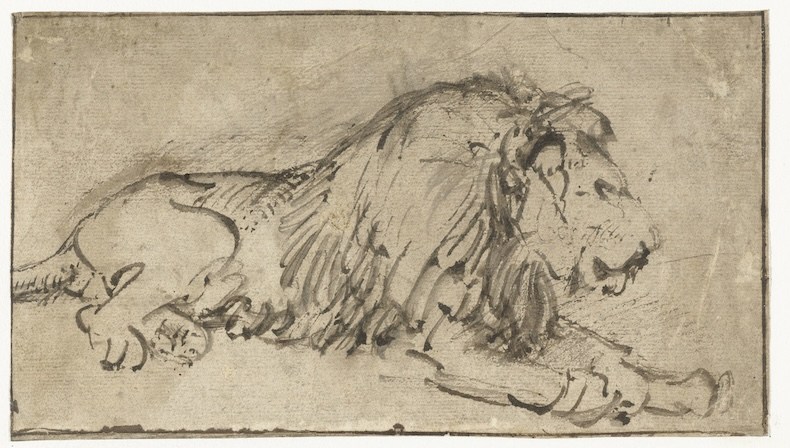
‘Rembrandt’s Lions: Art and Exile in the Dutch Republic’ is at the Morgan Library & Museum until 31 January 2027.
From the December 2026 issue of Apollo.