From the December 2026 issue of Apollo.
Is it my imagination, or are the cats friendlier in Assisi? As I make the short walk from my lodgings to the Basilica of St Francis, several stop me with an amiable miaow and, finding me receptive, twine themselves around my legs. I am going to meet one of the basilica’s friars, Giulio Cesareo, to discuss how the Umbrian town has just marked the 800th anniversary of its most famous son, Francis of Assisi, who died on 3 October 1226. Grasping for small talk as I follow Fra Giulio to his office, I mention my cat observation. Without missing a beat, he replies that this is one of the ways in which Francis’s teachings still manifest themselves today: people are kind to animals and the animals are kind in return.
The Franciscan anniversary celebrations got off to an early start. In February, the saint’s remains – essentially his entire skeleton – went on public display for only the second time in the basilica’s history. Usually enclosed in an urn, for one month they were laid out in a transparent case in front of the altar, with tens of thousands of people streaming in to see them each day. The bones themselves are said to bear signs of Francis’s renowned asceticism: his femurs are particularly thin and friable, possibly the result of a life spent kneeling in prayer and walking to preach the renunciation of worldly goods. Fra Giulio tells me the display was deliberately scheduled before the official October octocentenary, for fear that combining the two would draw more visitors than the little hilltop town could handle.
This was a sensible move. Over the weekend of 4 October, Francis’s feast day, Assisi’s population briefly doubled. Some visitors had come to take part in a night-time pilgrimage retracing the several-mile procession of Francis’s coffin: from the tiny Porziuncola chapel near which he died, past the church of San Damiano where his female followers paid their final respects, and finally to the site of the basilica. Yet this anniversary wasn’t only a religious affair. Francis is the patron saint of Italy and 4 October is a national holiday (reinstated in 2026 after a 50-year hiatus). Mussolini pushed for both these designations around the time of Francis’s last centenary, having co-opted the saint as a poster boy for fascism. This 4 October, Italian prime minister Giorgia Meloni, citing a 19th-century patriotic text, called Francis ‘il più italiano de’ nostri santi’.
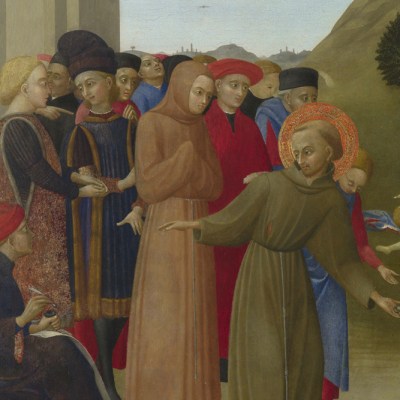
Fra Giulio, unsurprisingly, argues that Francis’s teachings – particularly his call for peace – are international rather than national, and certainly not nationalistic. He insists, too, that the focus should be on Francis’s message rather than the saint himself, though that may be a battle already lost: Francis has long been a darling of the visual arts. Several exhibitions marking the anniversary celebrate his iconography through the ages, including one currently being held in Arezzo, following the triumphant ‘Saint Francis of Assisi’ show at the National Gallery, London, in 2023. No exhibition, however, can fully convey this visual legacy, since it cannot include the frescoes depicting man and saint in the Basilica of St Francis. Bidding Fra Giulio farewell,
I head there next.
Built into the hillside overlooking the Umbrian Valley, the basilica complex consists of two churches stacked on top of each other. Construction began in 1228, the year Francis was canonised. The Lower Basilica is low-ceilinged and crypt-like, while the Upper Basilica is long, aisleless and light-filled; the walls of both are covered in frescoes. A Maestà from the 1280s attributed to Cimabue in the Lower Basilica’s transept features one of the earliest ‘portraits’ of Francis, who stands beside the enthroned Virgin and Child, displaying his stigmata. Although much retouched over the years, the image makes you feel that you are looking at the unmediated Francis. Here he is, with big ears (which later overpainting tried to make smaller) and an oversized habit, fixing us with his kindly gaze.
The Upper Basilica presents the most complete telling of the story of Saint Francis, running around the lower register of the nave: 28 scenes based on his biography, the Legenda Maior (1263), covering his life before his conversion; his years as a friar, expelling devils and preaching to birds; his death and the continuation of the Franciscan mission. The frescoes were probably painted in the last decade of the 13th century, prompted by Pope Nicholas IV’s elevation of the basilica to the status of papal church. Their attribution to Giotto is contested, but their magnificence is not. Almost three metres tall, they form a sequence of near-life-size, architecturally inventive and colourful stage sets. Looking up at the Confirmation of the Rule, I feel I could step into the foreground and join the cluster of Franciscans kneeling before the pope’s throne.
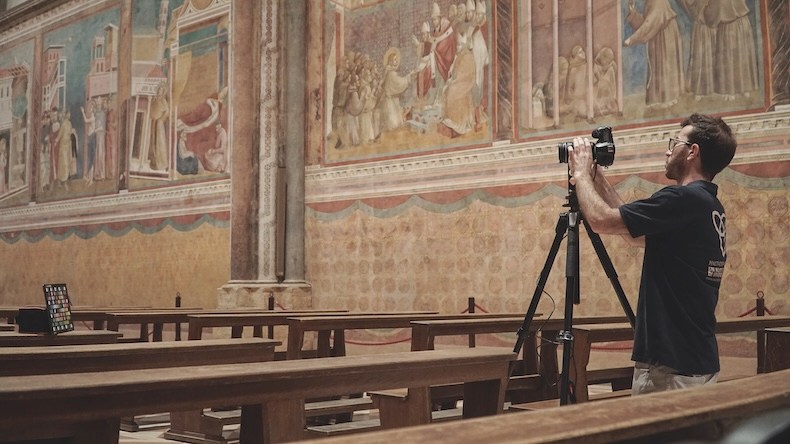
But I’m not here just to gaze. I’m here for my second meeting of the day, with Luca Ponzio, the digitisation specialist whose team at Haltadefinizione is working with the friars to create a ‘digital twin’ of the basilica. The first iteration of the project, ‘Preserving Assisi’, has been launched online to mark the 800th anniversary. Using a combination of photographic techniques, including 360-degree imaging and gigapixel photography (images made up of at least a billion pixels), the team has created a navigable view of the basilica complex, as well as the ability to zoom in on the tiniest details in the frescoes: individual brushstrokes, the texture of the plaster, the almost invisible patchwork of giornate (the sections of fresco painted in a single session, before the plaster dries). My first instinct when exploring the website is to zoom in on the clouds in the Death of Saint Francis, where, famously, the face of a devil is camouflaged: at this scale, it seems the most obvious thing in the world.
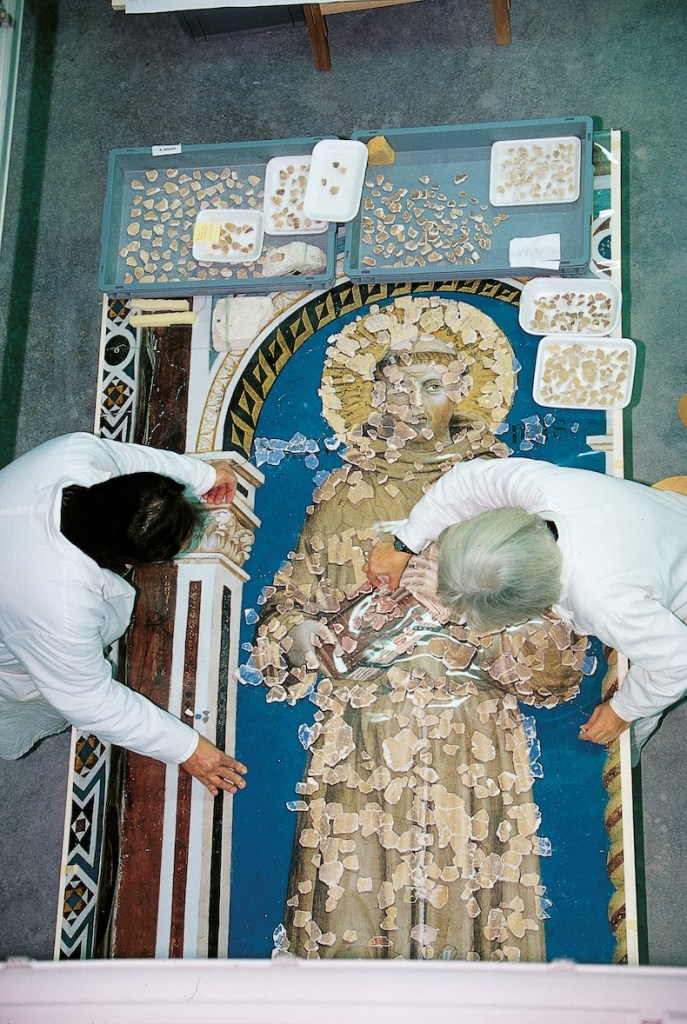
For Ponzio, a major achievement of the project is bringing the basilica’s art – in all its ingenious, imperfect glory – to those who might never get to see it in person. As the project’s name suggests, preservation is another central aim: to create an exact, meticulously detailed record of the frescoes for posterity. Earthquakes are a recurring threat in Umbria, and the catastrophic quake of 1997 showed just how devastating they could be for the basilica, killing four people working inside the building and bringing down two frescoed vaults in the Upper Basilica. Indeed, it was high-resolution photographs of the church, taken just days before the earthquake and the first of that quality ever made, that allowed conservators to begin piecing back together the painted fragments they had sifted from the rubble – a small stroke of luck amid devastating circumstances. The photographs had been commissioned by Panini, the same publisher that is now Haltadefinizione’s parent company. The ‘Preserving Assisi’ images may prove just as valuable to future restorers, though it is hoped they will never be put to quite the same test. Ponzio’s team is now exploring how AI might help place the remaining fragments of the vault frescoes, those which conservators have struggled to reassemble for nearly 30 years.
Sitting back at my lodgings that evening, an Assisian cat in my lap, I reflect on the different ways Francis’s 800th anniversary has been marked: through pilgrimage and nationalism, through art and its conservation. Anniversaries can prompt us to think about the future, too. What will the world look like as the anniversaries unfold, from now until the 900th, and what part will faith, politics, technology and environmental change play at each milestone?
From the December 2026 issue of Apollo.